

The World Cup Finals is Sunday, which means it’s possible someone could whiff on a decisive penalty kick, and etch themselves into the Hall of Shame. When it happens, an analyst on the postgame show may offer the classic defense: only those who take penalties can miss them. To look like a fool, you must first dare to try.
Fortunately, baseball has no such requirement. You can look like a fool swinging out of your cleats at a slider in the dirt or by doing nothing at all, staring at a two-strike slider that cuts through the middle of the plate. Action or inaction, the fool’s door is always open, and today, we can try to quantify foolishness.
Two weeks ago, we went looking for holes in swings, covering where hitters fail. Today is about how spectacularly. Welcome to Fool Points, the first leaderboard where you do not want to be #1.
The Rules of Foolery
A hitter can earn Fool Points two ways:
- The Windmill: Swinging and missing a pitch by an embarrassing amount. Statcast tracks the miss distance on every whiff, and the league’s 90th percentile miss this season is 8.27 inches. Miss by more than that, and you’ve earned Fool Points, with the total scaling up the further you miss. Miss by double the threshold, double the points.
- The Statue: Taking a called strike in the heart of the zone. The closer the pitch is to dead-center-middle, the more points you earn for admiring it.
Both flavors get multiplied by a count weight, because context matters: a foolish act with zero strikes is worth 1x, with one strike 1.5x, and with two strikes 3x, because watching strike three float down Main Street, or corkscrewing yourself into the on-deck circle for strike three, is the maximum foolishness a man can achieve in this sport.
Through the All-Star break, that’s 4,534 foolish whiffs and 21,323 meatball takes converted into one glorious leaderboard.
The Master of Kung-Fool
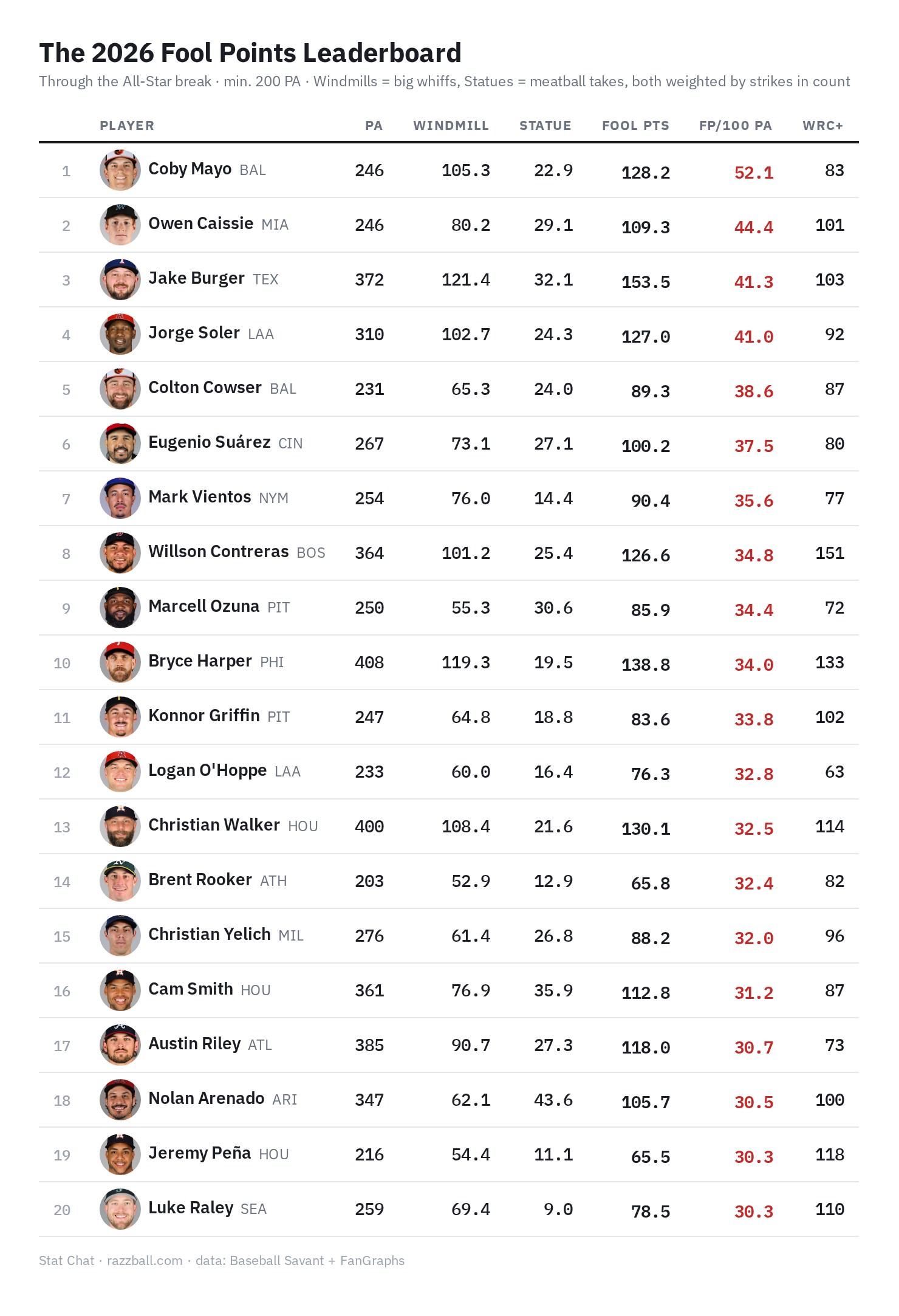
Ladies and gentlemen, your 2026 Master of Kung-Fool: Coby Mayo, and it is not close. Mayo is lapping the league at 52.1 Fool Points per 100 PA – second place is more than 8 points behind – while striking out a third of the time en route to an 83 wRC+. And in a development that should surprise no one who has watched Orioles baseball this year, teammate Colton Cowser joins him in the top five, making Camden Yards the proud home of the league’s premier fool factory.
The rest of the leaderboard is a who’s-who of grip-it-and-rip-it hitters: Owen Caissie (who also has a 39% strikeout rate), Jake Burger, and Jorge Soler, all swingers who have never met a slider they wouldn’t chase into the parking lot.
Top Fool – The Biggest Windmill of 2026
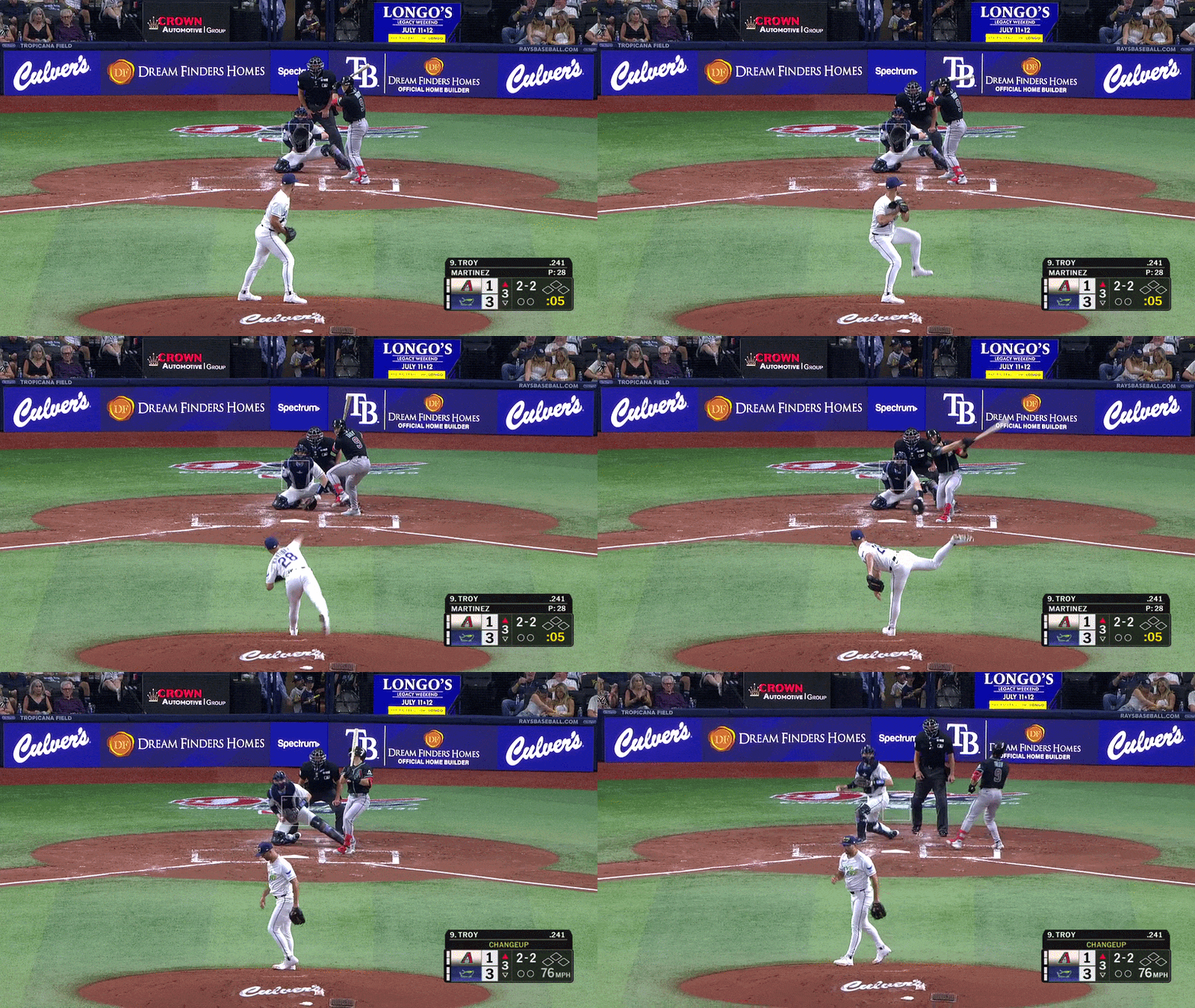
Tommy Troy, June 26: A strikeout swinging in which Troy missed the pitch by roughly 41 inches. That is not a typo. Three and a half feet
So Does Being a Fool Matter?
Here’s where I’m supposed to reveal that Fool Points are secretly the key to evaluating hitters. Reader, they are not.
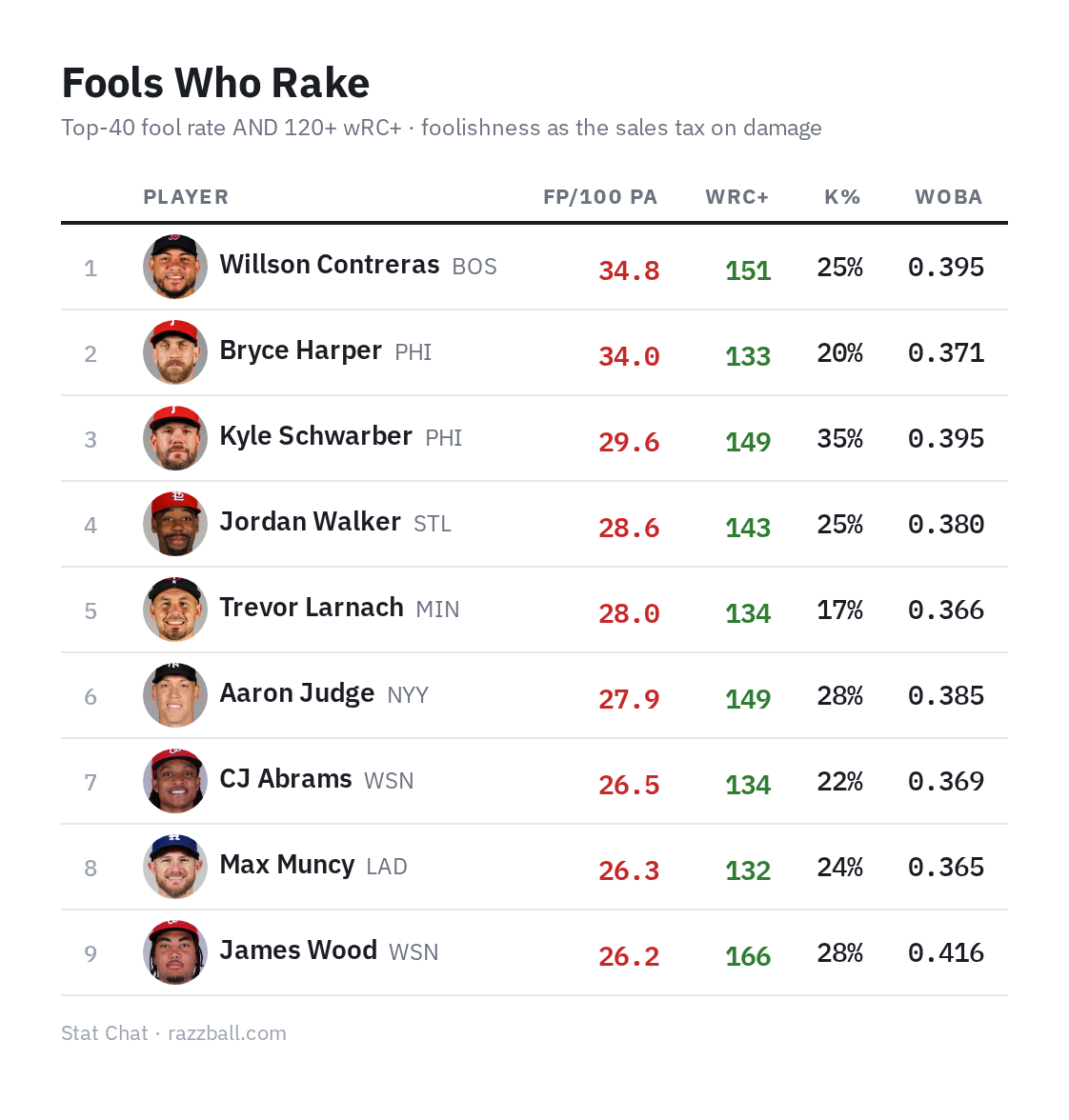
The correlation between Fool Rate and wRC+ is r = -0.245. It’s negative, so yes, looking like a fool is mildly bad, but it explains only about 6% of the difference between hitters. For proof, look at the top of the chart: Willson Contreras (151 wRC+) has nearly the same fool rate as Coby Mayo (83 wRC+, hitting like a pitcher with good bat-to-ball skills). Same foolishness, 68 points of wRC+ apart.
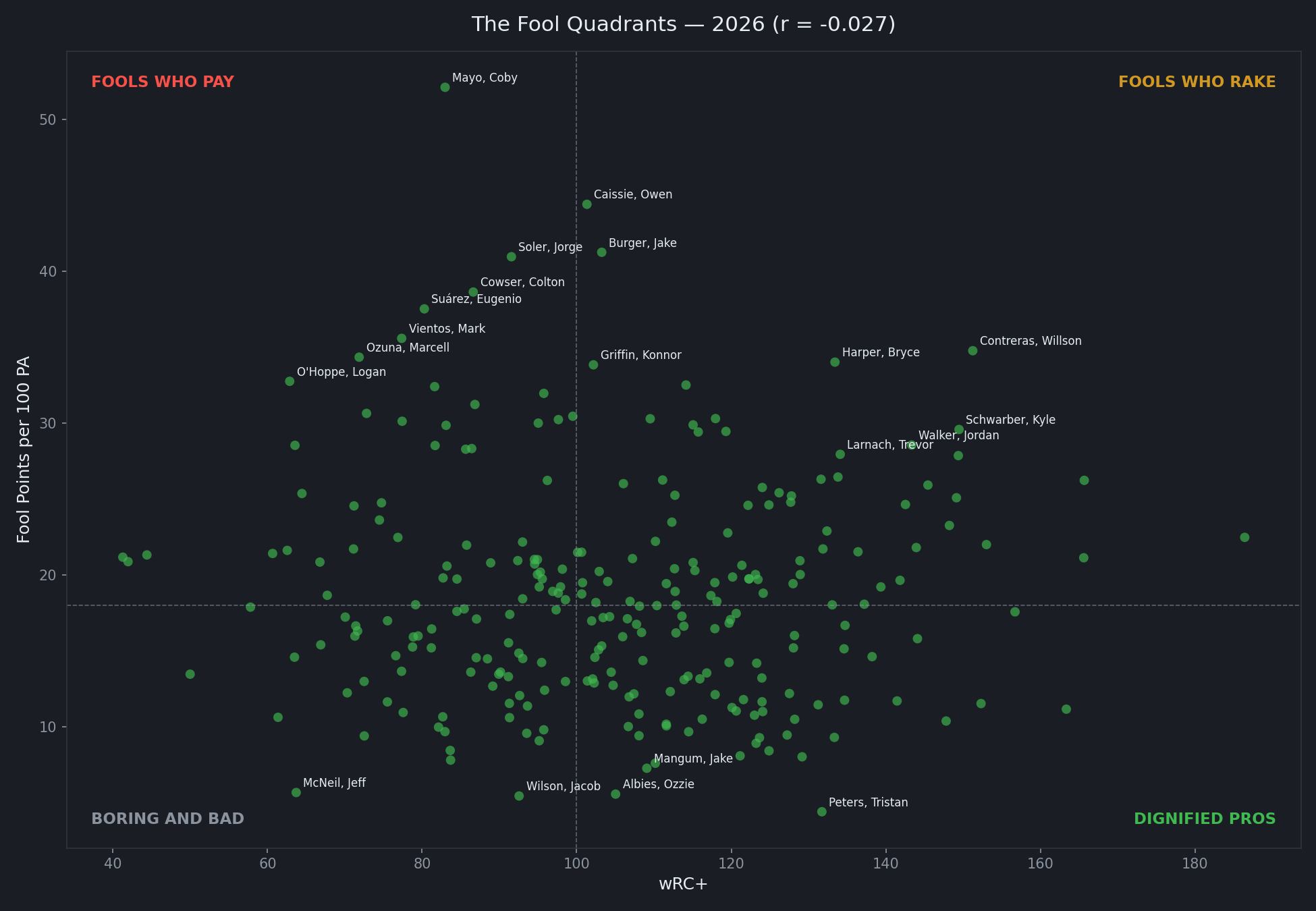
What the chart lacks in predictive power it makes up for in characterization. The four quadrants are basically hitter personality types:
- Fools Who Pay (high fool rate, bad hitting): Mayo, Caissie, Soler, the foolishness is part of a genuine skill problem.
- Fools Who Rake (high fool rate, great hitting): Contreras, Bryce Harper, Kyle Schwarber, Aaron Judge, James Wood. For these guys, fool points are simply the sales tax on damage. Judge appearing here two weeks after we documented him avoiding his swing hole is a fun reminder that having a hole and being a fool are different sins, Judge avoids the former and shrugs at the latter.
- Dignified Pros (low fool rate, good hitting): Luis Arraez has exactly 1.13 Windmill points all season, roughly one foolish whiff since March. Also here: José Ramírez, Ronald Acuña Jr., and the fascinating Sam Antonacci, who has literally zero Windmill points. Every fool point Antonacci owns came from standing still.
- Boring and Bad (low fool rate, bad hitting): Jeff McNeil and friends, failing responsibly.
Windmills vs. Statues
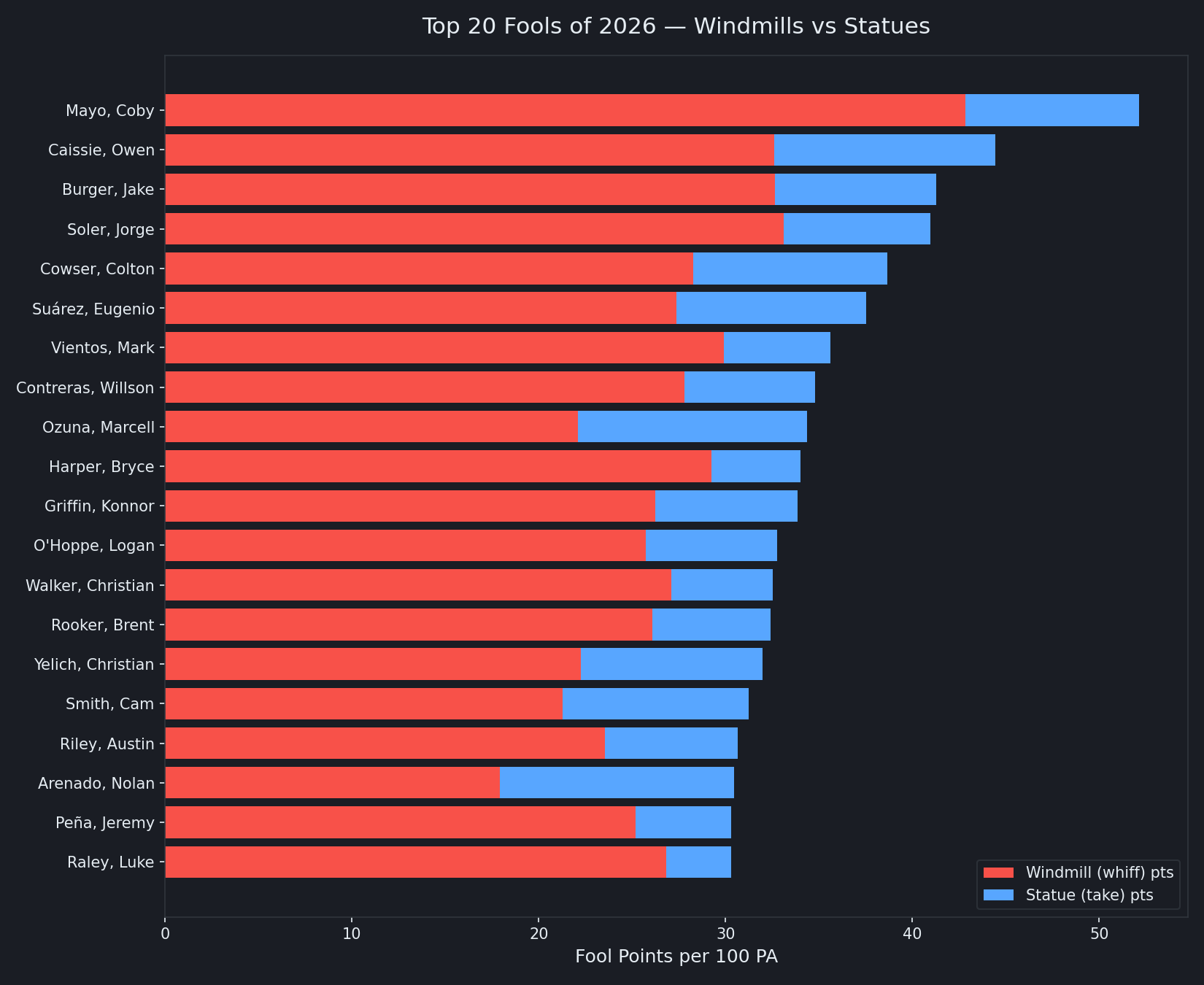
One more layer: not all fools are the same kind of fool. League-wide, Windmill points outnumber Statue points 12,614 to 8,366, and most of the top-20 leaderboard is Windmill-heavy (Harper is 86% Windmill). But there are specialists. Nolan Arenado leads the top 20 in Statue points, the man famous for one of the longest, loopiest swings in baseball apparently prefers to keep it holstered while center-cut fastballs go by. And down the leaderboard, Taylor Ward has quietly accumulated the most Statue points in baseball (52.1), which pairs amusingly with a very respectable 120 wRC+. Some guys are just picky, even about meatballs.
There’s an honest caveat here: for elite contact hitters, some meatball takes are strategic; Arraez spitting on a first-pitch center-cut fastball because he’s hunting something else is a choice, not a failure. The 3x two-strike weighting mostly separates the pickers from the statues, but it’s worth remembering that early-count takes live in a gray area.
