

If you grew up watching baseball movies, you know the scene from Mr. Baseball (1992). Tom Selleck’s Jack Elliot is introduced to the Japanese league as an aging slugger past his prime, and his new team’s translator delivers the most brutally simple scouting report in cinema history: “You have a hole in your swing.” The idea of a hole in a hitter’s swing has been explored in other movies, notably a movie that rhymes with “Shmuble with the Verve” but Mr. Baseball is the one I go back to (probably because it was about an American living in Japan).
That concept of a swing-hole has been on the back of my mind since bat tracking data went public in 2024. Now, two and a half seasons into the bat tracking era, we have enough data to actually go looking for those holes. Not anecdotally, not via broadcast observation, but statistically, using every competitive swing logged in Statcast since 2024 to build what I’m calling a Hole Score for every qualified hitter in baseball.
The methodology is straightforward: for every hitter, I looked at every combination of zone (Savant’s 9-zone strike zone grid), pitch category (Fastball, Breaking, Offspeed), and pitcher handedness (L/R) where they had at least 50 tracked swings. For each combination, I calculated three things:
- Whiff rate: How often does the swing miss entirely
- Hard hit rate: How often does exit velocity hit 95+ mph
- Miss distance: How badly do hitters miss the ball in that location
Each metric is normalized within pitch category so we’re comparing fastball whiff rates to other fastball whiff rates, not to breaking ball rates. The three components are weighted 40/40/20 (whiff and hard contact equally, miss distance as a tiebreaker) and combined into a single 0-to-1 Hole Score where 1.0 is the biggest possible hole.
Here are the 20 biggest individual zone/pitch/hand holes in baseball across the 2024–2026 seasons (minimum 50 swings):
| Rank | Player | Zone | Pitch Type | Hand | Swings | Whiff% | Hard Hit% | Hole Score |
| 1 | JJ Bleday | Bot-Away | Offspeed | RHP | 82 | 65.7% | 8.1% | 0.905 |
| 2 | Jake Meyers | Bot-Away | Breaking | RHP | 56 | 65.2% | 3.1% | 0.871 |
| 3 | Tyler Stephenson | Bot-Away | Breaking | RHP | 54 | 74.8% | 3.7% | 0.842 |
| 4 | Mitch Garver | Bot-Away | Breaking | RHP | 53 | 67.8% | 10.7% | 0.811 |
| 5 | Harrison Bader | Bot-Away | Breaking | RHP | 53 | 63.4% | 10.0% | 0.796 |
| 6 | Matt Wallner | Top-Away | Fastball | RHP | 59 | 78.8% | 5.9% | 0.792 |
| 7 | Joey Ortiz | Bot-Away | Breaking | RHP | 60 | 51.0% | 4.2% | 0.785 |
| 8 | Brayan Rocchio | Bot-Away | Offspeed | RHP | 52 | 62.3% | 21.7% | 0.776 |
| 9 | Aaron Judge | Bot-Away | Breaking | RHP | 126 | 64.3% | 11.3% | 0.775 |
| 10 | Nolan Gorman | Top-Away | Fastball | RHP | 64 | 80.2% | 11.5% | 0.763 |
| 11 | Spencer Torkelson | Bot-Away | Breaking | RHP | 102 | 59.9% | 6.3% | 0.762 |
| 12 | James Wood | Bot-Away | Offspeed | RHP | 63 | 56.5% | 10.0% | 0.761 |
| 13 | Orlando Arcia | Bot-Away | Breaking | RHP | 57 | 55.2% | 7.7% | 0.758 |
| 14 | Jake Burger | Bot-Away | Breaking | RHP | 82 | 64.3% | 9.8% | 0.757 |
| 15 | Christian Walker | Bot-Away | Breaking | RHP | 92 | 63.2% | 12.0% | 0.757 |
| 16 | Dansby Swanson | Bot-Away | Breaking | RHP | 132 | 55.3% | 5.6% | 0.756 |
| 17 | Gleyber Torres | Bot-Away | Breaking | RHP | 91 | 55.8% | 2.9% | 0.754 |
| 18 | CJ Abrams | Bot-Away | Breaking | LHP | 52 | 54.8% | 12.1% | 0.753 |
| 19 | Mark Vientos | Bot-Away | Breaking | RHP | 83 | 65.0% | 9.5% | 0.751 |
| 20 | Andrew McCutchen | Bot-Away | Breaking | RHP | 64 | 66.1% | 10.8% | 0.749 |
A few immediate observations: right-handed breaking balls low and away (zone 9) dominate this list, which confirms what every pitching coach has known for decades, it’s the hardest pitch location to do anything with against same-side pitchers. But the more interesting question isn’t where the holes are. It’s what pitchers are doing about them.
Part One: The Found Hole – JJ Bleday
Hole: Outside Bottom Offspeed from RHP | Hole Score: 0.905
JJ Bleday has the biggest documented hole in baseball. Low-outside offspeed from right-handed pitchers: 65.7% whiff rate, 8.1% hard contact rate, 4.8 inches of average miss distance. Those are historically bad numbers. A hitter can survive a hole if pitchers don’t know it exists, but the data says they’ve found Bleday’s.
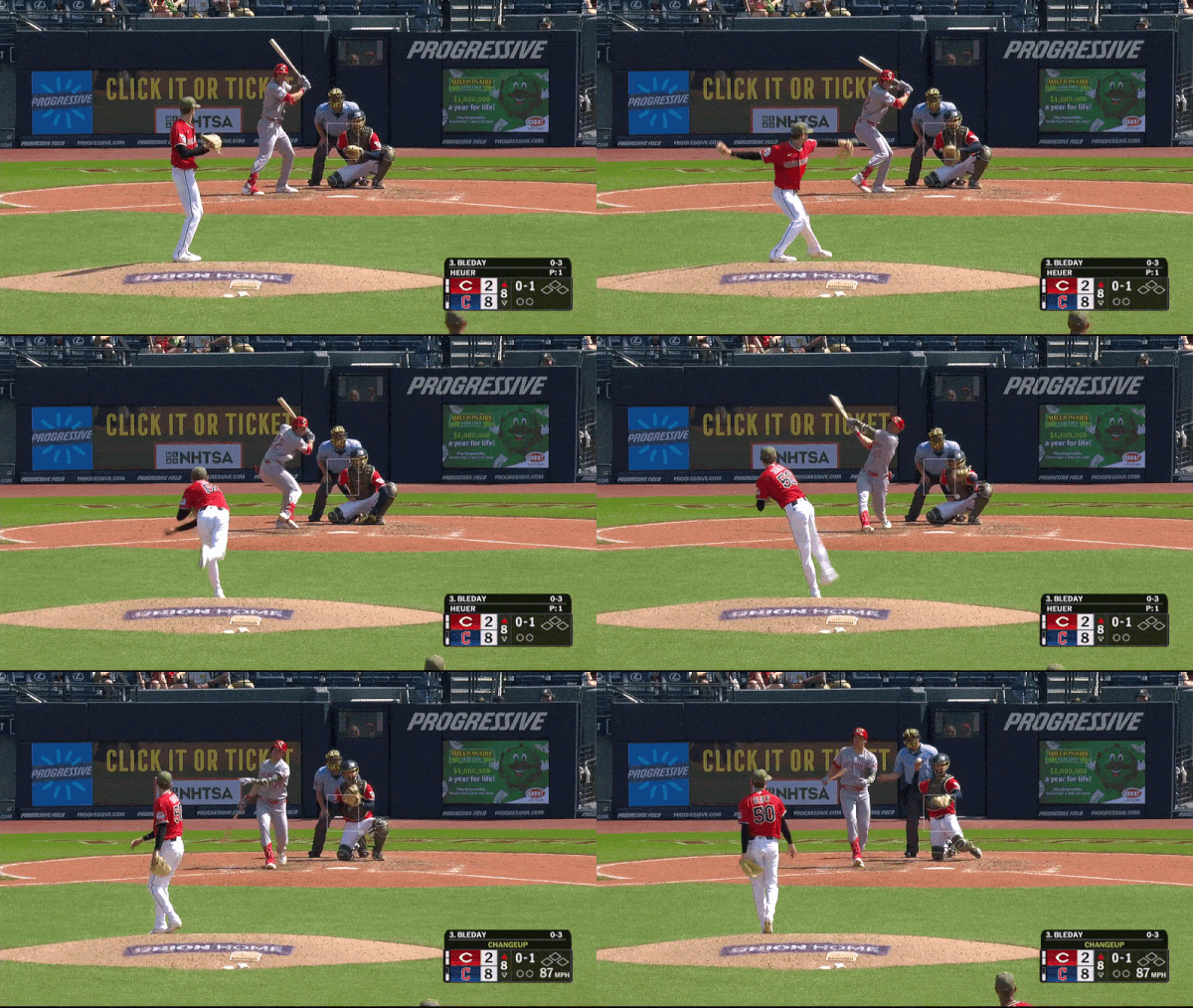
Here is what pitchers are actually doing with that information, measured as a percentage of all pitches thrown to Bleday from RHP that landed in that zone:
| Season | vs RHP Pitches | Into Hole | Hole % |
| 2024 | 2,008 | 45 | 2.2% |
| 2025 | 1,070 | 35 | 3.3% |
| 2026 | 695 | 29 | 4.2% |
Every single year, pitchers are going there more. From 2.2% in 2024 to 4.2% in 2026, nearly double the frequency in two seasons. This is the clearest example of a hole being found, logged in some advance scout’s report, and systematically exploited with increasing precision.
Part Two: The Avoided Hole – Aaron Judge
Hole: Bot-Away Breaking from RHP | Hole Score: 0.775
Aaron Judge has a hole. That sentence probably requires a moment to sit with. The two-time MVP, the guy who hit 62 home runs in a season, has a zone/pitch/hand combination that produced a 64.3% whiff rate and 11.3% hard contact rate across three seasons of bat tracking data.
The hole is real. What’s interesting is what pitchers are doing about it:
| Season | vs RHP Pitches | Into Hole | Hole % |
| 2024 | 2,124 | 81 | 3.8% |
| 2025 | 2,061 | 97 | 4.7% |
| 2026 | 783 | 21 | 2.7% |
Pitchers found it in 2025, usage jumped from 3.8% to 4.7%. Then in 2026, they backed off sharply to 2.7%. Why?
The most likely answer is the danger of the adjacent zones. Judge’s hole is in zone 9 (the bottom-away corner), but zones 5, 6, and 8 (the heart, mid-away, and bot-middle) are where Judge does catastrophic damage. A pitcher trying to hit zone 9 with a breaking ball and missing by four inches toward the middle has just served up a 450-foot home run. The margin for error is razor-thin, and pitchers in 2026 seem to be deciding the risk isn’t worth it.
Part Three: The Forgotten Hole – Dansby Swanson
Hole: Bot-Away Breaking from RHP | Hole Score: 0.756
Dansby Swanson has been on a scorching hot streak since June 17th with a 263 wRC+ over that stretch that has fantasy managers scrambling to add him. There are two ways to interpret a hot streak like that: either a player got mechanically better, or pitchers started making worse decisions.
The data suggests it’s the latter.
Swanson’s hole; bot-away breaking balls from RHP is severe. In 2026, before June 17th, he saw 28 pitches in that zone from right-handed pitchers. He made contact on 12 of them. Hard hits: zero. Whiffs: 6. Hard hit rate: 0.0%.
Then the hot streak started. Since June 17th? Two pitches into the hole. That’s it.
Here’s what the exploitation trend looks like across all three seasons:
| Season | vs RHP Pitches | Into Hole | Hole % |
| 2024 | 1,901 | 78 | 4.1% |
| 2025 | 2,004 | 92 | 4.6% |
| 2026 (pre-6/17) | 904 | 28 | 3.1% |
| 2026 (6/17+) | 200 | 2 | 1.0% |
Meanwhile, his overall hard hit rate went from 23.7% before the streak to 32.0% during it. Swanson isn’t hitting better against his hole, he’s obliterating everything else because pitchers have temporarily stopped throwing him the one pitch he can’t handle.
The Takeaway
The concept of a hole in your swing has existed forever, but we now have an ability to measure it, to say with precision that JJ Bleday’s hole score against low-inside offspeed is 0.905, that Aaron Judge’s adjacent zones are too dangerous to exploit consistently, that Dansby Swanson’s 263 wRC+ hot streak is built on pitchers forgetting to throw him one specific pitch.
Jack Elliot fixed his hole by the end of Mr. Baseball (spoiler: he learned to go the other way). Real major leaguers rarely fix theirs so cinematically, and if JJ Bleday doesn’t fix the hole in his swing… he could still end up like Jack Elliott (being the hitting coach for the terrible 90s Tigers).
