

The Moment of Zen:
A core element of Buddhism, particularly Zen, is meditation. Sitting meditation, in fact, is called zazen, making the connection between Zen and meditation hard to miss. I resisted any sort of formal Buddhist practice for much too long, largely because I was convinced meditation would not be a useful activity. After all, what good comes from just sitting there?
It turns out to be difficult to count the ways good comes from simply sitting. Aside from increasing focus and ability to remain patient and calm, as well as allowing for greater frequency of equanimity, there are actual health benefits. There is evidence of meditation having positive impacts on things like depression, high blood pressure, sleep problems, etc. In my own life, meditation has clearly improved my ability to respond with consideration to what happens in life, as opposed to impulsively reacting to it. It turns out the difference between a response and a reaction can be immense.
As I look back now, I better understand that my initial resistance to meditation was about fear of failure. I was convinced that I would be terrible at it – how in the world am I going to think about nothing at all for extended periods of time? I felt sure there was no chance I could remain focused on nothing, so to avoid what I deemed as failure, I just avoided meditating altogether. Now, though, my understanding is very different: instead of seeing being distracted as an obstacle to meditation, I now think distraction is an essential part of the practice. Distraction is natural – the brain thinks, whether we want it to or not. The process of meditation, as far as I can tell, isn’t so much about learning not to think as it is learning how to recognize when thinking is occurring. How often do we create narratives in our head that become our perception of reality? Part of the practice of meditation is recognizing thoughts for what they are – thoughts, not reality. My thoughts may be based on truth, but they aren’t necessarily true. Things that have actually happened to me are part of what I use to construct my memories, but those memories are also made up of what I fear might happen, wish would have happened instead, or the future possibilities I’ve conjured out of thin air. Part of the process of meditation is simply identifying that we are, in fact, thinking, not remembering. We are creating narratives around our lives, and when we learn to recognize when we are creating the narratives, we become better at pausing them and going back to the breath. So simple and difficult and frustrating and absolutely life-changing for me.
Thus, what I initially feared would be my failure is the only way I know to improve – I get better at meditation by being distracted and then learning to acknowledge when I have lost that focus. It is in recognizing that I have become distracted that I learn to be distracted less frequently.
How in the world does this apply to fantasy baseball?
I may have mentioned once or twice by now: Fantasy is a game of failure. We cannot predict human behavior 100% of the time, so our predictions about players are going to be wrong. Often. The best fantasy players aren’t necessarily good at predicting what players will do; they are simply less bad at it than the rest of us are. The best fantasy players are also likely less reactive to their analytical misses, able to respond and adjust accordingly, while the rest of us are still yelling at ourselves for our misses – or, even worse, blaming players for how they have failed us. The best fantasy players are able to acknowledge their analysis was wrong and quickly begin the process of rebuilding analysis to help move forward.
This requires taking hard looks at your teams and being honest with yourself. In that spirit, I’m taking a few minutes this week to look back at some of the analytical misses I’ve made in this column. In recognizing the misses, I am hoping to make adjustments where they are called for and improve my process moving forward so that the misses come less frequently in the future (more on that in future articles). Here goes:
Spencer Arrighetti – in search of Ks, in receipt of headaches
In my May 19th piece, I recommended picking up Arrighetti, thinking that he would bring a mix of Ks and inconsistency. If you picked him up, you’ve seen the inconsistency part – Arrighetti has been both brilliant and kind of terrible. Through the end of May, his results were dominant, at least in ways that matter to fantasy managers: Arrighetti’s ratios were very strong (with an ERA under 2.00 and a WHIP just over 1.10), and he was racking up wins. If you went with him, you were likely glad you picked him up for those first 2 weeks despite his lack of strikeouts. Good news… His Ks have picked up nicely. Bad news… his results have been quite bad of late. In June, his ERA is up to 9.00 (yikes) while his WHIP is up to 1.60 in the month. Yet, he’s up to a 28.1% K% and an 18.4% K-BB% (which includes improving his BB% by about 4.5%).
So, what’s next with Arrighetti? The fact is: I have no idea. Unfortunately, this is kind of the Arrighetti experience – great results mixed with terrible results. If you’re protecting your ratios, then it makes sense to get Arrighetti far away from your team, but if you’re in position to need Ks, I think I’m still on board with him. I love that he’s controlling the strike zone better, and his June BABIP (.361) and LOB% (54.2%) suggest that he’s been really unlucky this month (maybe due to the uptick in ground balls he’s inducing?). Maybe this is my own stubbornness, but for now, I’m tempted to play Arrighetti in softer matchups and bench him against better teams (which, as I mentioned in the May 19th piece, was my strategy anyway) to see if his luck will improve. But the moment his K% drops or if he keeps getting shelled, then obviously it makes sense to drop him. I’m just not there yet in 15-team leagues. In 12-team leagues and smaller, though, I’m definitely much more hesitant to put him in my lineup.
Michael Conforto and Matt Shaw – increased playing time… not so much
I’ve written about both Conforto (May 25th) and Shaw (June 22nd) in recent articles thinking that both players were moving into more consistent playing time roles. For Conforto, his playing time increase continued for a few days but then quickly bottomed out. He finds himself getting a few more at bats lately, but clearly I just misread the tea leaves here. For Shaw, the story is similar. When I wrote about him, his playing time was clearly up and stayed up for a couple of games after my article’s publication before quickly bottoming out. Currently, Shaw looks to be shaping up more for a shortside platoon role, so clearly, I misread what was happening there as well. Neither player has a ton of reason to be rostered right now, but I’m still going to watch Shaw closely to see if anything changes there. I also apparently need to get a better sense of Craig Counsell’s lineup usage in Chicago before making any big moves on Cubs’ waiver wire pickups.
Nolan Schanuel and Mike Trout – apparently, these guys are who they have always been
In my March 30th article, I made an argument for getting on board Schanuel’s uptick in power while not getting too excited about Trout’s hot start. Oops.
My argument for Schanuel was that he appeared to be swinging less often so that he could more consistently hit the ball harder. Since then, though, Schanuel’s numbers have stabilized in ways that definitely don’t help fantasy managers. He’s swinging outside the zone more often now, and his HH% is creeping back toward career norms. His EV this year is essentially identical to previous years’, and his maxEV is 3 mph lower while his Barrel% has been cut in half. While he had 2 HR by the end of March, he now has a whopping 6 total. Nothing to see here – I clearly got excited over nothing.
For Trout, I made the argument that his falling bat speed was concerning while I also thought his K% would go back to recent years’ rates (near 30%) and his walk rate would dip well below 20% (since he didn’t have a 20+% in his career except for 2018). Well, his bat speed is back (up to 75.1 mph, 85th percentile), his K% is quite good (only 24.8%), and while his walk rate has dropped below 20%, it’s just barely below that number (19.7%). And his Statcast page is absurd:
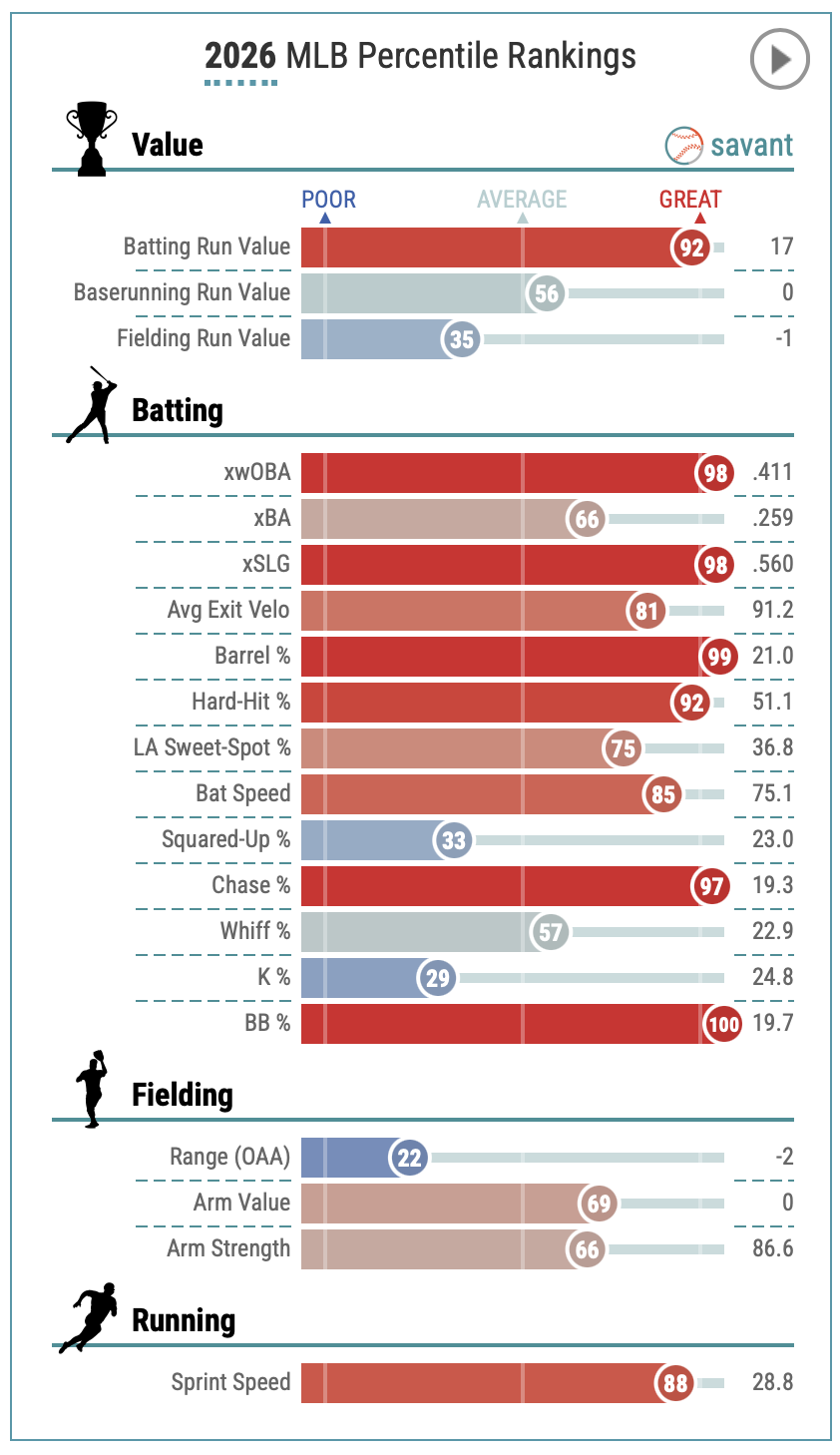
Trout isn’t prime Trout anymore, largely due to injuries (like the one that has him currently on the IL). But the guy is still pretty incredible when he’s on the field. Will he stay healthy once he returns from the IL? My confidence isn’t high, but clearly, he’s worth the risk of rostering, at least if you want a piece of a stat line that currently stands at a .234 BA, 17 HR, 54 R, 36 RBI, and 7 SB. If anyone Trout managers in my leagues are looking to get out from under his IL stint, I’d definitely be interested in taking a chance on getting an elite power bat for the second half. Just beware of soft tissue injuries.
One takeaway from my Angels’ experience is simple: If a player has established himself as carrying certain skills, assume those skills will be relatively consistent until there is extensive evidence of a change.
May your decisions in the coming week all be measured responses, not impulsive reactions. Let’s hope mine will be as well. Until next week. –ADHamley
