

The Moment of Zen:
This morning, in a discussion about “desire” in the context of Zen, a friend mentioned a piece of wisdom a teacher had offered him many years ago: “Balance is continuous adjustment.”
I find myself mulling that simple sentence over and over in my mind. Balance is continuous adjustment. Meaning, balance isn’t a state of ease as I might suppose it to be. Balance isn’t a state of being ok with anything and everything. If my friend’s teacher was right (and I suspect she just may have been), balance is a process of adaptation that never stops. What makes us appear to be balanced, I suppose, is not the ease with which we face the world, but instead it’s the skill with which we adjust to any situation. Understanding at all times that any situation is possible, and preparation for the contingencies that might happen allows us to respond – not react – to just about anything that does happen.
As I consider what “balance” might actually mean in a Buddhist context, I can’t help but envision the image of the dharma wheel, at least the most commonly westernized version of the wheel.
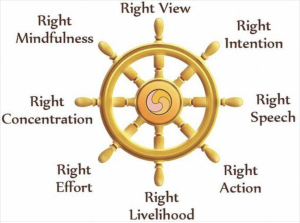
**https://www.facebook.com/UNFFTBuddha/
Like any religious symbol, the dharma wheel (or, in Sanskrit, dharmachakra) has been popularized and commodified to the point that the image often has no real meaning when we see it out and about in our daily lives. But when considered in the context of Buddhist – or, frankly, life – practice, the wheel gives us a visual reminder of the path to an existence that is not overwhelmed by dukkha. Perhaps, dukkha is indeed the natural state of humans, but a holistic following of the Noble Eightfold Path, which not surprisingly, requires continuous adjustment and responses to all contingencies of life, can allow us to develop the tools to make decisions based on right intention, leading to right effort, leading to… well, you probably get the idea.
My friend’s simple statement this morning – “Balance is continuous adjustment.” – is a good reminder that even what looks simple in our lives, perhaps especially what looks simple, is the result of work and training and focus and willingness to continue struggling toward a better place.
How in the world does this apply to fantasy baseball?
As goes life, so goes fantasy baseball. In life, we face challenges, joys, and griefs – big and small. In fact, “challenges, joys, and griefs” may serve as a starting point definition for the term “life.” So it goes.
In fantasy, on a less significant level (I would hope, anyway), we face challenges, joys, and griefs as well. Once we feel we’ve locked onto successful strategies, they blow up in our face (a microcosm of my fantasy season so far). Once we feel the game has beaten us, we somehow find success. If fantasy is met with arrogance, the lesson of humility will soon be learned – at least by the wise. If fantasy is met with resignation, like life, the process becomes more of a dragging, painful slough in which we learn very little because we have little openness to solutions.
Balance, according to a wise friend, is continuous adjustment. I’ll work to remember that as I examine my teams this FAB Sunday, and I’ll try to use it to assess my rosters to the best of my ability. Starting with a man who has been incredibly frustrating to roster this year – despite my confidence in drafting him over and over and over. As I said, arrogance is quickly met with humility.
I love Framber Valdez, the player – the man himself leaves me with some questions. Over the last 10 months, he’s done two very questionable acts with a baseball, and both acts were public and looked nothing but bad for him. One involved hitting his own catcher and clearly not feeling the least bit apologetic. The other involved hitting Trevor Story with a 4-seam fastball, a pitch, by the way, that Valdez had not thrown a single time this season up until that moment. Ugh. It’s probably fair to say that Valdez, the man, could use some practice in his own types of balance.
But I enjoy the player – the old-school mentality Valdez brings as a pitcher. He doesn’t always have the stuff of an ace, but over the years, he has proven time and time again that he knows how to get the results an ace would get. But instead of striking everyone out to get those results, he finds ways to get hitters to get themselves out with groundball after groundball.
This year, however, his results have been a reason for my team’s slow starts. He’s been bad. I roster him in lots of places. Thus, I have been not-so-great in lots of places (well, to be fair, my results aren’t all due to Valdez, but he’s playing a part). With my friend’s message about balance and continuous adjustment in mind, though, I’ve decided to take a closer look at what’s going on. Is he broken? Is he unlucky?
This season’s line for Valdez is enough to inspire a rage drop: in 67.2 IP, he has damaged his fantasy managers by earning a 4.39 ERA (supported by a 4.34 xERA, 4.14 FIP, and 4.29 xFIP) and a 1.32 WHIP. His BB/9 is up to 3.33, not great. His K/9 is down to 7.18, also not great. His K% makes things look even worse, as he’s down to 18.3% from last year’s 23.3%, causing his K-BB% to drop from last year’s 14.8% to 9.8% in 2026. He’s allowing significantly more contact this season in all facets of his game: In the strike zone, he’s allowing 5+% more contact (92.2% compared to 2025’s 87%). His overall Contact% is up almost 5 points (80.4% compared to 2025’s 75.5%). Worst of all, outside the zone, hitters are making contact 59.6% of the time compared to 49.9% in 2025. He doesn’t seem to be having much success fooling hitters. And when he fails to keep them guessing, batters are putting the ball in the air much more frequently: His FB% is up from 22.8% to 33.8%, and his GB% is down a corresponding amount, 47.6% compared to 2025’s 58.6%. Valdez makes his living on keeping the ball on the ground, so 10-11% swings in both FB% and GB% are very bad signs.
But what is the problem? Since he can’t fool hitters, leading to more balls in the air and obviously less control over hitter outcomes, that suggests to me we should look at his pitches themselves. Has he lost the ability to throw them?
After looking at the numbers below, my non-expert analysis (so take with the necessary grain of salt) is this: his problem looks mechanical and very fixable. Check out these numbers:
| Pitch Type | 2026 Velo | 2025 Velo |
| 4-seam Fastball** | 95.2 | 93.7 |
| Sinker | 94 | 94.3 |
| Slider | 85.9 | 84.4 |
| Curveball | 78.5 | 79.4 |
| Changeup | 89.1 | 89.9 |
**Valdez has thrown the 4-seam only 2x, one of which to hit Story and one for a K.
There are virtually no differences here. All of his velos are basically in line with last season’s.
| Pitch Type | 2026 Stuff+ | 2025 Stuff+ |
| 4-seam Fastball** | 70 | 78 |
| Sinker | 97 | 98 |
| Slider | 126 | 111 |
| Curveball | 117 | 122 |
| Changeup | 96 | 99 |
**Valdez has thrown the 4-seam only 2x, one of which to hit Story and one for a K.
The only worrisome Stuff+ number I see is his 4-seam, down to a score of 70, 28-30 points below league average. But he’s thrown that pitch only twice this season, and one of them was clearly intended to go straight at Story. Valdez knows it’s not a money pitch for him, so he doesn’t use it. The Stuff+ then really isn’t a meaningful number. As for Stuff+ on other pitches, those numbers are all fine to excellent, and his slider looks significantly improved.
| Pitch Type | 2026 Location+ | 2025 Location+ |
| 4-seam Fastball** | 66 | 70 |
| Sinker | 102 | 104 |
| Slider | 100 | 99 |
| Curveball | 96 | 96 |
| Changeup | 108 | 101 |
**Valdez has thrown the 4-seam only 2x, one of which to hit Story and one for a K.
Once again, the only problem pitch appears to be the 4-seam, which is likely why he doesn’t throw it. But the location, stuff, and velo all look good, yet he’s using his sinker 3% more often this year and his curveball 4.6% less often this year. Is that a confidence thing? There doesn’t appear to be anything wrong with the pitch itself.
Some of the answers to the mystery may come in the spin rate:
| Pitch Type | 2026 Rev. Per Minute | 2025 Rev. Per Minute |
| 4-seam Fastball** | 2211 | 2270 |
| Sinker | 2172 | 2203 |
| Slider | 2423 | 2573 |
| Curveball | 2877 | 2943 |
| Changeup | 1651 | 1708 |
**Valdez has thrown the 4-seam only 2x, one of which to hit Story and one for a K.
His spin rate is down across the board, which I suspect is why batters are making more contact, and Valdez is struggling to keep hitters off balance. I’m no physicist, but I think that spin rate comes mostly from the ability to commit to and follow-through a pitch motion. If a pitcher isn’t completing his motion, that would likely affect velo as well, but we’ve already seen that Valdez’s velo is fairly in line with last year. So what gives?
The one corresponding number I can find that might explain his lack of spin is his arm angle – he’s lowered his arm angle on every pitch he routinely uses:
| Pitch Type | 2026 Arm Angle° | 2025 Arm Angle° |
| 4-seam Fastball** | 41 | 41 |
| Sinker | 38 | 42 |
| Slider | 30 | 38 |
| Curveball | 39 | 42 |
| Changeup | 38 | 41 |
**Valdez has thrown the 4-seam only 2x, one of which to hit Story and one for a K.
Is it that simple? He needs to regain his more vertical arm slot? I certainly can’t say for sure that’s the answer, but so far, it’s the one truly compelling bit of information I find. So what’s my narrative? I suspect, true to this week’s topic, Valdez has lost balance – both physically and mentally. His body isn’t centered the same way, which I can at least imagine may be due to lack of confidence caused by getting hit more. A cycle that feeds itself. Certainly, I could be wrong, but at least this is data to work from.
If a guy who couldn’t get past high school calculus can see this change, I have to think the Tigers staff will be correcting it soon, just in case it’s the culprit. That makes me think I need to stick with Valdez on my teams, just maybe bench him for a couple of weeks while this gets ironed out. Maybe all he needs is a little balance. And I just need a little patience.
Next week this time, I’ll be halfway around the world learning more about one of the origin places of Zen, so my next article will be in two weeks. In the meantime, good luck with balance, both in life and in the game.
Until then. –ADHamley
