

From the days of Cy Young and Lou Criger, to Carlton and McCarver, to Maddux and Perez, to Wakefield and Mirabelli, to Kershaw and AJ Ellis, we’ve always had the “personal catcher”, the guy who can’t hit but has some super special relationship with the star pitcher. We also had the “catcher’s catcher”, guys who also can’t hit, but pitchers swore by for making them better, examples like Brad Ausmus, Henry Blanco, Jose Molina to Jeff Mathis.
As long as these magic catchers and magic pitcher-catcher partnerships have existed, there have been nerds trying to both quantify and disprove the existence of catcher magic. Craig Wright first used the term “Catcher ERA” (CERA) all the way back in The Diamond Appraised first published in 1989, and since those days, CERA acted as the foil to smart baseball men to easily defeat by saying “there is nothing special to the CERA because my formula shows it is all random”. The decades of CERA taking a beating continues all the way to 2015 with The Hardball Times article Do Catchers Have an ERA? However, one thread these articles from the past left open was the idea that “in the future” there could be enough information to further investigate what effects catchers may have on pitchers…
Ladies and gentlemen, welcome to the future, where we not only have pitch-by-pitch data, we have pitch grades, pitch location, pitch usage, and even bat tracking. It’s time to revisit battery splits with a fresh new perspective. To start with, I created the Battery Splits tool, which aggregates not just a pitcher-catcher battery’s ERA, but also their FIP, and pitch grades (Stuff+/Location+/Pitching+):
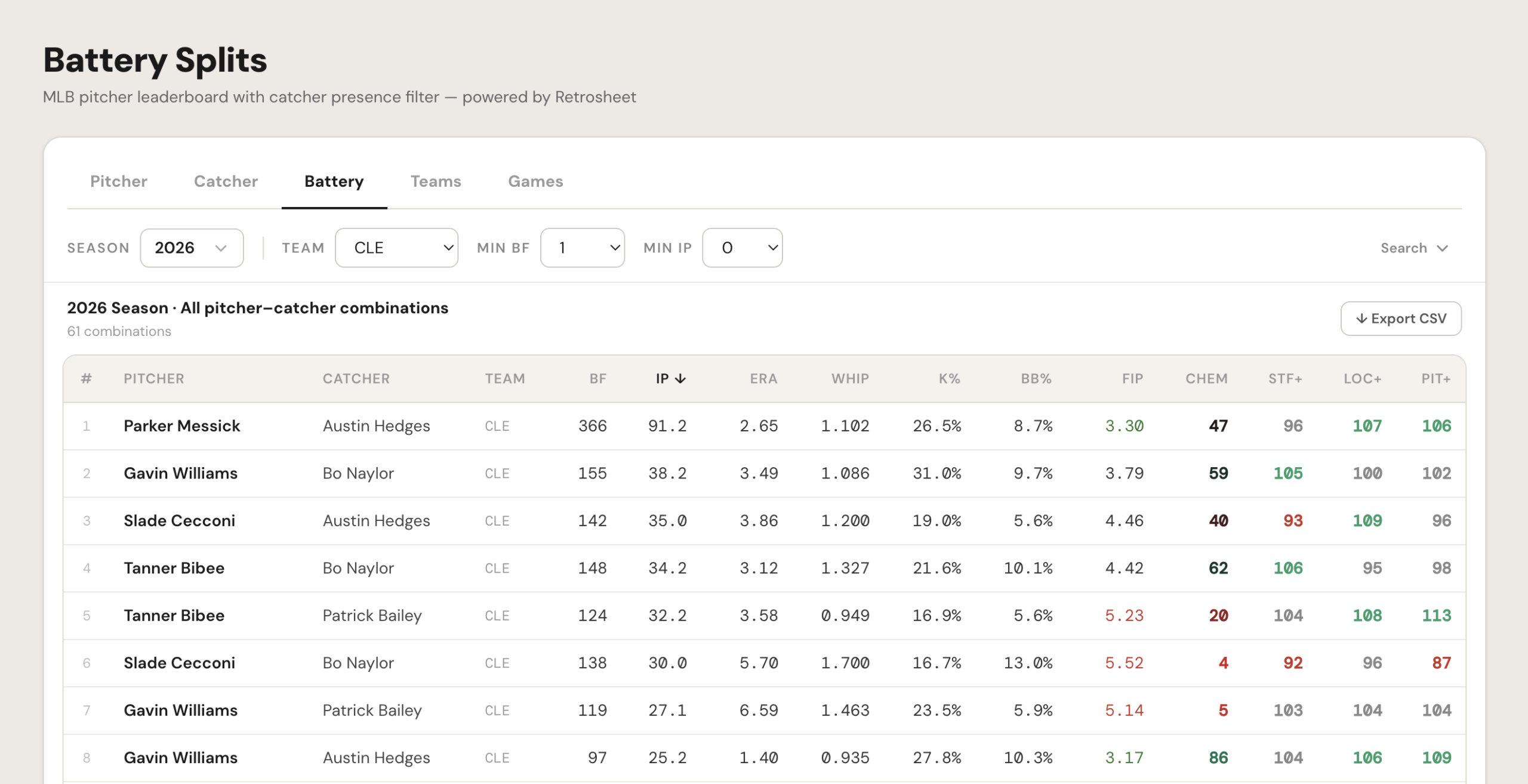
In addition to the pitching metrics, I added a “Chemistry” score (CHEM) for batteries. This takes the FIP of the pitcher-batter combination and compares it against the pitcher’s overall FIP. A low CHEM means the pitcher has a higher FIP with a certain catcher compared to when he is pitching to other catchers. Clicking on the “Team” tab shows the best/worst battery combination for all 30 teams (data goes all the way back to 2008).
Looking at some examples, you can see Logan Gilbert and Cal Raleigh, who have been working together through the minor league and are known for their battery chemistry and personal rapport:

Then, looking at examples of “worst”, you see Slade Cecconi and Bo Naylor, where Bo Naylor’s defensive troubles were part of the reason Naylor is now starting for the Columbus Clippers and not the Guardians:

…but as mentioned above and closely studied by the hater-nerds, these are just the examples that “fit” the narrative that battery splits mean something. For every “Logan Gilbert and Cal Raleigh are best friends” example, you can find a counterexample like Casey Mize and Jake Rogers having the worst CHEM score on the Tigers despite being minor league teammates like Gilbert and Raleigh were:

What this comes down to is that these result-based metrics can’t tell the whole story, we need to go pitch by pitch, grade by grade, and see what’s “different” when pitchers are working with their favorite catchers.
To study this, I’m looking at three examples of “high” chemistry score pitcher-catcher combinations:
- Colin Rea and Carson Kelly
- Battery FIP: 3.51 (127.0 IP)
- Colin Rea’s FIP when it’s not Carson Kelly: 5.46 (106.1 IP)
- Keider Montero and Dillon Dingler
- Battery FIP: 3.74 (101.0 IP)
- Keider Montero’s FIP when it’s not Dillon Dingler: 6.42 (80.1 IP)
- Logan Gilbert and Cal Raleigh
- Battery FIP: 2.97 (157.0 IP)
- Logan Gilbert’s FIP when it’s not Cal Raleigh: 4.95 (60.2 IP)
For these three batteries, I want to answer the following questions:
- Do pitchers have different pitch model grades depending on the catcher?
- Do pitchers change their pitch mix depending on who’s catching? Do pitchers avoid any pitches when it’s not their favorite catcher?
- Do pitchers throw to different spots depending on the catcher?
Colin Rea and Carson Kelly
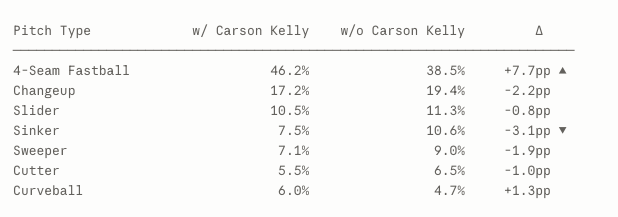
The biggest difference when Rea is throwing to Carson Kelly vs non-Kelly catchers is that he throws a lot more 4-seam fastballs:
With higher Location+ numbers for the 4-seam fastball:
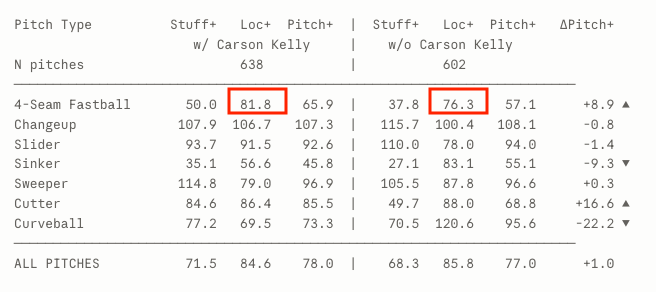
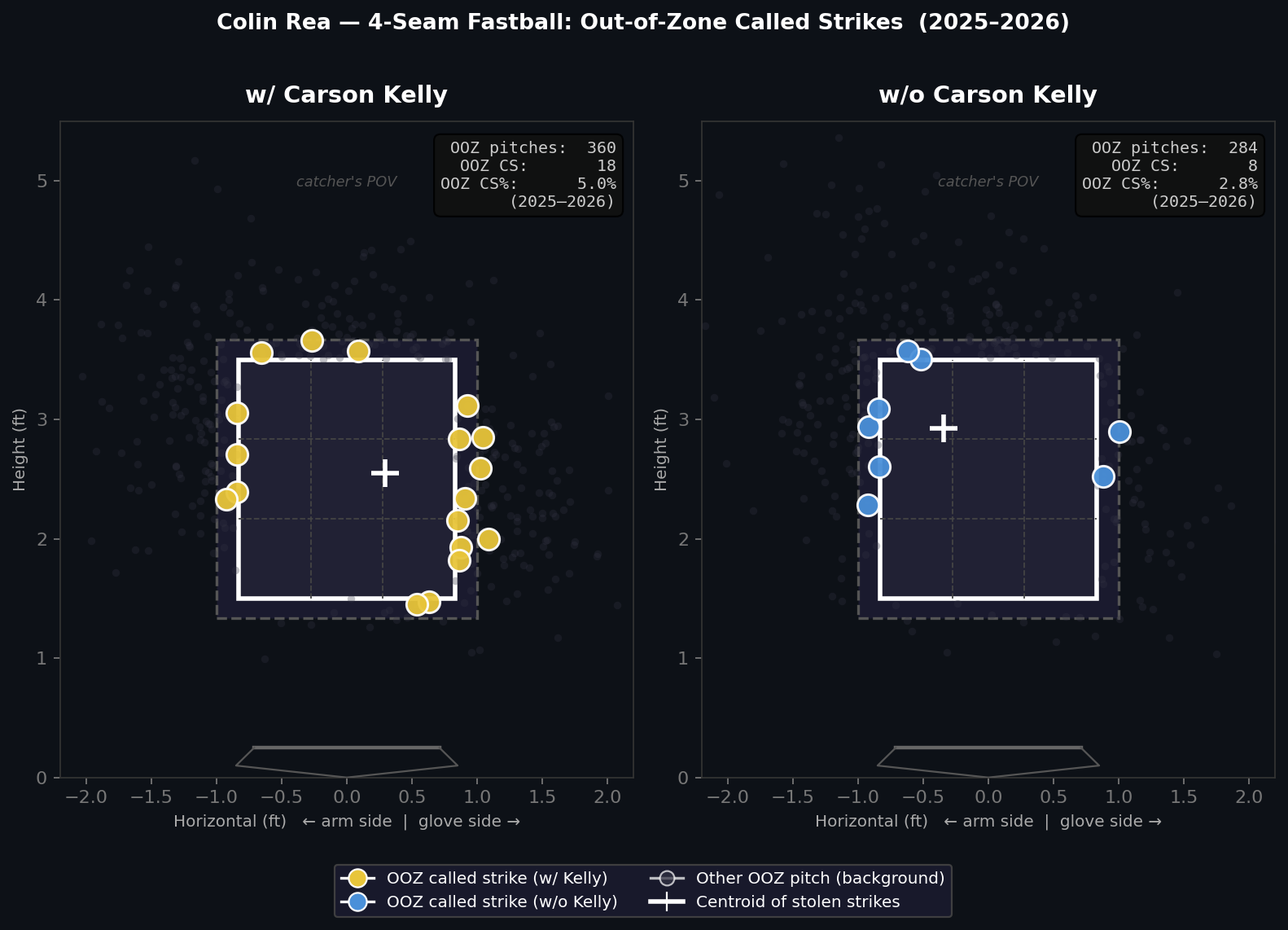
One thing that could explain this is the framing bump that Kelly provides to Rea compared to other catchers. Even in the age of ABS, Carson Kelly is providing Rea with a 5% OOZ (out-of-zone) called strike rate on 4-seam fastball vs 2.8% with other catchers.
Keider Montero and Dillon Dingler
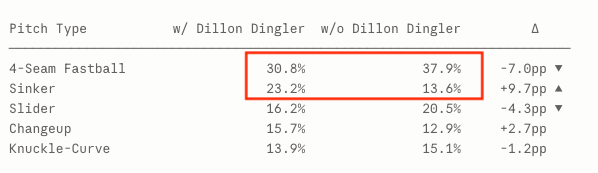
First, starting with pitch usage, Keider has thrown more sinkers to Dillon Dingler than other catchers:
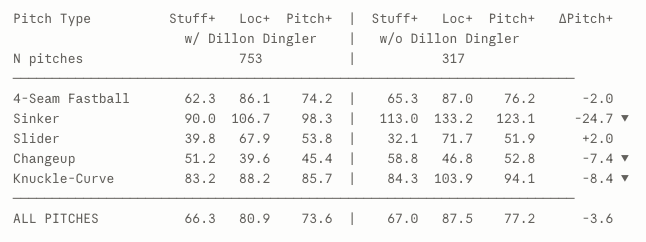
However, when you look at the model grades, he actually has worse grades on sinkers, along with overall being a worse pitcher grade-wise:
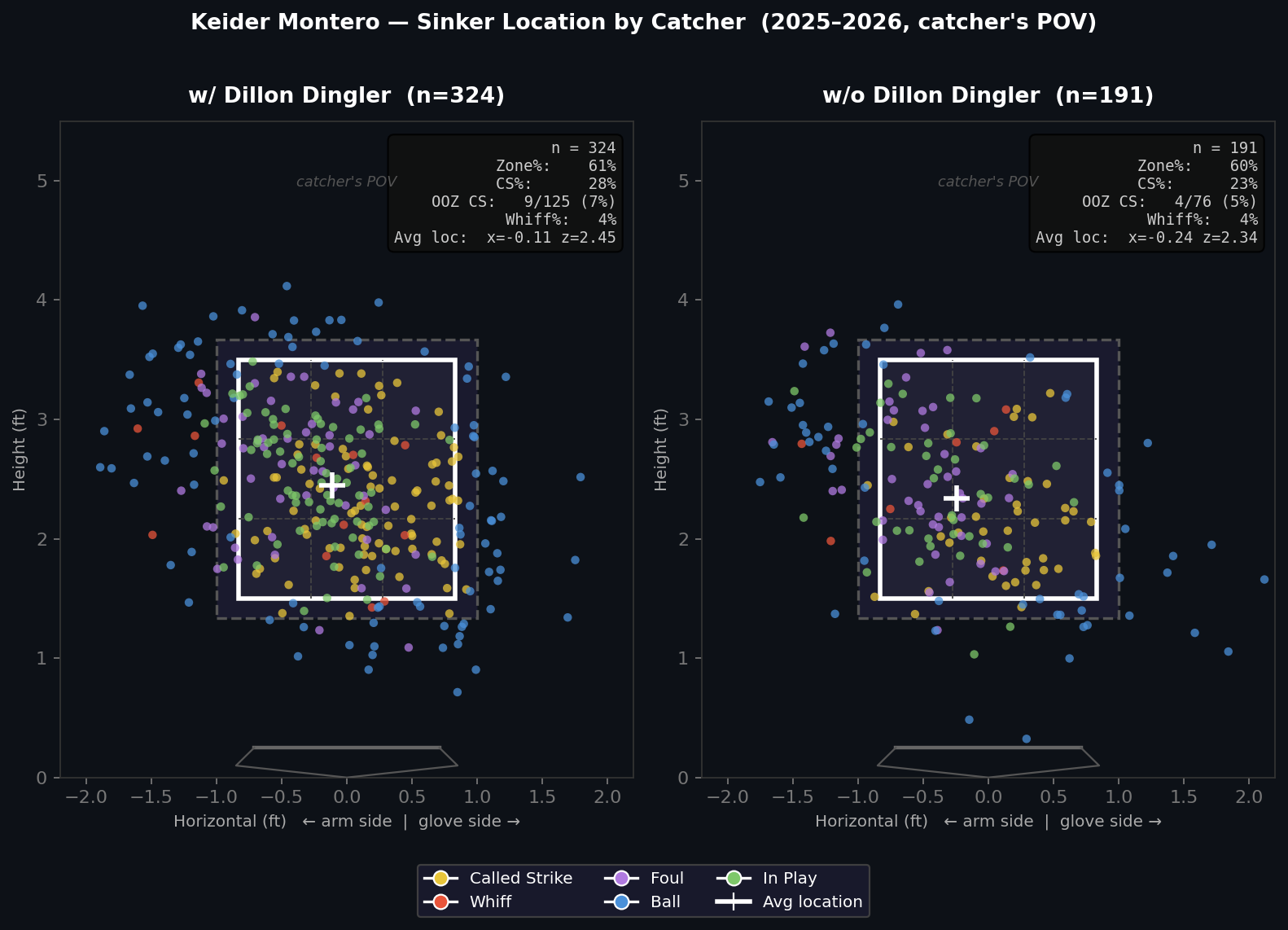
I plotted the sinker location to see if there were any patterns, but it looked pretty similar. Perhaps there is something in the pitch sequencing I’m missing, but I’m willing to say that when it comes to Keider Montero and Dillon Dingler, there isn’t anything special, and this falls into the more random fluctuation side.
Logan Gilbert and Cal Raleigh
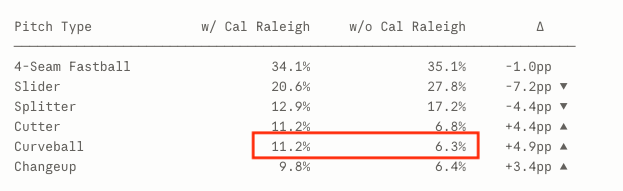
The thing that immediately stands out between Cal and Gilbert is the increased usage of the curveball:
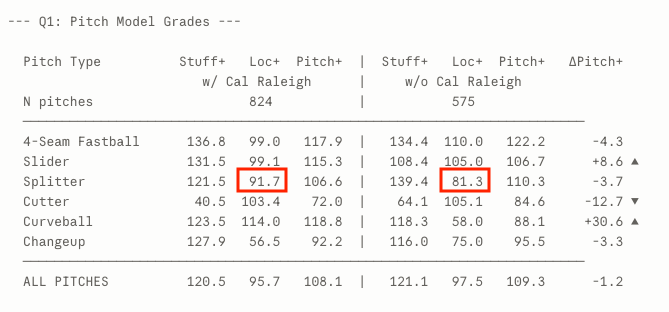
And also his improved Location+ on his splitter, the money pitch in his arsenal
Plotting both the splitter and curveball, a pattern emerges where he’s far more willing to throw the splitter higher and bury the curveball with Raleigh:
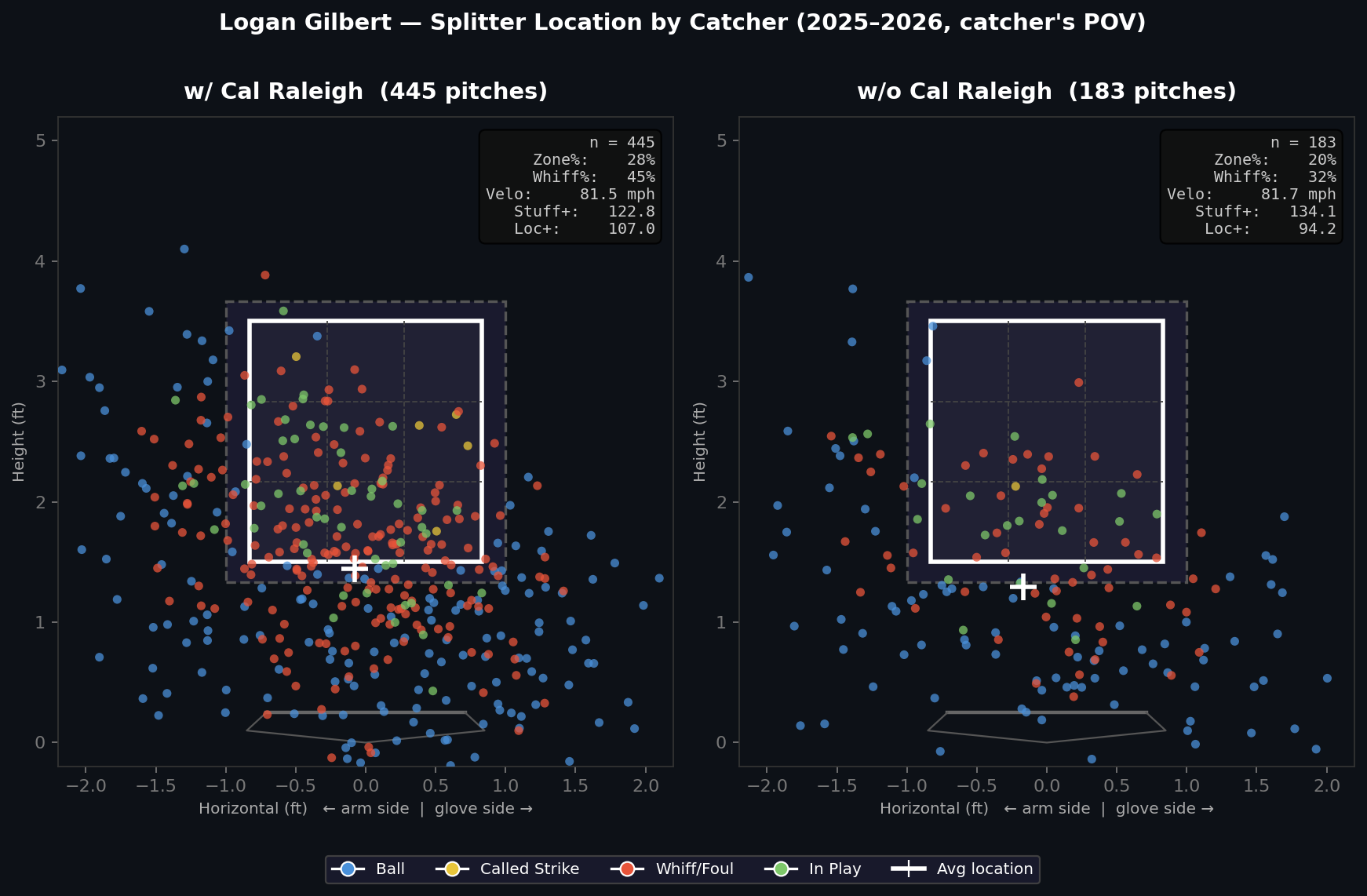
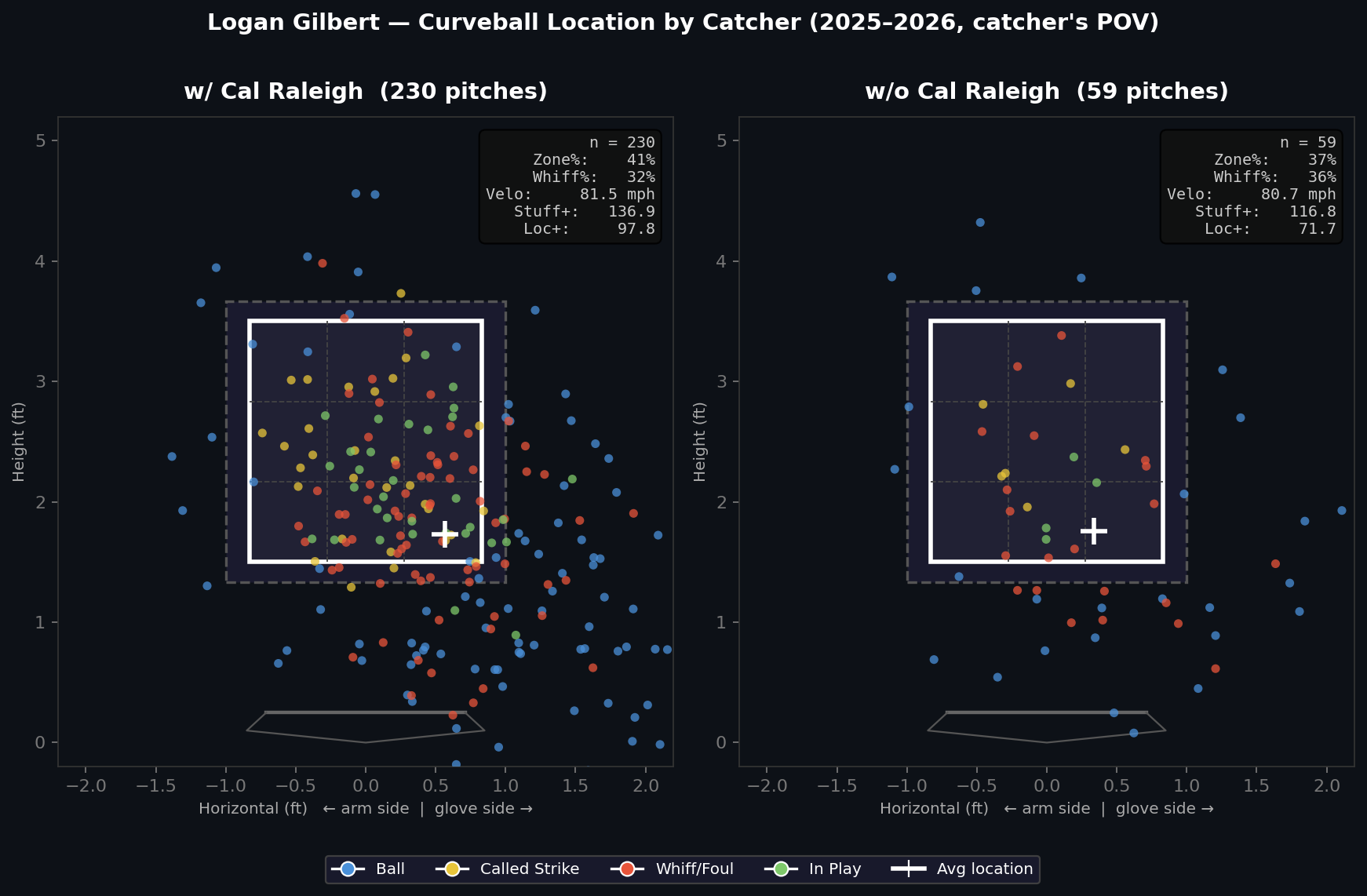
Perhaps this is the greatest indicator of the battery effect. There is an observable trust factor that goes into Logan Gilbert’s pitch location, depending on who he is throwing to. Splitters are trusted to be thrown high enough to induce a swing, while curveballs can be buried in the ground when he throws to Raleigh. It’s hard to dismiss all three of Logan Gilbert’s pitch usage, pitch grade, and pitch location all to random fluctuations that occur between combinations of pitchers and catchers.
Conclusion
Are battery effects random? Certainly not, there are observable differences you can spot if you look for them. Is it useful for fantasy? Possibly. I’m not sure if Cal Raleigh getting hurt again would make me want to sell high on Logan Gilbert, but it would certainly be a piece of data I would consider in the future.

What an amazing article. I am so impressed!
I need your Solomon advice. I can’t decide whether to offer a
2. two pitchers (Baz plus Cameron) to get Sonny Grey.
3.Just hold
If not Sonny Grey, can you please suggest a couple of SPs to try and get.
Have a great weekend!!