


Welcome to Stat Chat Season 2, where we’ll continue to search for the deeper truths behind baseball numbers. Last season we covered why left handed hitters get favorable strike calls, analyzing swing data from a pitcher’s perspective, sustainability of an insane pitcher debut, and a lot more. While the goal of these articles is not to provide fantasy baseball tips, I will always try to include at least one player name of note from what we uncover at the sandwichpick office.
For episode one, we’ll cover the return of major league baseball, sort of. The return of exhibition baseball, where stars take 70% effort swings for two at-bats before they leave to play golf somewhere in the Florida sun. Meanwhile, 32-year old non-roster invitees battle 22-year old career Double-A pitchers looking to leave an impression in the Arizona sand, while the baseball deprived fans half heartedly watch from their $15 seats that cost less than the supercharged Uber ride back to their Marriott Courtyards.
The return of baseball (in some form) brings back familiar numbers; Wins, ERA, batting averages, as I write this Elly De La Cruz is 5-9 with 5 XBH for a 2.000 OPS, and Charlie Condon is batting .600 (6 for 10). Of course, we disregard these numbers as being “just spring training”, but we shouldn’t throw out all numbers from spring training. This is especially true in 2026 because at this point, any competent fantasy player is working with projections of averages of projections, where someone with a super computer counted the number of nose hairs Hunter Goodman has to project what his ISO will be, and combined that with another super computer that calculated what his flyball rate will be based on the number of times he tapped his bat before an at-bat (thanks to Google Cloud). At this point, any extra intel we can get from Spring Training could be a decisive advantage come draft time.
One important note about this article: While I’ll be looking at these numbers to highlight a player, I generally avoid any spring training number to fade a player in a draft (unless there is some specific concern about injury or playing time). A player throwing a few mph slower in a spring training start really doesn’t say anything in an exhibition setting.
While most numbers from February and March won’t matter, here are some Spring Training numbers I will be keeping an eye on:
-
Velocity Increases (throwing the ball edition)
As players report to camp, we enter the “best shape of life” news cycle, where players tell the media they are somewhere between feeling good to great, or adding an impossible amount of muscle between November and February. The proof is in the radar gun, however, and more important than the result we see on the field are pitchers who are throwing harder than what we saw in 2025. Some notable examples below include (this only for 4-seam fastball):
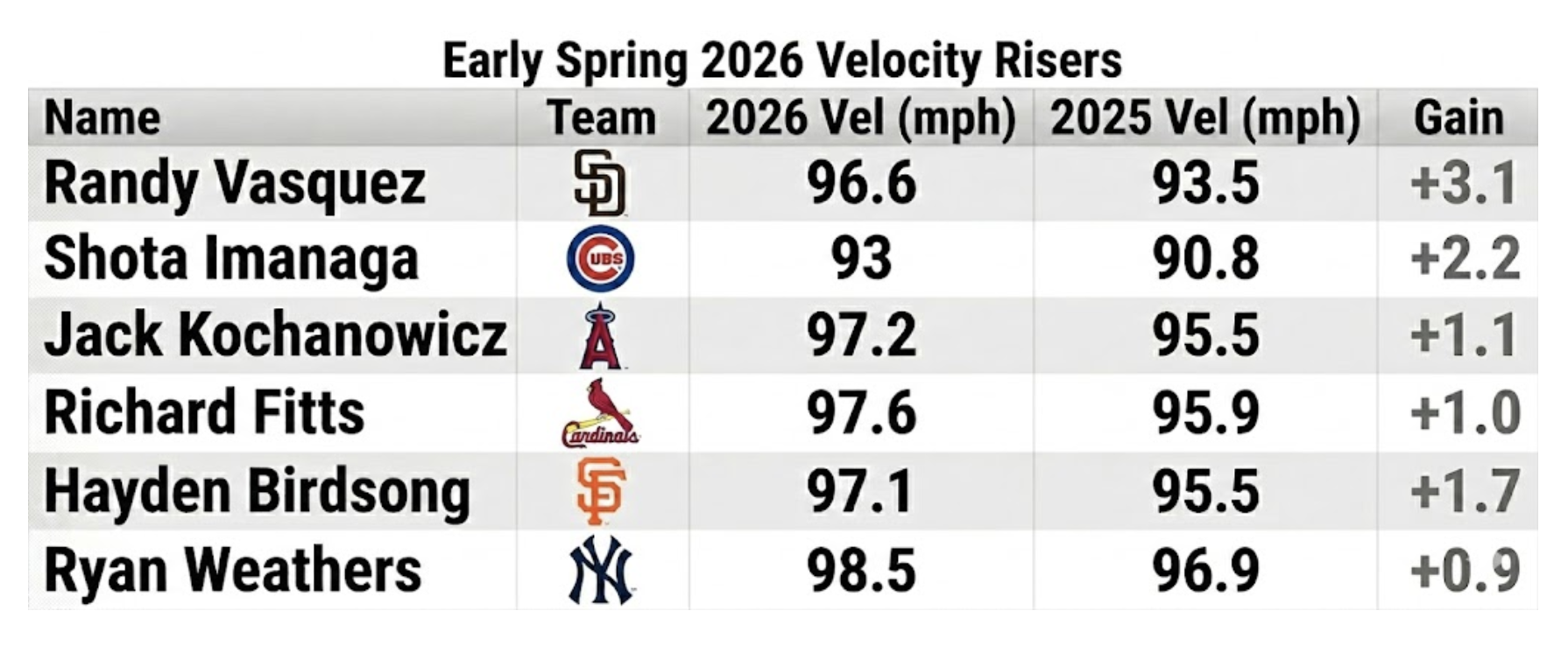
Couple names that especially stand out are Shota Imanaga and Ryan Weathers. Imanaga because he was once very effective, but turned into a doodoo factory where velocity decrease was cited as a factor, and Ryan Weathers because he is newly joining the Yankees this season, and there is a chance the team has “unlocked” something (and hopefully “unlocking” a new injury).
-
Stuff Grade Standouts
One of the hardest things to project in modern fantasy baseball is who will get the most Saves. In fact, Saves in general are so hard to come by, there aren’t enough reliable +30 Save guys for everyone at this point unless you play in a league with 8 or fewer teams:
![Bluesky Post Will Harris @sandwichpick.bsky.social One of the biggest differences in playing fantasy baseball now vs 10 years ago is there's literally not enough + 30 save closers for everyone in the league to even have one- [graph with +30 save seasons]](https://razzball.com/wp-content/uploads/2026/02/Screenshot-2026-02-27-at-5.32.05-PM.png)
With that, it’s become more important than ever to evaluate players based on pitching model metrics instead of their unreliable reliever ERA. I wrote an article last year covering this exact topic, and the convergence of Saves towards whoever has the highest Stuff+ on the team. So with that said, I’ve looked at Stuff+ grades (posted by @TJStats) from Spring Training, and compared those numbers against the model grades we already had on relievers from 2025, and pointed out several players who are not listed as “Closer” (or Co-Closer, Committee Closer, or any other designation there are in Roster Resource), BUT have the best or 2nd best Stuff+ in their bullpen.
- Mason Montgomery – Pittsburgh Pirates, Current Role: Middle Reliever, Spring Stuff+ = 117
- Mason Montgomery was part of the big Pirates three-team deal they swung with Tampa Bay and Houston. While Montgomery was electric in his debut with the gaudy stuff numbers, he struggled to find the zone and ended up with a high ERA and dealing with arm troubles. He’s flashed his high Stuff+ in spring again in 2026, and given the low grade by current presumptive closer Dennis Santana, Montgomery could be poised to grab the closer role for Pittsburgh that’s actually looking to be competitive in 2026.
- Grant Taylor – Chicago White Sox, Current Role: Setup Man, Spring Stuff+ = 114
- Grant Taylor was a 2nd round pick by the White Sox in 2023 and actually nabbed 6 saves (of the 25 the team had all summer) in 2025. His stuff graded poorly in 2025, but he has come out firing in 2026 with a ~100mph fastball. With Seranthony Dominguez the presumptive closer, there will be a lot of pressure for Grant Taylor to take over if/when Dominguez struggles or is traded.
- Yoendrys Gómez – Tampa Bay Rays, Current Role: Long Reliver, Spring Stuff+ = 109
- Gómez was part of a low-key trade between the White Sox and Rays over the offseason. Much like his former teammate Grant Taylor, Gómez has gone through a reinvention over the winter, throwing an extreme sweeper and high break changeup. While Gómez will have tough competition with Griffin Jax (109 Stuff+) and Garrett Cleavinger (111 Stuff+) in the same bullpen, he’s still a name to keep an eye on.
-
Velocity Increases (hitting the ball edition)
While hitting the ball really really (really) hard once, doesn’t make you a superstar (just ask Daniel Palka and Franchy Cordero), a young prospect doing so gives us an idea of the hitter’s potential power ceiling. It’s better to know a player can hit the ball +115mph as opposed to it being an open question. With that said, an increase in a player’s max velo in spring is always a positive indicator that the player may have actually gotten stronger (as opposed to trusting their “I’ve put on muscle” comments) or that they are at least healthier they previously were.
Some of the max velocities we’ve seen from players so far in spring:
- Gabriel Moreno – Arizona Diamondbacks, new max velo = 111.8mph (previous high = 111.1mph)
- Gabriel Moreno comes into this season after a disappointing 2025 where he missed most of the season due to a fractured finger. His new career max indicates he’s healthy and looking for a big bounce back (currently ranked 14th best catcher by ADP).
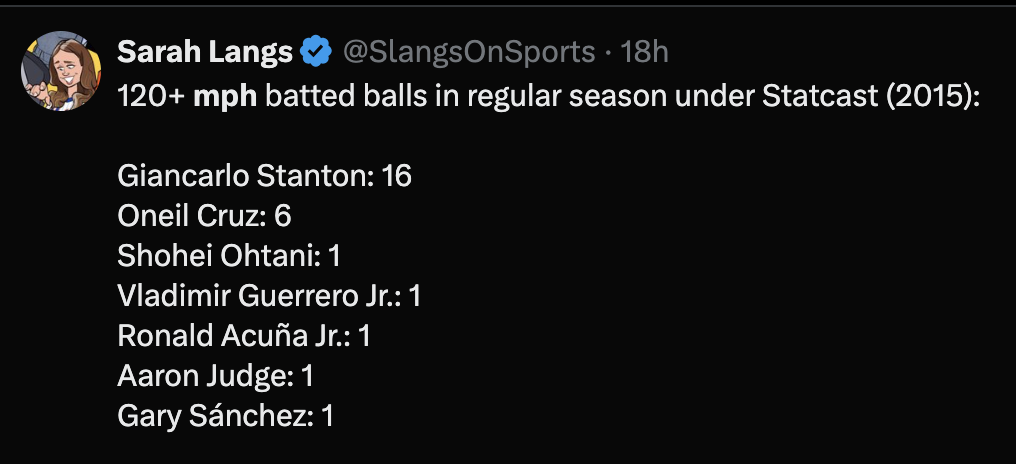
- Jac Caglianone – Kansas City Royals, new max velo = 120.2mph (previous high = 114.4mph)
- While it has never been a secret that Caglianone can hit the ball hard, the fact that he was able to crack the 120mph barrier puts him in rarified air.
- Zac Veen – Colorado Rockies, new max velo = 113.3mph (previous high = 109.2mph)
- This is a case where the self assessment and numbers agree (somewhat). Veen showed up to camp claiming to have undergone a body transformation and the results have been apparent as he has hit the ball harder than he has in a regular season game (both minor and major).

Veen is a good story!
Carson Whisenhunt has added velo, changed his mechanics, and added a cutter he learned from, I think Verlander or Webb. Someone good.
Good to see guys know they aren’t making the cut and doing something about it!
Yes, keeping an eye on Veen! Looks he’s put on some big time muscle.