

The Moment of Zen:
Today, I find myself thinking about the Ensō circle. The Ensō, translated roughly as a “circular form,” is a complex and absolutely essential symbol in the world of Zen. According to Buddhist nonprofit group Lion’s Roar, this circle helps us see the truth of “buddhanature” (a nature which we all possess, according to Buddhist thought) as it is “[n]either large nor small, neither wide nor narrow, neither good nor bad, neither transient or eternal.” It relates to the Buddha because he was considered to be “a circle like vast space, lacking nothing, nothing in excess” (https://www.lionsroar.com/what-is-an-enso/, quoted from the Shinjinmei).

Image from https://www.lionsroar.com/what-is-an-enso/
The Ensō fascinates me largely because it has so many meanings to parse. As I understand it, this “Zen circle” can represent enlightenment, nothing (or zero), a wheel, presence, absence, or harmony, among a number of other possible meanings. And, as an incomplete circle (notice the circle isn’t closed), the Ensō is often connected to the idea of wabi-sabi, which is an awareness and appreciation of how beautiful imperfection can be.
The symbol serves as a reminder to me that, yes, I am imperfect (I don’t so much need a reminder of that!). And that being imperfect is actually the way I’m supposed to be (I do need that reminder). Understanding the “okayness” of imperfection isn’t easy for many of us – it feels counterintuitive. But finally coming to acknowledge the acceptability of imperfection has allowed me to fail. Not that I want to fail, of course, but in prior years, my fear of failure would keep me from doing the things I wanted to do because I wasn’t willing to risk not being good at it. How small the world can be when we will not allow ourselves to fail. My world of experience is so much larger now.
How in the world does this apply to fantasy baseball?
Baseball is a game of failure and imperfection. The best of the best fail almost 7 of every 10 times they get up to bat. The greatest pitchers in the game give up homers on a regular basis and, from time to time, even get shelled. Fantasy baseball is also a game of failure. I’ve certainly never drafted a perfect roster, even in leagues where I’ve had success, and I suspect no one reading this article has drafted a perfect roster either. As I’ve written about before, a good fantasy team is one in which probably a full quarter to a third of the team is continually churned in the FAAB process. Guys are going to fail. We fail when we draft those guys, or when we cut players who later turn out to have great seasons.
So, if failure is such a large part of the game, both in baseball and in fantasy, why are we so quick to give up on players who have had success previously but who have had recent failure? Players are complex, like the Ensō. They are humans with emotions and flaws and hot streaks. But as fantasy managers, we are vicious with those on our roster who show too much imperfection. “Rage” and “spite” drops happen all the time. And we are slow to forgive a player who we feel dragged our team down. On some level, our emotional response is completely understandable, maybe cathartic. But it’s also often kind of dumb.
On that note, here is a player that I think we may have given up on too early, instead of recognizing his complexity and imperfection and the possibility that he might bounce back. I know I did, and now I’m beginning to think that giving up on him so quickly qualifies as being on the “dumb” side of things.
Anyone who thought Michael Conforto was completely washed after last year’s disastrous year with the Dodgers had plenty of good reason to think so. His .199 BA was frightening, and his 12 HR in 486 PA (down from 20 HR in 438 PA just the season prior) wasn’t exactly comforting. But, amidst our disappointment and anger over the damage he was doing to many of our teams, it was easy to miss a simple fact: some of his underlying numbers suggested that bad luck was also playing a significant role in what many of us perceived to be decline-related failure.
In 2025, while his Barrel% was down below 10%, his hard hit metrics were fairly stable. Especially his HH% (down to 44% in 2025 from 45.8% in 2024) and his maxEV (112.9 mph in 2025 compared to 113.6 in 2024). Though both of those numbers were slightly down, they certainly weren’t indicators of a player whose skills had collapsed, and his 74 mph bat speed was 77th percentile. He also had an extremely strong BB% (11.5%, 84th percentile) and K% (only 23.3%, 81st percentile). His contact metrics were consistent with the previous season’s, and his CSW was actually better than 2024’s. Yet, the results didn’t show it, and for most of us, the bad numbers were enough reason to think Conforto’s days of fantasy relevance were in the past.
But flip to 2026, and his baseline results have changed significantly this year. In fact, just about everything this year for Conforto is better than last year (even though last year’s underlying numbers were, well, pretty Michael Conforto-like). While his bat speed has dipped a few tenths of a mph, he is hitting the ball harder and with better quality of contact. Though he doesn’t have enough PAs to qualify for MLB leader lists, his EV is a robust 95.1 mph (up 5 mph from 2025) – an EV that, by the way, would rank Conforto as third in MLB if he had enough plate appearances to qualify. His HH% is a ridiculous 55.6%, and his launch angle suggests he’s aiming for homers (this year, his LA is 18.8°, compared to 12.9° in 2025). His overall Contact% and CSW% have both gotten worse this year, but based on his other metrics would appear to be worse by design – he’s almost certainly sacrificing contact for more power.
Unlike last year, though, so far, the results have also been there: While given only 76 PA to this point, he has a .302 BA with 3 HR, 11 R, and 11 RBI. Do the extrapolation game, and we see Conforto on pace to hit 26 HR with 94 R/RBI over a 650 PA season – not bad. Some other numbers have my interest as well, particularly his 4% increase in what was already a strong BB%. Conforto’s red-filled Statcast page tells us what his performance has been like so far:
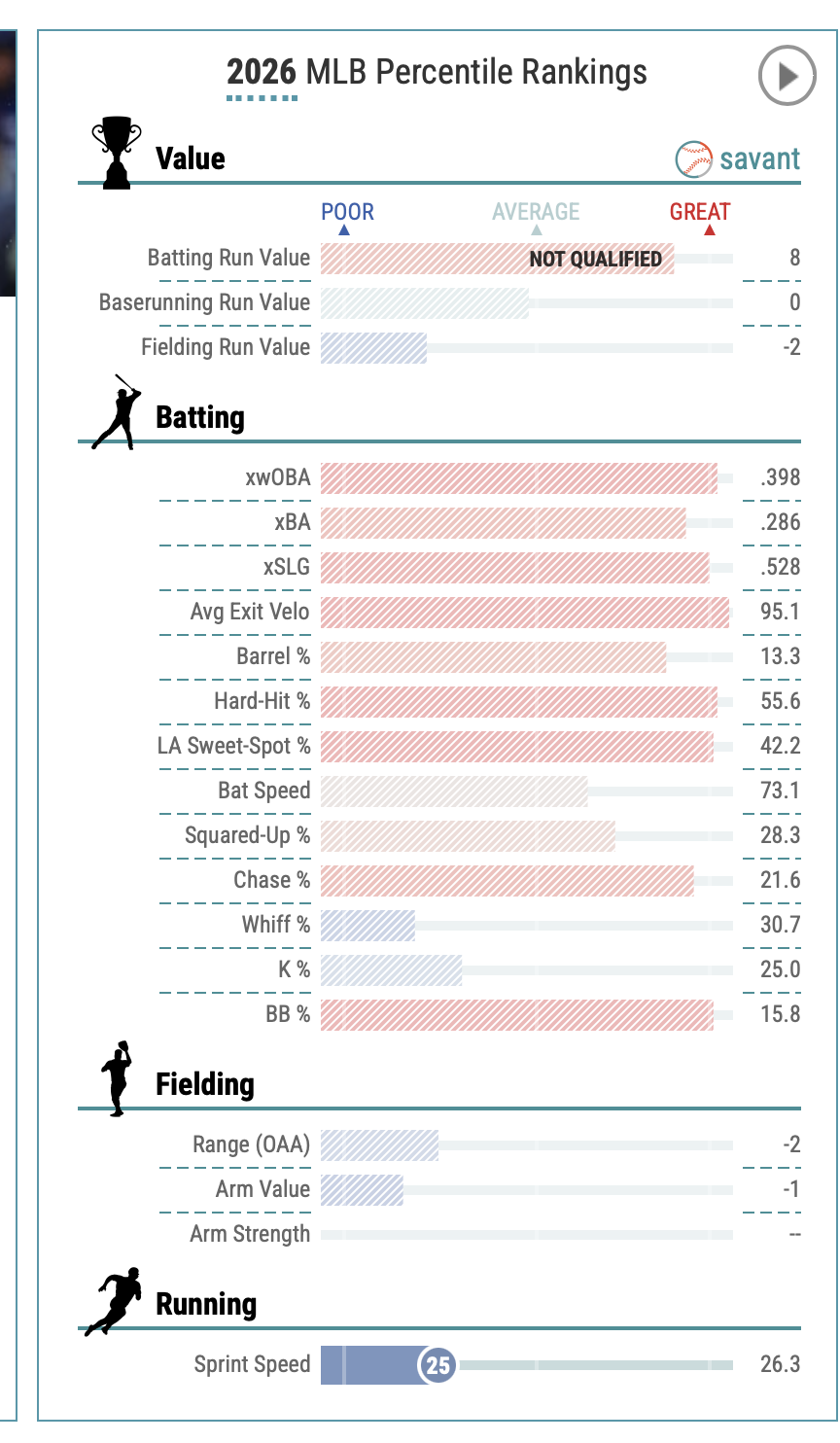
His Statcast page also shows his problem: he hasn’t gotten enough PAs, which is why all of his red bars are shaded pink. That problem is, however, quickly becoming less of a problem. Though he had only 41 PAs through May 6th, he is playing much more frequently now, racking up 35 PAs in the team’s fifteen games since. With the increased play, he has held his own to be sure: he has a .300 BA (9 of 30) with 2 HR, 5 R, 5 RBI, and strong plate discipline (22.9% K%, 14.2% BB%). He also has been working from the heart of the Cubs’ order – in his nine games started of the team’s fifteen games since May 6th, he has been in the 2-hole (3 times), 5-hole (1 time), or 6-hole (5 times).
Conforto is very much a platoon player (he has 4 PAs total vs. LHP this season), so he isn’t shallow-league worthy unless in a daily lineups league or during a week when the Cubs face lots of RHP (like, for instance, the week of 5/25-5/31 when the Cubs are scheduled to face six RHP in the team’s seven games). But Conforto is a great streaming option in deeper leagues, and he is widely available even in high stakes leagues. As I work through FAAB today, I’m picking him up everywhere I can.
It may be that Conforto’s good play will come to a screeching halt, and he’ll go back to last year’s not-so-great player. But I’m willing to believe that last year’s failure wasn’t a sign of a player who has reached the end of the line, but just a guy who had a bad year. Let’s hope so.
Until next week. –ADHamley
