

Early into the offseason Tom Tango brought up the idea of the bayesian strikezone, where the quote “strike zone” exists on three levels; The actual rulebook strike zone, what the umpire calls, and the implied strike zone based on what the batter offers at. The third only exists in theory, since every batter would have a different strike zone, and it’s not something we actively track or cover.
To mentally illustrate what the implied strike zone means, picture it’s the third inning and a batter steps up to the plate with a reputation for always swinging on inside pitches. The umpire has been calling a decent game, maybe a little tight on the lower half of the strikezone. On a 0-2 pitch, the batter takes an inside pitch, a pitch the umpire has been calling all game as a strike (and also is a rulebook strike), but the umpire quietly stands up! The catcher looks back, confused, and there’s a confused murmur in the crowd. The umpire thinks, “this hitter is known for hunting inside, so if he didn’t swing, then it must have been too inside.
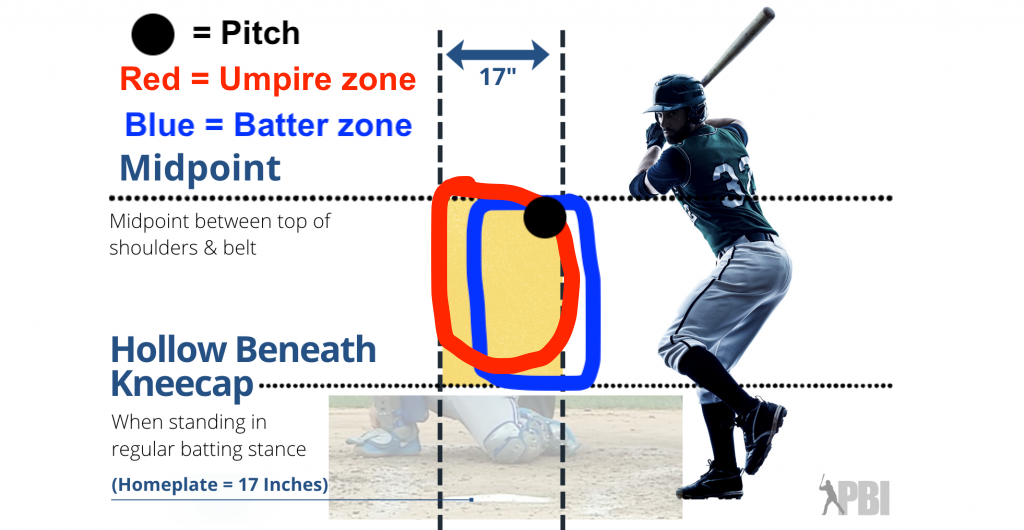
(2026 Update: the catcher taps his helmet and the batter is called out by ABS, but anyways)
The example is just a hypothetical to show that there is an influence on the called zone that the batter is making. I’ve extensively covered the different ways called balls/strikes can be influenced last season, and while they were all factors that were relating to factors that affected the umpire themselves, I did not consider the idea that the batter himself could be influencing their strike zone positively or negatively. So in this post, I was going to take a deep look at called strikes/balls vs what the hitter swings at.
The easiest way to study this is to go straight to the extremes. Let’s pull up the +400 PA leaderboard from 2025 and look at the highest and lowest ends of the O-Swing% leaderboard (outside zone swing rate). In the red corner, we have Javier Baez and Yainer Diaz, the biggest chasers in the big leagues, in the blue corner, we have Trent Grisham and Juan Soto, two of the most patient hitters in the majors last season. Thanks to the new Heat Maps Pivot tool on Fangraphs, we can visualize just how much these 4 players swing:
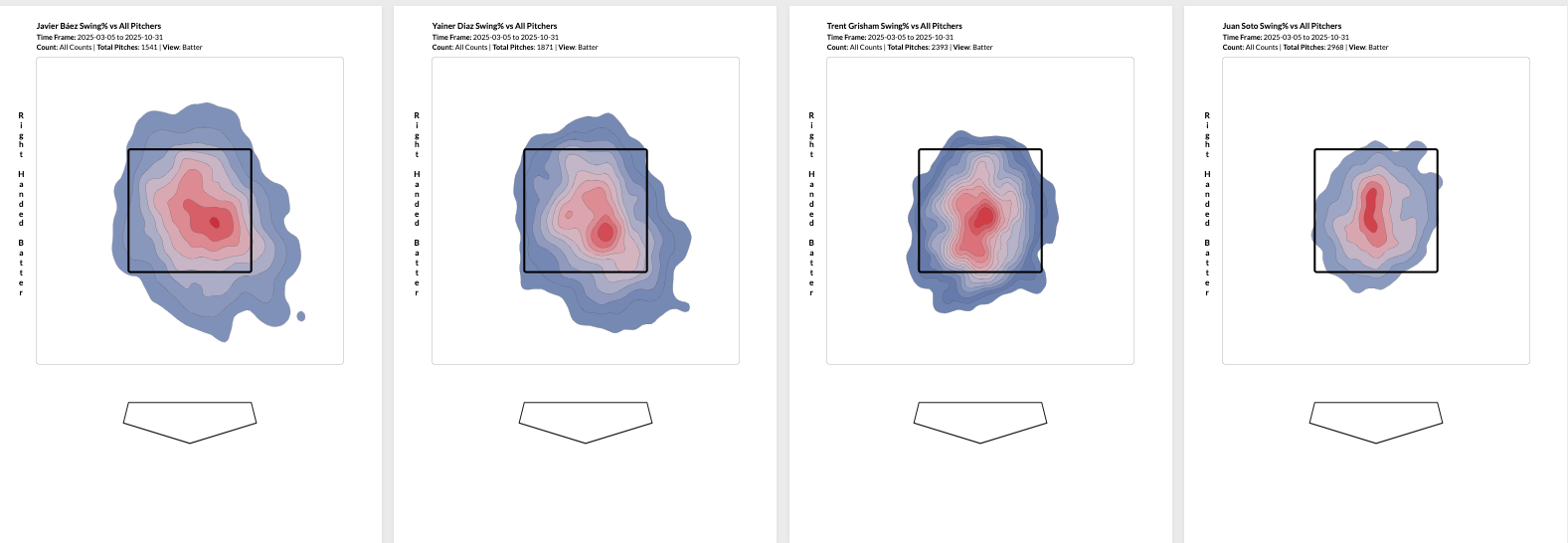
If it was apparent right away, we have Baez and Diaz on the left, Grisham and Soto on the right. The perspective is of the catcher, so the big blue tail on Baez is him chasing breaking balls going away from him (like he loves to do). Meanwhile, Soto’s heatmap is a work of art, look at how concentrated his swings are to the center of the plate and quickly fades to white around the edges of the strike zone. Not only does he never chase, he doesn’t even swing if it’s going to be *close* to a ball.
Now we are going to show a heatmap that is “called strike%” instead of “swing%”, so this is showing the % pitches taken that are called as strikes (in the same order as above, from left to right Baez / Diaz / Grisham / Soto);
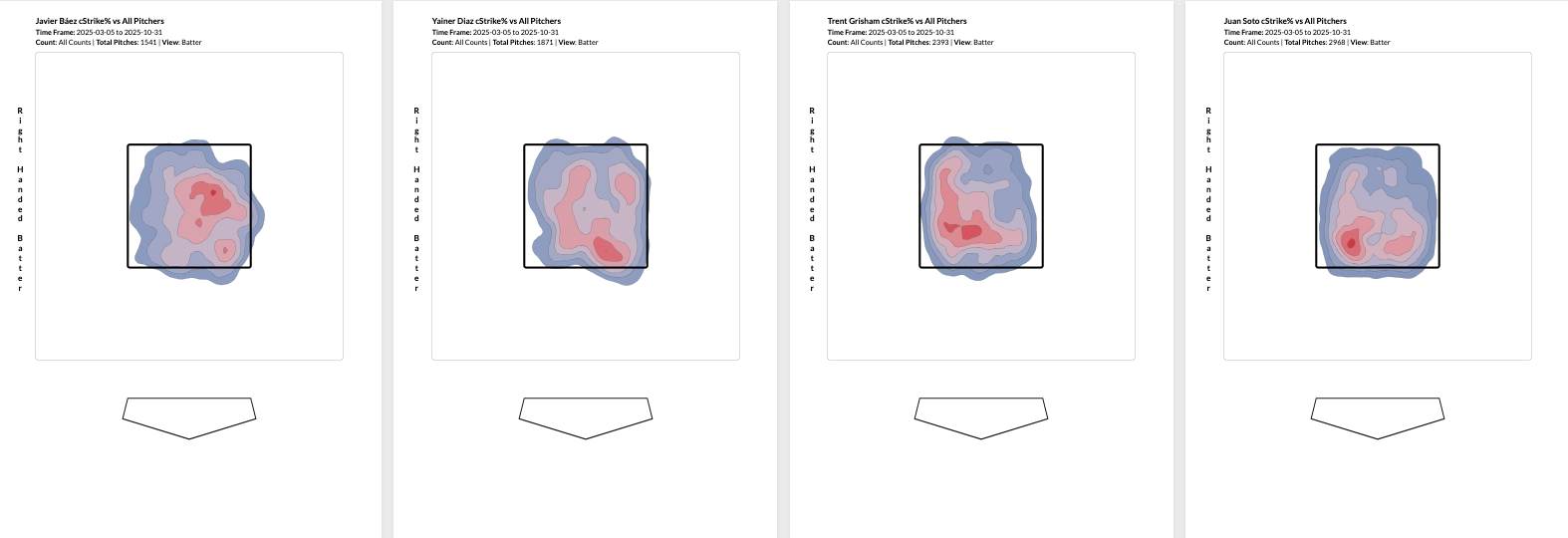
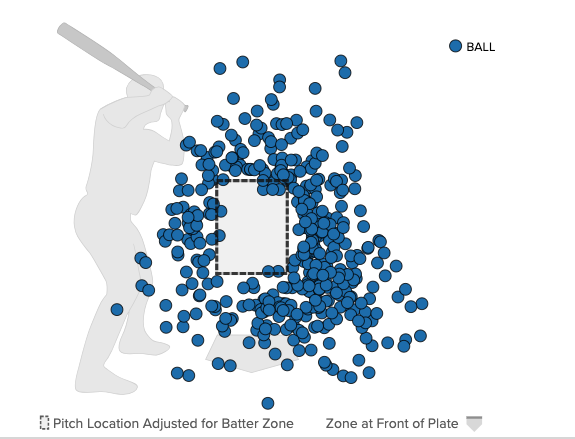
It’s hard to tell, but I want dear reader to focus on the amount of blue Javier Baez has around the red circle in the middle, and that patch of white you see on the top right corner of the zone? I assumed that was just missing data because he never not-swings at that spot, but in fact those are called balls he gets. Look at the concentration of blue dots in that corner and these are just in 2025!
So looking at this visual evidence, I wanted to see how Swing% affects the % of times a player gets a pitch in the strike zone called a ball. In this case specifically looking at that right top corer, I filtered for specifically Zone 3 (the top right corner) to see if Javier Baez shows a correlation between hitters who chase a lot and here is the scatter plot showing relationship between how much of a “chaser” a hitter is, and how often a pitch thrown in that top right corner is called a ball (Javier Baez is 24th highest of 240 hitters with +200 PA):
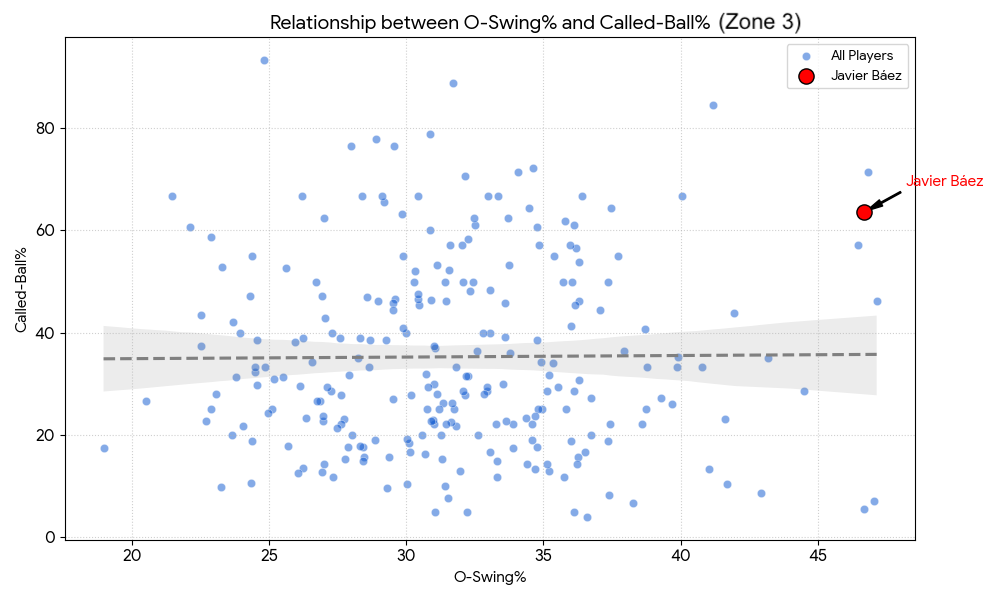
Javier Baez certainly stands out in that corner, but unfortunately, there is not a straight forward relationship here for us to discover. Perhaps we need to hyper focus on certain spots where a hitter *always* swing that will suddenly be called a ball if they suddenly take the pitch? There’s more work to do here, and I’ll return to this in a future edition of Statchat
