

George Kirby was supposed to be a safe pick, the kind of guy who doesn’t walk anybody and quietly finishes as your SP2 while you spend your attention elsewhere. Instead, he’s posted a 4-ish ERA and has been a confounding spot on your roster, unsure if you need an upgrade or just more patience. The frustrating part is that his pitch models say nothing is wrong. Pitching+, which grades stuff and command together on a scale where 100 is average, has him at 112, 110, and 111 over the last three years, and Location+ says his command is as sharp as it’s ever been. Meanwhile, lefties have a .333 weighted on-base average (up from .319 last season), and righties have an above average .315 wOBA (up from .278 last year).
The overall arsenal still seems to be okay for Kirby, so what’s caused the collapse this year?
What The Models Don’t Know
Before getting to the new thing, it’s worth exploring a blind spot in pitch grading.
Stuff+, Location+, and Pitching+ all look at what a pitch physically does: how hard it’s thrown, how much it moves, where it ends up, how it plays off the rest of the arsenal. What none of them ask is who was standing in the batter’s box. A slider moves the same whether a righty or a lefty is watching it, so it grades the same either way, and then everything gets averaged into one season-long number. If a pitcher is essentially two different pitchers depending on handedness, that grade hands you the blend.
I looked at every starting pitcher since 2024 with at least 150 batters faced (BF) from each side of the plate, and Stuff+ tells you nothing about how much worse a guy will be against batters from each side of the plate. Comparing the highest-rated pitchers against the worst-rated pitcher, you will see no correlation between “platoon issues” and a starting pitcher’s model grades. The best pitchers in baseball aren’t less vulnerable to opposite-handed hitters, they’re just better against everybody.
So the grades won’t tell you whether a pitcher has a handedness problem. Something else has to.
Measuring Pitching Chaos
Every pitcher changes his plan depending on who’s in the box, since a righty’s slider is a weapon against a right hadned hitter, but a mistake against a lefty. What I wanted to measure was how much a starter had to change. Take a pitcher’s pitch mix against a same handed batter (SHB), meaning righty-on-righty or lefty-on-lefty, and compare it to his mix against an opposite handed batter (OHB). Some guys throw essentially the same five pitches to everybody. Others turn into a different pitcher entirely: two pitches to their own side, then a scavenger hunt through the arsenal when the advantage flips. I’m calling that difference the Approach Entropy Gap. Positive means he spreads it around more against the other side, negative means he narrows down.
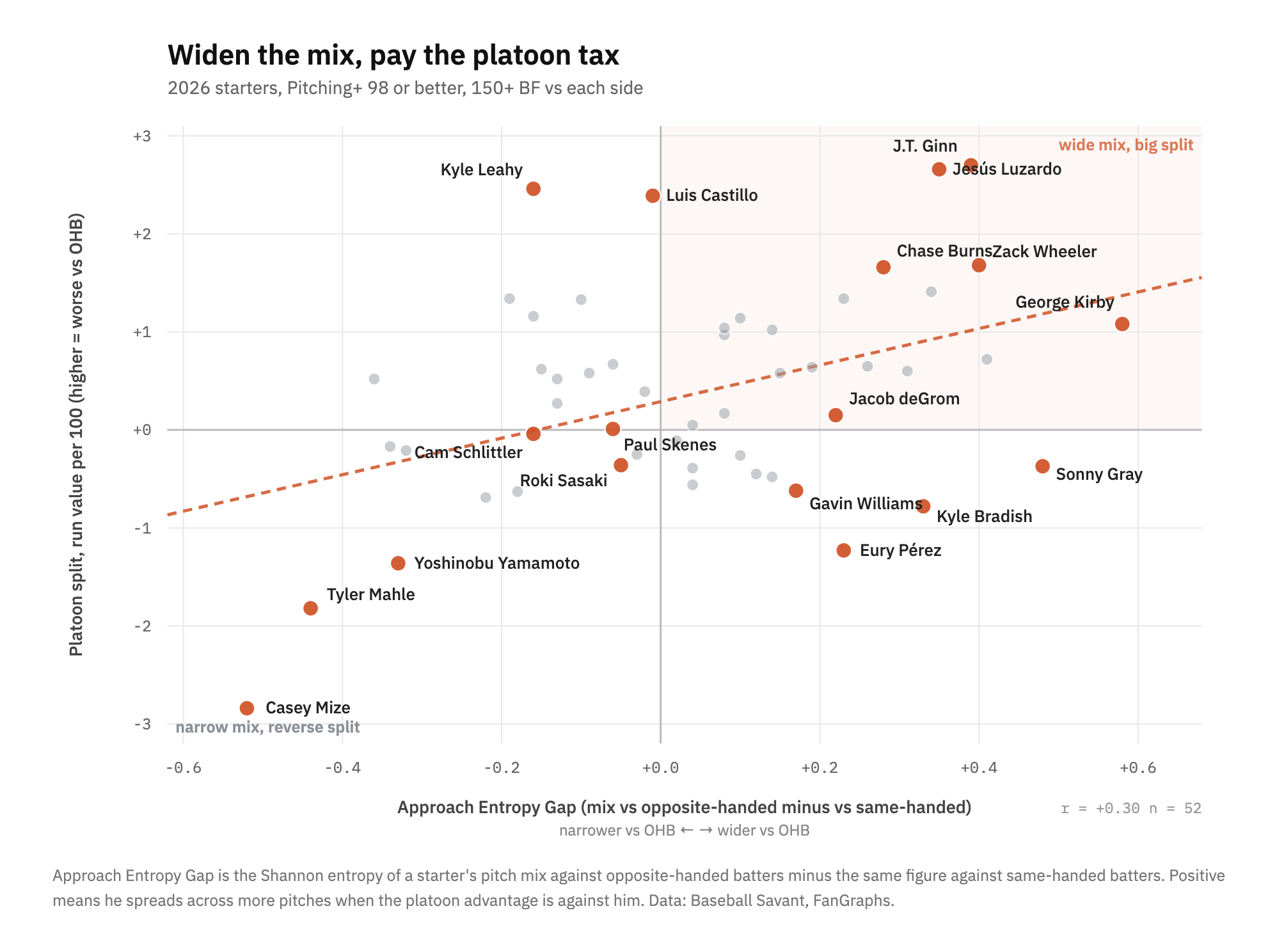
What the Gap Is Actually Telling You
My first instinct was that a wide gap means a pitcher is in trouble against the other side. It’s more specific than that. Wide-gap pitchers are notably better against their own side, and no worse than anyone else against the opposite side. The gap predicts platoon splits almost entirely through the strong side. It isn’t finding pitchers who are bad against lefties, it’s finding pitchers who are elite against righties.
The mechanism is straightforward once you see it. A pitcher with one platoon-dependent weapon, usually a sweeper or a slider, leans on it constantly against same-handed hitters, which is a narrow mix and a lot of dominance. Against the other side, that pitch is useless, so he shelves it and spreads out over whatever’s left. The gap isn’t measuring whether he has a plan, it’s measuring how much of his success is tied to a pitch that only works against one side of the plate.
Zack Wheeler is the poster child. He has one of the widest gaps in baseball and one of the largest platoon splits, which sounds alarming until you look at the levels instead of the difference. He’s in the 98th percentile against righties and the 71st against lefties. He doesn’t have a lefty problem, he is Roger Clemens against righties, and only Johnny Cueto against lefties.
There’s still a real cost, and it shows up somewhere I didn’t expect. You’d assume a pitcher without his best weapon gets hit harder, and league-wide that’s what drives platoon splits. But the gap tracks walks about as strongly as it tracks contact. Walk rates against the other side jump 4.1 percentage points for Kirby, 5.7 for Wheeler, 6.8 for Chase Burns and 8.0 for J.T. Ginn, against a league average of 2.2. The pitcher spreading across five pitches they don’t fully trust aren’t getting barreled, they’re simply nibbling around the strike zone.
So What’s Wrong With Kirby
Kirby has the second-widest gap in this year’s pool, which should come with a dominant strong side, but instead righties are hitting .279 off him. Everyone else near him on the leaderboard is either overpowering their own side (Wheeler, Ginn, Jesús Luzardo are all at or near the top) or a pitcher nobody expected much from: Kumar Rocker, Andrew Abbott, and Bryce Elder, Kirby is the only well-graded starter throwing a mix this scattered without the dominant strong side that’s supposed to justify it.
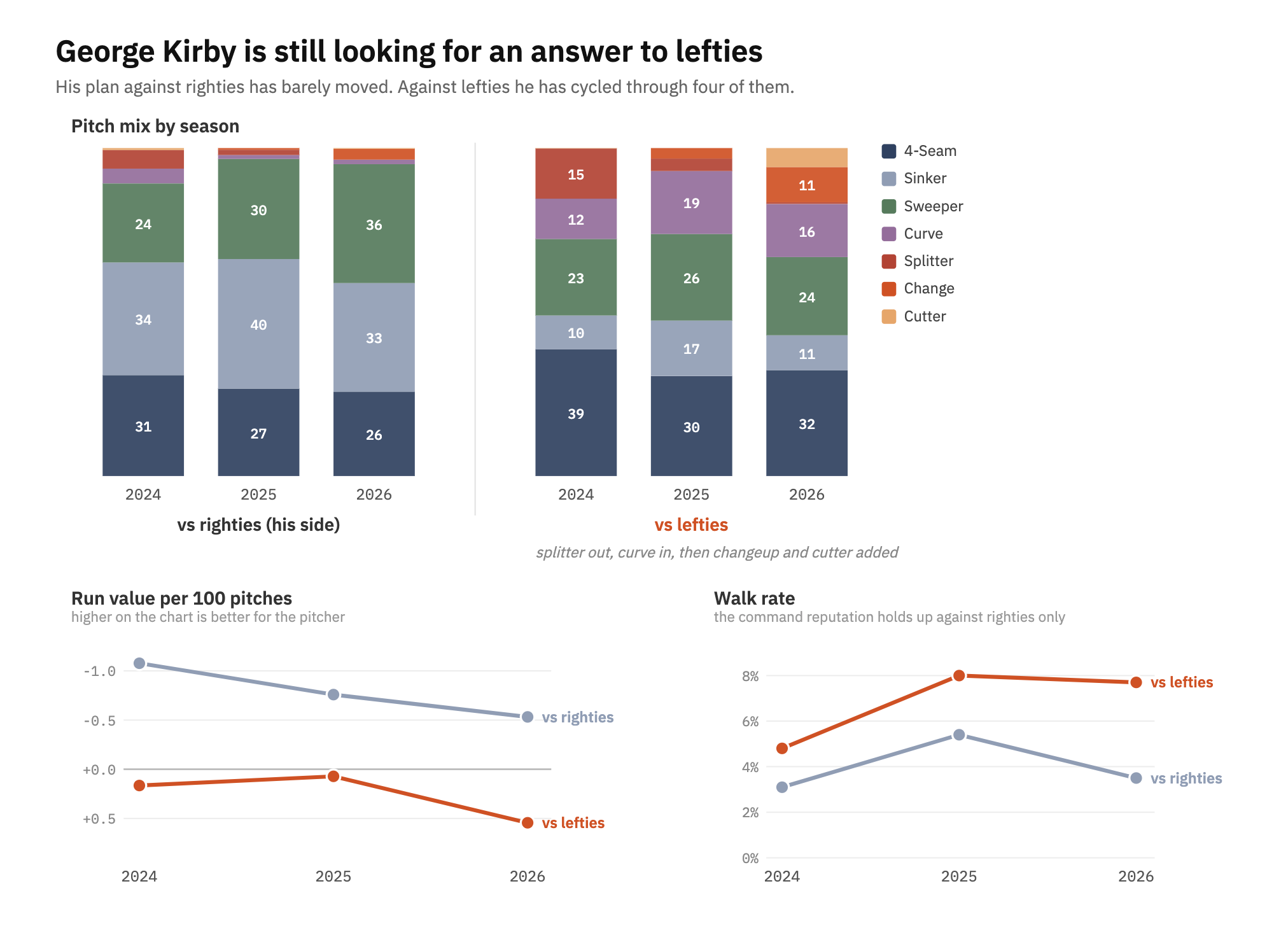
The history explains how he got there. His splitter was already a problem against lefties in 2024 and got worse in 2025, so he correctly shelved it. What’s happened since is his search for a new approach. The curveball took over in 2025 and worked, then stopped working this year as its whiff rate fell from 37% to 22%. So he added a changeup, which has been mediocre, and a cutter, which is the one pitch actually working against lefties, but he only throws 6% of the time.
That’s four different answers to the same question in three years, and his command shows what it costs. His zone rate against lefties has fallen from 53% to 49% while holding flat against righties, and he falls behind lefties 27% of the time now. The guy whose entire identity is pounding the strike zone still pounds it, just not when a lefty is up.
If you’re looking for a reason to stay interested, the cutter is it. It’s the only thing that has worked against lefties in three years, and it’s barely being used.
Where This Breaks
Plenty of pitchers have a wide gap and no platoon problem at all. Sonny Gray has the third-widest gap in the pool and is better against lefties, as are Kyle Bradish and Eury Pérez. That’s the other three eighths of those matched pairs, and it’s a lot of pitchers. The misses also aren’t evenly spread: when I looked at the pairs that went the wrong way, Frankie Montas and Cooper Criswell accounted for six of the ten worst, so there are probably other factors that work into what causes a pitcher to have high entropy.
Who’s Next
If this is worth anything, it should let you spot the next one before the ERA catches up. So I screened for the Kirby shape: a wide gap, already below average against the other side, sliding against their own side compared to last year, and still carrying a Pitching+ of 100 or better. Sixty starters qualified in both 2025 and 2026, and two cleared all four conditions. One of them was Kirby.
The other is Will Warren, and he’s further along than Kirby is. His Pitching+ is 111.3, a hair above Kirby’s, so the models like him just as much. But he’s at the 21st percentile against lefties, and against righties, the side that’s supposed to be paying for all that improvising, he’s fallen from the 58th percentile to the 29th in a single season. That’s a steeper one-year drop than Kirby has managed in three. He was also the wide-mix half of matched pairs against Nick Pivetta and Kevin Gausman last year, both of whom handled the other side better with nearly identical grades.
One last pitcher to talk about is Sonny Gray, who is 14-3 with a 2.79 ERA, one of the best seasons of his career at 36, and none of what follows is a prediction that it collapses tomorrow. But his Pitching+ is 101.5, and his Stuff+ is 101.2, which is to say the models think he’s been ordinary, and his wOBA and xwOBA agree with each other at .297 and .298, so it isn’t a batted ball mirage either. What’s carrying him is unusual. He’s in the 83rd percentile against lefties and the 49th against righties, which means a right-handed pitcher is getting his value from the side he’s supposed to struggle with. His approach gap also jumped from +0.01 last year to +0.48 this year, one of the biggest one-season moves in the pool, so this improvising is new.
The concern isn’t that Gray is bad. It’s that there’s nothing underneath him. Reverse splits are less stable year to year than ordinary ones, and when his lefty numbers drift back toward normal, the floor he lands on is a league-average performance against righties. Kirby’s problem is that the strong side stopped paying, Gray’s problem is that the strong side isn’t the one doing the paying.

Very interesting research! Walk rate by platoon seems especially telling and useful…
Do you have access to older data, say, for example, to see where Greg Maddux falls in the graph, or any of the great pitchers who seemed to have book on every player, not just RH vs LH. (Maddog threw mostly 2-seam FB and sinkers but added more cutters vs LH batters. I guess he’d be wide mix.)