

April always gives us a few breakout stars. By May, the real challenge begins in finding out who is next to make a big leap in performance. This season has already delivered plenty of surprises. Veterans, like Mike Trout, left for dead, are suddenly producing elite numbers again. Young hitters, like JJ Wetherholt or Kevin McGonigle, are arriving with immediate impacts. This week, our Hitter Profiles are going to go underneath the box scores, looking for clues pointing toward what comes next. Bat speed gains. Launch angle changes. Chase rate improvements. Some players are building legitimate skill growth while others are riding unsustainable heaters fueled by bloated HR/FB rates. Sometimes the next breakout is hiding in a hitter with a .240 average but elite contact quality. The goal is to identify tomorrow’s stars before the rest of the league catches up. So let’s dig into the underlying data, separate noise from skill, and uncover where the next surprising surge could be coming from.
JJ Bleday
JJ Bleday is starting to look like one of the more interesting early-season waiver finds in fantasy baseball. Over the last two weeks, the underlying metrics have been elite across all of MLB with top-20 exit velocity, 13th in barrels, and eighth in hard-hit rate. That quality of contact has translated into production, with a .375 expected batting average, four home runs, and an even walk-to-strikeout ratio during that stretch. When Bleday is controlling the zone like this, the former No. 4 overall pick suddenly starts to resemble the hitter prospect evaluators dreamed on coming out of Vanderbilt. The opportunity is lining up, too. Since arriving in Cincinnati following the Eugenio Suárez injury, Bleday has not only forced his way into everyday at-bats, but also climbed into the two-hole directly in front of Elly De La Cruz. That lineup spot could be massive for fantasy value if it sticks. Hitting ahead of one of baseball’s most dynamic run producers creates a path to plenty of runs scored, while pitchers may be less willing to nibble with De La Cruz looming behind him. The Reds have clearly taken notice with recent reports around the club suggesting Cincinnati views him as the best current option between Friedl and De La Cruz because of how well he’s swinging the bat. The playing-time outlook also improved recently after the club optioned Rece Hinds back to Triple-A, leaving Bleday with a clearer runway for starts.
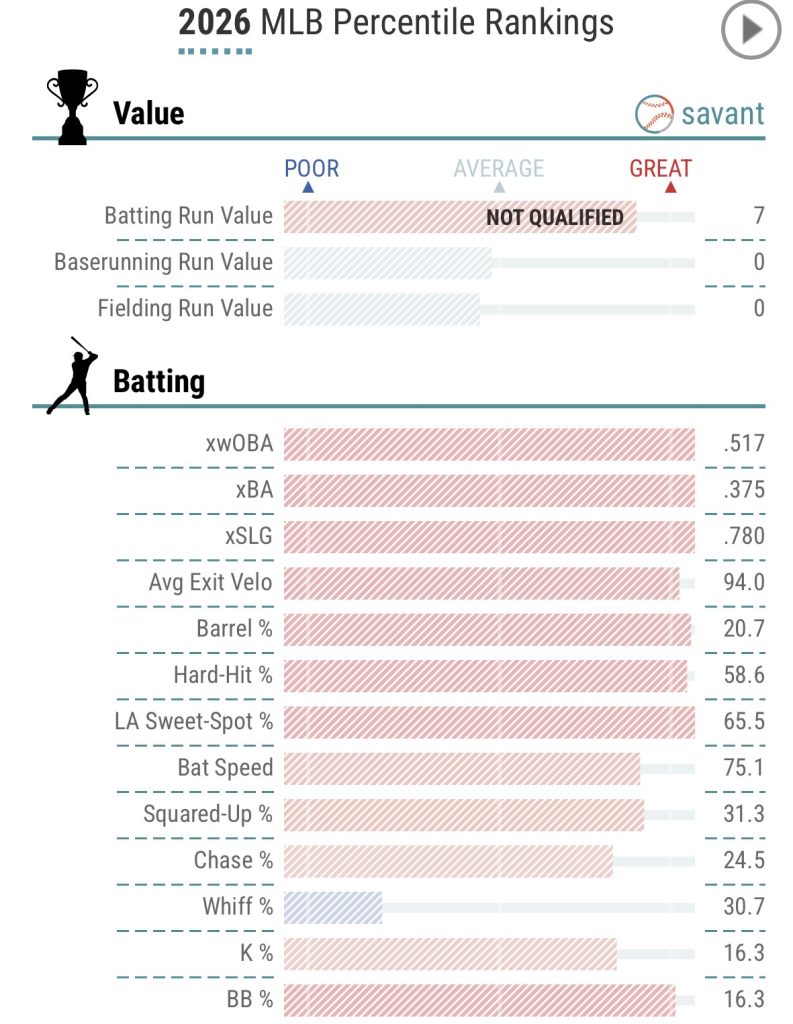
Before the call-up, Bleday was already forcing the issue in Triple-A with a dominant .341/.462/.659 slash line. The plate discipline gains are showing up alongside strong contact, and those are often the markers that support sustainable breakouts. There will still be some batting-average volatility because Bleday’s swing can get pull-heavy and pitchers will eventually adjust, but the power looks very real right now. For fantasy purposes, Bleday profiles as one of the better short-term power values available in many leagues. The everyday role, premium lineup spot, and quality-of-contact data all point toward continued usefulness over the next month. If the approach gains hold, there is a path for this to become more than just a temporary hot streak. The talent has always been there. The difference now is that the opportunity and swing decisions are finally matching up.
Maikel Garcia
Fantasy managers spent a relatively aggressive draft pick to acquire Maikel Garcia this spring, as the versatile infielder routinely came off the board around the sixth round. Early returns, however, have left many frustrated as the production has lagged behind expectations. Before fantasy managers get trigger happy and move on from a slumping investment, it is worth digging into the two pillars of Garcia’s fantasy profile between power and speed. Starting with the power department, the last two weeks have quietly revealed some intriguing changes beneath the surface. Garcia ranks sixth in baseball in square-up rate during that stretch and is one of only four players in the top 10 with a fast swing rate north of 20%. The company is notable with Adolis García, Jake Burger, and Juan Soto. That is a collection of hitters capable of changing a game with one swing, and while Garcia is not likely to suddenly morph into a 35-homer bat, the underlying traits point toward legitimate power. Perhaps even more encouraging, Garcia’s bat speed has increased for the third consecutive season and now sits right around league average. Combined with his patient approach and improved quality of contact, there is enough here to project a path toward 18-to-20 homers over a full campaign. That may not sound elite in today’s power environment, but paired with his stolen-base upside, it becomes a far more impactful fantasy profile.
On the speed side, there is little reason for concern. Garcia’s sprint speed remains intact and his stolen-base efficiency has held steady as well. The slower start simply created fewer opportunities to run. As he continues reaching base more consistently, the stolen bases should follow naturally. Overall, Garcia appears to be rounding back into the player fantasy managers aggressively targeted on draft day. The underlying data suggests the breakout stretch may be closer than many realize. If another manager in your league has already soured on him, the buy-low window may not stay open much longer.
Cole Young
Cole Young has had a relatively quiet start to the season for the Seattle Mariners, and on the surface, there is not much jumping off the page. Through 39 games, Young is hitting .272 with three homers and two steals in four attempts. For a highly regarded former first-round pick, those numbers may feel underwhelming at first glance. Fantasy managers looking for an immediate breakout probably expected more impact by now. Dig a little deeper, however, and there are signs that Young may be laying the groundwork for a stronger second half. His underlying profile is beginning to shift in encouraging ways. Compared to last season, Young has increased his barrel rate by roughly three percentage points while adding another ten points to his hard-hit rate. Those are meaningful gains for a player whose offensive profile has long revolved around bat control, approach, and athleticism more than pure power output. The batted-ball distribution is evolving as well. Young has slightly increased his launch angle while cutting back on ground balls in favor of more line drives. That may not sound dramatic, but it is often the first step in a young hitter’s power development. Right now, many of those extra line drives are simply turning into hard contact and doubles. As he continues refining the swing path and learns which pitches he can lift consistently, it is reasonable to expect some of those line drives to eventually become home runs.
There are also hints that more speed production could emerge. Young stole 20-plus bases twice during his minor league career, so the current two-steal pace almost certainly undersells his athleticism. Part of that comes down to opportunity. If the on-base percentage improves as the quality of contact continues trending upward, the stolen-base totals should follow naturally. The Mariners have historically been willing to let athletic players run, especially when they are getting on base consistently. From a fantasy perspective, Young still profiles more like a middle-infield stabilizer in deeper leagues than a true breakout star. His statistical similarities to players such as Bryson Stott and Jonathan India feel appropriate right now as players who provide value through balanced production rather than elite category juice. But the recent batted-ball improvements suggest there may still be another level coming. If the contact gains continue and the power creeps up, he could quietly become a very useful middle infielder in a wide range of formats by the end of the season.
