

Grand Teton’s peak is about 13,775 feet above sea level. Climbing this beast usually starts at Jackson Hole, where the face of this behemoth is visible. This massive wall of jagged granite extends 7,000+ vertical feet above the valley floor. The trek up to the summit is a long and punishing route. To make the upward push, a climber must withstand a fair amount of pain and suffering.
While I am not here to talk about mountaineering, I am going to compare owning Jackson Merrill to a grueling test of perseverance that started from the hole that Merrill dug. There was pain. There was suffering. We had to grind and slog through it to reach the heights of where we are today. This excruciating ordeal lasted a little over three months. From late March to early July, it was a brutal stretch, until something clicked. Now that he’s finally made considerable progress compared to where he was earlier in the year, let’s review how he got here.
Before I get into the details, I want to mention that Razzball did a piece on him in May, worth reading. ADHamley pointed to better days ahead, a much easier call to make now than it was then. So what changed, and is it sustainable?
The Up and Down
Jackson Merrill has had a very up-and-down career over the last three years. The fantasy community was unclear on how to value him this year, which is understandable. The bust narrative circulated. Was he a sleeper or bounce-back candidate? Or was it better or less risky just to value him somewhere in between his first two seasons?
He took the fantasy world by storm as a rookie. I think everyone was expecting an encore performance in 2025, but his average dropped, K’s spiked, and he only had one SB.
Merrill suffered several injuries that impacted his game last year. He had three separate stints on the IL, and we can see why he likely did not steal many bases. He suffered a hamstring strain in April that cost him about a month of action (24 games). The other lower-body injury was an ankle issue in mid-August. He also suffered a concussion in June after being tagged on the head while trying to swipe a bag. Nobody knows how this impacts players; we often dismiss this injury as 7 to 10 days off, and everything returns to normal. That is a best-case scenario, while often these injuries can take much longer and are very tricky. I can buy the lost-season narrative in 2025 due to injuries. It was not completely lost, but it was sidetracked a number of different ways as he had to overcome obstacles.
Down In A Hole
And then finally, in 2026, we all thought his production would normalize or get back to where he was his rookie year (for the bulls out there). However, he came out of the gate slowly, and the bust narrative was fully in play. He pretty much got worse in every category we care about since his rookie season except stolen bases. He was hitting as low as .194 with a .576 OPS near the end of May (51 games).
Despite his struggles, Merrill remained relevant with his speed. The Padres have run more under Stammen and are 6th in stolen base attempts versus 18th last year, and Merrill has taken advantage of the green light on the basepaths. While it does not entirely make up for a poor stretch over most of the first half, he was able to salvage some value before ultimately making up ground everywhere else. He has 24 SBs on the season and has only been thrown out twice (92%+ success rate).
Then something changed in July. It was like he flipped a switch.
Surface-Level Stats
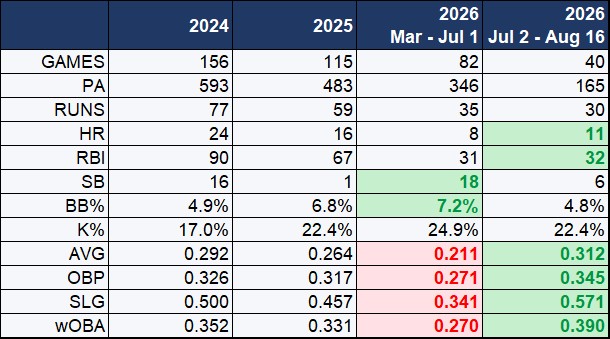
I selected July 2 to August 16 primarily for two reasons: July 2 is when we finally see improvement in the stats that we care about and the 40-game sample size is a pretty easy way to annualize the pace over a full season, which is approximately a 44/128/24 pace (zoinks).
Back to Basics
If you asked Jackson Merrill how he got back on track, his answer is pretty simple: he went back to the basics and tried to just “be himself.”
While that sounds like standard player-speak, he wasn’t kidding. He actually went back and watched tape of when he played in high school. He really did not want to change his approach and overcomplicate things, especially during the season. While not really scientific, it makes sense. Don’t think too much is about as straightforward as it gets.
How many times have we seen a player focusing too much on adjustments or mental cues, and all it ends up doing is messing with them and getting inside their head? If you play golf and you are like me, I start thinking about all kinds of $hit when I am on the tee box and end up hitting a bad shot. Or I think about what I did not do on my last shot only to overfocus on that the next time and mess something else up.
So, given this back-to-basics mentality, what has that done for Merrill? We can easily see the increase in his production and surface-level stats, but let’s dig under the hood to see what changed.
Statcast

Batted Ball


He tweaked a few things, even if he did not technically agree to make major adjustments to his swing during the season. The biggest change I see is that he’s elevating more. He increased his launch angle from 13.2 to 17.3, which is optimal and right in the sweet spot. This change has resulted in some ancillary benefits: ground balls are down significantly, fly balls are up, and line drives are up. The improved elevation has resulted in him becoming less of a ground ball hitter and more of a fly ball hitter. (GB/FB ratio went from 1.06 to 0.73). He also is not pulling the ball or trying to pull it as much; he is going up the middle more.
The changes are leading to better overall contact quality. We can see this in the metrics. Most notably, the barrel rate surged. As expected, his hard-hit rate went up, and his home run to fly ball ratio (HR/FB) increased dramatically. The better overall contact quality resulted in less soft contact and a decrease in pop-ups (IFFB%). His exit velocity ticked up during this 40-game sample, although it’s not solely responsible for the improved results. It is a product of those mechanical changes and better contact quality.
What about his BABIP? Yes, his BABIP has increased from .265 to .343, but this looks legitimate. His contact quality is better: he’s hitting the ball harder and generating more line drives, which produces a higher BABIP. His xwOBA also significantly increased in parallel (.304 to .394), while his wOBA was .390. Also, look how close his xBA and xSLG are to his actual BA and SLG. This tells me that while some better luck is involved, the gains are supported by improved quality of contact and validated by the Statcast metrics.
Statcast – Bat Tracking

His attack angle changed from 9 to 11 degrees, which indicates a better path for barreling the ball (barrels are up as previously noted). The other thing that happened, whether it was intentional or not, is that his ideal attack angle changed. It went from 45.3% to 52.9%. This basically means that more than half of his swings are now at an ideal angle. His bat speed is essentially flat, while his swing length remains largely unchanged.
Plate Discipline

Another notable factor driving the improvement is contact consistency. He is simply missing less when he swings (whiff rate down and contact rate up). He is striking out less despite swinging at more pitches overall. The key here is that his contact quality is better when he does swing. He is even making more contact out of the zone, which is one reason his walk rate has declined. He was never a huge walk guy, though.
Splits
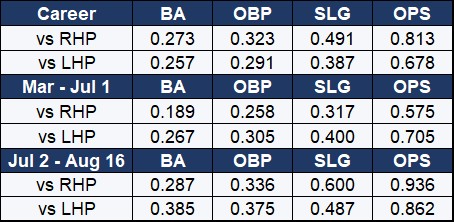
Interestingly, his platoon splits shifted. He had reverse splits against left-handed pitching earlier in the year when struggling and reverted more to his traditional splits once he made an adjustment and started to heat up (higher SLG and OPS vs RHP). It could mean that something was off earlier and now it has normalized, which correlates to better production. One other item worth mentioning: he has drawn zero walks against left-handed pitching during this 40-game stretch, which explains why his average actually exceeds his OBP in that split.
Pitch Value
While I did not show the pitch value data in a table, he is handling more pitches better than before if we look at run value. In fact, he had a negative run value on all pitches except sinkers and curveballs. Now he has a positive run value on all pitches except splitters and showed considerable improvement on every pitch. Again, how do I explain this? He is recognizing pitches better. Pitchers have also adjusted how they are attacking him and shifted their mix too. They are throwing him more pitches that he was struggling with before he made the adjustment, and he is hitting them better too. Maybe it goes back to slowing things down and not thinking as much or overcomplicating things as he indicated.
Conclusion
Putting this all together, we see that the plate discipline is similar, though he is swinging slightly more overall, and even expanding the zone a little. The bat speed is constant, and swing rates in the zone are fairly similar. To me, this looks like he made an adjustment in his attack and launch angle. He is elevating the ball better, squaring it up more often, and barreling the ball at a significantly higher rate. He has improved his contact quality and increased his contact rate while reducing his strikeouts. This, if you want to call it a mechanical adjustment, looks tangible and sustainable, assuming these adjustments stick. Perhaps it is that simple: go back to basics, slow things down, do not overcomplicate things; in short, simplifying is the way to go.
Ironically, as soon as I complete my deep dive analysis and write-up, he is posting a 50% K-rate over the past week, albeit a small sample size. This looks like part of the natural ebbs and flows of a baseball season. The gains that I show in my analysis look tangible and are supported by the underlying data. The sample I have used is statistically significant and has given the majority of the metrics time to stabilize. Luck was involved too, to some degree, but he earned that production. Let’s hope he continues his vertical push to the summit.
Thanks for reading. You can find me on X at @Toolsy3.
