

Alec Burleson is having the kind of season that can be easy to overlook or chalk up to just “good, not great.” The St. Louis Cardinals first baseman is hitting .287 with 19 home runs, 84 RBI (now that’s great! It’s a top-five mark in 2026), and an .836 OPS through 120 games, numbers that are certainly good but do not immediately jump off the page as elite power production. But if you look beneath the surface, there is a very different story.
According to Baseball Savant, Burleson has an expected 24.7 home runs this season compared to the 19 he has actually hit. That six-homer gap is the largest difference in the majors. More importantly, this is not simply a case of a hitter getting lucky on a handful of batted balls. Burleson’s Statcast profile shows a player consistently making the type of contact associated with legitimate power. That makes Burleson one of the more intriguing power bats to watch over the remainder of the season.
Burleson Should Be Hitting Way More Home Runs
The first number is the most obvious. Baseball Savant’s adjusted home run tracker estimates that Burleson should have 24.7 home runs based on the quality and power of his contact, while he has actually hit 19. The Statcast home run tracker evaluates how often a player’s batted balls would have been home runs in each of the 30 MLB parks, while the adjusted version also accounts for environmental conditions. Six missing home runs is not a small number or something to dismiss.
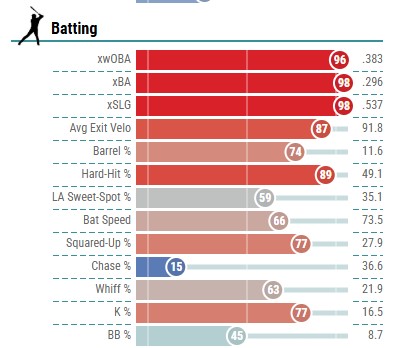
It is especially interesting because Burleson is not merely accumulating a high expected home run total through a large volume of mediocre fly balls. His underlying contact quality is excellent, as the 2026 Statcast numbers include a 91.6 mph average exit velocity, a 111.7 mph maximum exit velocity, a 48.1% hard-hit rate, and an 11.4% barrel rate. His expected statistics are even more impressive: a .299 expected batting average, .537 expected slugging percentage, and .383 expected wOBA.
The percentile rankings tell the same story. Burleson ranks in the 98th percentile in both expected batting average and expected slugging percentage, while his expected wOBA ranks in the 96th percentile. His average exit velocity and hard-hit rate are both in the 85th percentile. In other words, the expected numbers aren’t merely saying Burleson is a little better than his surface statistics suggest. They are saying he is producing contact that looks like one of the better hitters in baseball.
Burleson’s Home Runs Are No-Doubters
And then there is perhaps the most compelling piece of evidence from Statcast. His no-doubter home runs.
Burleson ranks second in the majors in percentage of no-doubter home runs this season (78.9%, behind only Jarren Duran). These are the home runs that would leave every MLB ballpark, regardless of the dimensions. That matters because it removes much of the noise from the discussion. A hitter can benefit from a short porch and inflate his home run total, but no-doubter home runs demonstrate that the hitter is producing balls with enough combination of exit velocity and trajectory to leave any stadium. Burleson has been doing that at an elite rate.
That makes the gap between 19 actual homers and 24.7 expected homers even more fascinating, but it’s not the only thing that tells us where the home runs have gone. There is another major reason to believe Burleson’s home run total has been held down. Specifically, where he plays his home games.

Busch Stadium has been an extraordinarily difficult environment for left-handed home run power. Over the last three seasons, its Statcast park factor for left-handed home runs is just 73, meaning it has suppressed left-handed home run production by roughly 27% relative to the league average. Baseball Savant’s park factors are designed to compare how frequently a particular event occurs in a park while controlling for the players involved and their performance in other parks, with 100 representing the league average.
That makes Busch one of the worst places in baseball for a left-handed hitter trying to turn hard contact into home runs. And Burleson is left-handed.
Burleson Would Have More Home Runs Literally Anywhere Else
The implications are obvious when looking at his individual Statcast home run breakdown. His expected home run total is higher than his actual total in every MLB park except Busch Stadium. In other words, if you take the exact same batted balls Burleson has produced this season and change the ballpark, his home run total rises in every stadium other than his own.
That is a remarkable illustration of just how much his home environment can obscure his power production. It also changes how his 19 home runs should be viewed. On the surface, Burleson looks like a hitter who will hover around the 20-homer mark for the third consecutive season. In 2024, he hit 21 home runs, followed by 18 in 2025. But the underlying data suggests 2026 is supposed to be a huge step forward in power rather than simply more of 2024 and 2025.
His barrel rate has jumped from 9.5% in 2025 to 11.4% this season. Burleson has seen his average exit velocity increase from 91.0 mph to 91.6 mph, while his expected slugging percentage has jumped from .471 to .537. His xwOBA from 2025 to 2026 has gone from .345 to .383. Those are not the numbers of a hitter who is simply waiting for a few fly balls to hopefully go over the fence. They show improvement in the contact itself.
Fantasy Implications Rest of Season
Burleson’s .482 actual slugging percentage is already a career high, and his .524 ISO is way above his previous career mark of .494. Yet even that career-best power production appears to undersell what he is capable of doing. And there are plenty of reasons to believe the best could still be ahead, even as the fantasy season comes to a close in five or six weeks.
Burleson does not need to change his approach dramatically to unlock this power. He is already hitting the ball hard enough and already producing barrels. He is already generating no-doubter home runs. What he needs is for more of those well-struck balls to get the benefit of a neutral or favorable home run environment. That could happen simply through regression.
A 19-homer hitter with a .480 slugging percentage is useful. A hitter producing contact consistent with 25-plus home runs while playing half his games in one of the most suppressive left-handed home run parks in baseball is much more interesting. For the rest of 2026, Alec Burleson should be viewed less as a player who is hoping to maintain his current power and more as a player who could exceed it, especially on the road and against right-handers.
That makes Burleson’s power one of the more underrated fantasy assets heading into the final weeks of the season.

Burleson was a major trade target for me at the deadline, only got him in one league, but I had drafted him plenty this year already. Was rewarded in that league with a 3 homer day the second day he was on my roster. Hoping for many more to finish the season
Was lucky enough to get him on 2-3 teams in draft season, but was not lucky enough to get him in trades this year.