

The Moment of Zen:
“Instant karma’s gonna get you.” – Beatles, “Instant Karma! (We All Shine On)”
“What goes around comes around.” – basically, everyone
You’ve probably heard of karma, and you’ve likely also heard it connected to one of the two quotes above. Of all of the Buddhist concepts I’m familiar with, karma seems to be the one everyone knows. Or at least thinks they do.
We tend to understand the concept as a result. Whatever you do will have a karmic consequence. While, on some level, that probably is a version of karma, that’s also, from what I can tell, not the focus of the idea. Originating from karman, a Sanskrit word for something akin to “action,” the word “karma” as we use it refers more to the action itself – and the intention that brought it. Consequence is part of the equation but not the crux of it.
Karma is created through virtuous actions, which are actions executed with good intention and wise understanding (among other things). But karma is more the cause than the effect – at least as I understand it anyway. A desire for virtue tends to lead to virtuous acts; those acts tend to lead to positive consequences. Probably not a huge surprise to anyone how the cycle often works.
Karma is also sometimes understood to be somewhat immediate in nature, but that also isn’t necessarily the case. If I do something terrible to someone, I may or may not be met with an immediate consequence. I might get my comeuppance, but I also might get a promotion or prestige. You get the point. And, frankly, plenty of stuff, good and bad, happens to us that has nothing to do with what we may or may not have done. Just dumb luck, not something we necessarily caused. So an action doesn’t simply lead to a karmic consequence. There’s more to the karmic process than simply “do good, receive good things.”
The more I study Buddhist practice, the more I have come to the idea that true karma is a level of contentedness that helps lead to virtuous action, and the karmic result is that our contentedness probably helps us deal with whatever comes next. What happens might be something we like; it might be something we hate. Who are we to judge if whatever happens is “good” or “bad”? I have had plenty of moments in my life when I experienced something I did not want to, yet later in life came to appreciate that moment that I so disliked to begin with. In that case, if we understand the consequences we receive to be some direct cosmic reward or punishment for what we’ve done, we’re probably going to suffer unnecessarily. Instead of accepting things as they actually are, seeing karma as a process of reward or punishment will likely leave us clinging to a desire for something to change for the better, or for the “good” thing that is happening to us to stay good forever. And that kind of thinking is a quick path to dukkha.
How in the world does this apply to fantasy baseball?
When it comes to fantasy baseball, perhaps our “virtuous” actions are the little parts of the grind – the FAAB, the examining underlying data, the listening to podcasts obsessively (or is that just me). When it comes to actual baseball, perhaps the “virtuous” actions are the little details that players work to correct to take a weakness and turn it into a strength. In both cases, the likely karmic consequence will be increased competitiveness, possibly more money, and a level of contentment with the commitment to getting better.
Here are two players who I think might be in store for their own fairly significant karmic consequences due to changes they’ve made – or lack thereof.
The consequences of the good karma – Brice Turang, 2B, MIL:
At the beginning of last season, I was pretty much out on Turang. I didn’t think he could justify his draft price because I was convinced he was a one-trick pony. And yikes did he prove me wrong. Again. And again. And again. This season, he’s being drafted even higher than in 2025 – but this time, I’m fully in.
Why? He made significant changes to his quality of contact, and he reaped plenty of reward from doing so. His Baseball Savant cards tell the story.
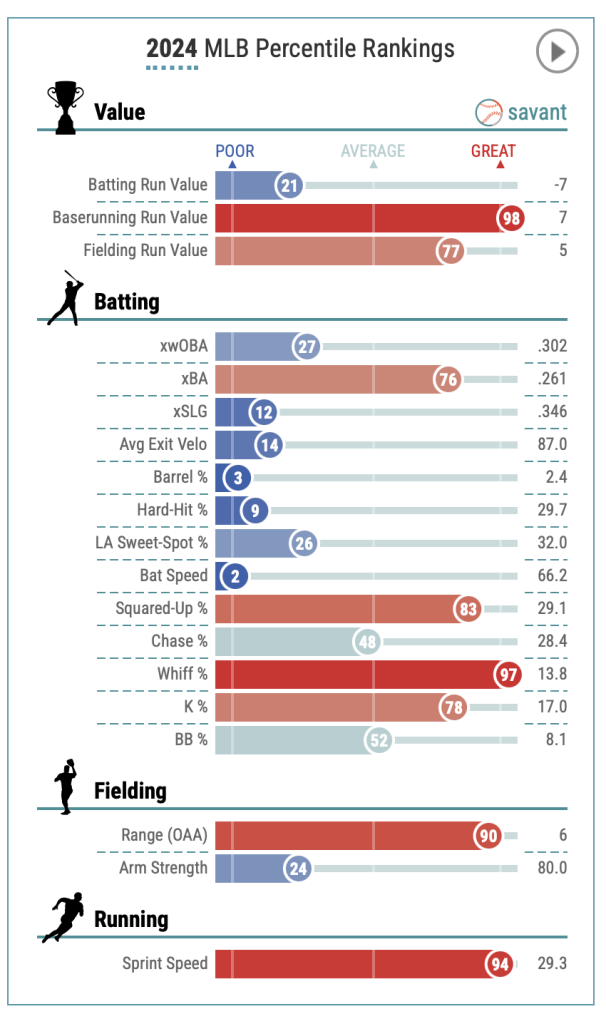
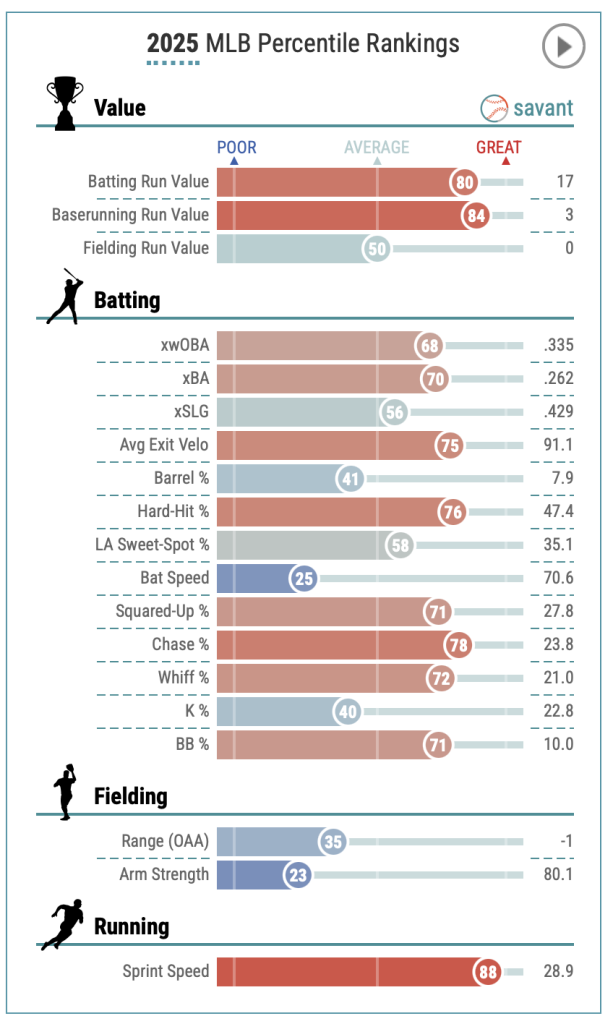
The 2024 card shows plenty of red: Baserunning and Fielding Run Values, xBA, plate discipline, and speed. The only stat that suggested to me that maybe power was a possibility was his Squared-Up%. But his 2025 card shows a completely different player: He added Batting Run Value, xwOBA, EV, HardHit%, and BB% to his list of skills.
More importantly, I think the changes are real. He completely changed how he made contact with the ball, which shows in practically every stat when comparing 2024 to 2025: His EV increased by 4.1 mph (it’s increased again this spring, up 3.7 mph). He increased his maxEV by 3.4 mph. His Barrel% was up 5.5%. His HH% was up an obnoxious 17.7%. He increased his FB% by 5.4%. And to do so, he sacrificed some of his Contact% (down 7.2%) and Z-Contact% (6.3%), but the new rates (80.7% and 86.5%) show he’s still a reasonably disciplined hitter. Changes in so many aspects of the way he contacts the ball suggest the new Turang is a product of intent. One might say virtuous intent.
Do I think he’s going to hit 30 HRs? No, not even close. But if he uses his speed to get even a modest 25 SB with the addition of 15-18 HRs, I like that player. And if he does what Turang can do – say, 50 SB – with those 15-18 HRs, that is a league-changing kind of player.
And the bad karma award goes to – Pete Crow-Armstrong, OF, CHC:
Don’t hear what I’m not saying: I love PCA as a player. His glove alone makes him worth the price of admission. I love his brashness, the hair colors, and the fire. As a Cubs fan, I’m delighted to see him roaming CF every game – if it’s in the air, he can probably track it down. I completely underestimated his upside to the point that last season’s PCA draft price in the early 100s usually left me looking elsewhere. And then, the first half of 2025 showed the kid can be something special – and I felt like an idiot. And post-ASB, I started feeling a lot smarter. He can be just as bad as he can be special.
When I got up to Wrigley for a game last year (it’s quite a trip from Birmingham, AL, after all), I saw exactly what I thought I had been seeing when I watched him on TV: PCA swings at everything. From the stands, I could see just how far out of the zone pitchers were attacking him, and he swung at seemingly everything that came his way, no matter how unhittable the pitch appeared to be. There is no pitch that he doesn’t think he can crush. And for 3 or so months of 2025, he seemed to be the next coming of bad-ball great Vladimir Guerrero Sr. That dude could hit any pitch with authority, and PCA looked like he was going to be able to do the same.
But then reality set in. It usually does for guys who have a 41.4% O-Swing%. Wow. And his O-Contact%? Not great. How does 55.5% sound? While his Z-Contact% was ok at 83.8, his overall Contact% shows the consequences of his free-swinging ways: 73.3% is the kind of contact problem that gets players a trip back to the minors.
I 100% think that PCA is likely to hit 25 HR and steal 25-40 bases this season – there’s no question his upside is worth drafting. But his .160 BA in August and .224 BA in Sept/Oct have me completely unwilling to chase him in RD 3. In some drafts, I’d even have to pick him in RD 2. No chance.
His approach to the plate – let’s call it a not-so-virtuous act – is one that brings consequences. One of those effects: He’s going to be exciting. But the other karmic reality that is virtually guaranteed – he’ll be frighteningly inconsistent. Not something I can draft in the first 50 picks of a draft.
May all of your fantasy decisions this season be based on your wise intention and reward you accordingly. Until next week. –ADHamley

Ummmmm, yeaaah….that song”s not by the Beatles.
I’m still pissed off about the cancellation of My Name Is Earl.