

To be clear, you didn’t draft Nico Hoerner this year for his power. You would never. But what did you expect when you drafted him for your fantasy team? Probably something like 2024, when he hit .273/.335/.373 with 86 runs, seven home runs, and 31 stolen bases. His value has always come from batting average, runs, and steals, with his elite contact skills providing a foundation for everything else.
That makes his 2026 season particularly frustrating. Through July 28, Hoerner is hitting just .254 with a .318 on-base percentage and .348 slugging percentage, a significant step backward from the .297/.345/.394 line he posted in 2025. He has still contributed 15 stolen bases, but the batting average decline has made him a considerably less useful fantasy asset than expected. So what happened? Where has the batting average, and therefore, the counting stats gone?
Nico Hoerner Is One of the Unluckiest Hitters of 2026
There is a strong statistical case that Hoerner’s batting average is significantly worse than what he should be doing right now. Statcast currently gives him a .295 expected batting average (xBA, just under last year’s career year of .297), meaning there is a massive 40-point gap between his actual .254 average and what his batted-ball profile says he should be hitting. That is not a small discrepancy that can be dismissed as noise. In fact, Hoerner is one of only two players with at least 400 plate appearances whose expected batting average is more than 30 points higher than his actual batting average. Baseball Savant’s expected-statistics leaderboard makes clear just how unusual that gap is.
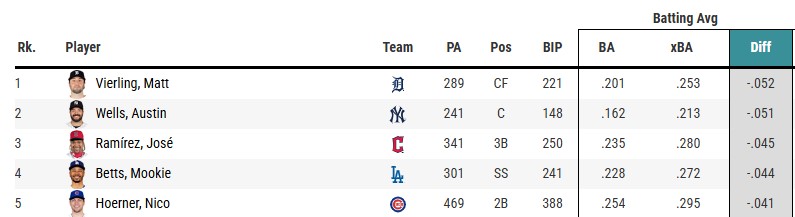
Expected batting average is not a guarantee of future performance, of course, and Statcast’s model is based on the quality and launch angle of his batted balls. But it does provide an important piece of evidence that Hoerner’s .254 average is not telling the whole story of his 2026 season.
The biggest clue that Hoerner has been the victim of poor fortune is his BABIP. He currently owns a .266 BABIP, well below his .302 career mark and dramatically lower than the .313 BABIP he posted in 2025. Hoerner’s BABIP has fluctuated throughout his career (it was .297 in 2024, .312 in 2023, and .300 in 2022), but a number in the mid-.260s is clearly out of line for a player whose fantasy value is built around putting the ball in play.
Hoerner’s Plate Discipline is Still Elite
That distinction matters for Hoerner because he almost never strikes out. His strikeout rate is just 8.2% this season, down from an already excellent 7.6% in 2025. When a player strikes out 25% of the time or more, a low BABIP can be partially masked because fewer plate appearances will result in batted balls. Hoerner doesn’t have that luxury because he is such a contact hitter. A huge percentage of his fantasy value depends on whether those balls in play turn into singles, doubles, and/or triples.
The contact-quality numbers also offer some encouragement. Hoerner’s average exit velocity is 86.0 miles per hour, which is not necessarily elite and actually represents a slight decline from his 86.7 mph mark in 2025. His 28.1% hard-hit rate is also down from 30.3% last season. So this isn’t a case where Hoerner is suddenly hitting the ball like an elite power hitter and simply watching everything get caught. He remains a low-power, contact-oriented hitter. His barrel rate is just 0.8% this year.
But Hoerner doesn’t need elite exit velocity or barrels to hit for a good average. His game is built around contact and speed. His 37.4% launch-angle sweet-spot rate is actually slightly higher than last year’s 36.1%, while his average launch angle has climbed from 12.5 degrees to 13.1 degrees. The combination suggests that his batted-ball profile hasn’t completely fallen apart. Instead, he is producing a lot of ordinary contact that simply hasn’t translated into hits at the rate we would normally expect.
Hoerner’s .295 xBA is almost identical to the .292 xBA he posted in 2025, when he actually hit .297. That is a critical point for evaluating his fantasy outlook. Statcast isn’t saying Hoerner has suddenly developed into a significantly better hitter than he was last year. It is saying his contact remains consistent with the hitter who produced almost a .300 batting average in 2025.
Recent Surge May Turn Hoerner’s Season Around
There are already signs that the tide may be turning. Hoerner went into the All-Star break struggling badly, but he opened the second half with a four-hit game against Minnesota and went 6-for-8 over his first two games of the second half. More recently, he erupted for eight hits in 13 at-bats over a weekend series, including a triple and five RBI. Those are obviously tiny samples, and they shouldn’t be used to declare that his season-long slump is over. But they are encouraging.
But what do we do in fantasy baseball? It’s been four months! Hoerner doesn’t need to turn into a power hitter to become useful again. He already has 15 steals, and his career track record gives us a reasonable expectation for strong batting-average production. He has hit .281 or better in four of the past five full seasons, including .283 in 2023, .273 in 2024 and .297 in 2025. His career batting average is .278.
The key is not to expect the .295 xBA to magically become his final batting average. Regression does not work that way. But if Hoerner’s BABIP moves even partway back toward his career norms while his elite contact rate remains, there is plenty of room for his batting average to climb over the final two months. And because batting average is directly connected to his ability to get on base, score runs, and create stolen-base opportunities, it would improve more than just one fantasy category.
Hoerner’s 2026 season is a perfect example of why fantasy managers should look beyond the surface-level stats. A .254 hitter with minimal power isn’t particularly exciting. A player hitting .254 with a .294 xBA, a .266 BABIP, an 8.2% strikeout rate, and an offensive profile that is similar to the one that produced a .297 average last year is much more interesting.
For fantasy managers looking for a buy-low candidate as trade deadlines come near, Hoerner is exactly the type of player worth investigating. His contact ability remains elite, his expected batting average is dramatically higher than his actual average, and his BABIP is sitting well below both his career and recent levels. If the results begin to catch up with what’s under the hood, Hoerner could finish the season looking much more like the dependable batting-average and stolen-base contributor fantasy managers expected to draft in 2026.
