

Ceddanne Rafaela, by all accounts, had a decent year in 2026. He finished #103 on the Player Rater and ranked as the 25th outfielder overall with a line of 67/16/70/17/.283. At first glance, that looks solid across the board and very similar to his past seasons, as he matched his career high in HRs and was in line with his previous stolen base totals, and that production came in only 138 games played, as he missed about three weeks with a quad strain in September. He also hit a career-best .283 and was on a 20/20 pace for much of the season. Is there more growth ahead?
Surface Stats
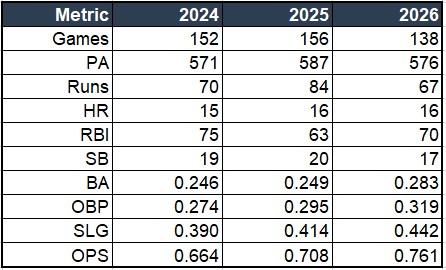
This all looks pretty good and consistent, doesn’t it? I remember watching a series in LA in early August when Rafaela went berserk. He racked up 7 hits in 14 ABs and bashed 4 HRs in that 3-game series. On the surface, he appeared to unlock new power that showed up in his age-25 season. After that big series, he was slashing 56/15/57/15/.289 in 107 games played as of August 2. He seemed destined to shatter his career-high HR total and put together his best statistical season to date, but it never materialized.
After that peak, Rafaela hit an empty .262 with 11 Runs, 1 HR, 13 RBIs and 2 SBs over his final 135 PAs (31 games). The power he flashed disappeared, and he went 23 games without a HR during that stretch. Granted, the quad strain cost him time, and Boston scored the fewest runs in MLB in September.
I’m not going to sugarcoat it: Rafaela overachieved in 2026, and his production was never backed up by his underlying metrics. It’s convenient to blame the quad injury for some of the shortfall, but there is much more to it. Nearly every quality-of-contact and approach metric got worse: chase rate, walk rate, exit velocity, hard-hit rate and barrels. His offensive gains came from an unsustainable .333 BABIP and a home run rate that his contact quality did not support.
Actual vs. Expected Stats

I will start with actual vs. expected stats. We can see some red flags right away. I am not saying expected stats are the be-all and end-all, but the gaps are significant. For context, his actual and expected stats were more closely aligned in 2024 and nearly identical in 2025, so this gap is new. The gap was even wider through his August 2 peak (.349 wOBA vs. .288 xwOBA) before his results fell in line with his expected stats down the stretch (.268 wOBA vs. .274 xwOBA).
Plate Discipline
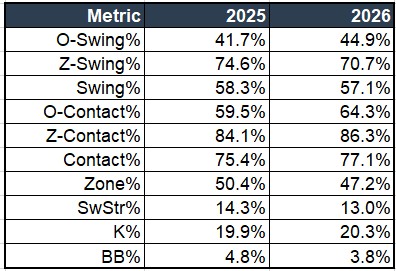
We know he is an aggressive hitter who does not walk. His chase rate is among the worst in baseball. He is swinging at more balls and fewer strikes. His zone swing percentage has been falling since 2024 (78.0% to 70.7%). Pitchers are also throwing him fewer strikes, which makes sense since he frequently chases. He is making more contact when he swings, but much of that contact is on pitches outside the zone, which has hurt his contact quality. More on that next.
Statcast and Batted Balls
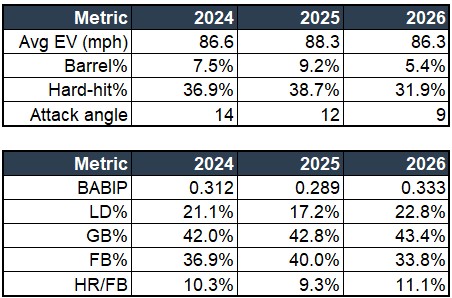
Rafaela hit 16 HRs in 2026, essentially matching 2024 and 2025, but the underlying numbers don’t support that total going forward. Specifically, hard-hit rate plummeted from 38.7% to 31.9%, barrel rate cratered to 5.4%, and average exit velocity slipped 2 mph to 86.3. Yet his HR/FB went up to 11.1% (highest level over a full season). That combination doesn’t make sense. When a hitter is making weaker contact, his HR/FB should be falling, not rising.
His batted-ball mix isn’t helping either. Rafaela’s fly-ball rate dropped from 40.0% in 2025 to 33.8%, and his ground-ball rate ticked up slightly to 43.4%. While his bat speed has been stable, his swing path has flattened (attack angle dropped from 14 degrees in 2024 to 9 degrees), which lines up with fewer balls in the air. Fewer fly balls, hit with less authority, should not translate into sustainable power. Even if you give him his average HR/FB rate for 2024 and 2025 and assume he plays 155 games, you only get to 16 home runs at most. That’s a big if, because his fly balls should not carry as well with his barrel rate and EV both down. For Rafaela to repeat 16 HRs, a lot has to go his way. At this point, it doesn’t add up.
The .283 BA also came with a .333 BABIP, well above the .300 average BABIP he posted across 2024 and 2025. Some of the jump came from an increase in line drives, but his EV and hard-hit rate fell. If I take the glass-half-empty view, this means softer liners and bloopers dropped in for hits, which looks more luck-driven, given the weaker contact. If his BABIP normalizes to .300 and his HRs come down, he falls back to the .250 BA range.
Other Callouts: SBs and Pitch Value
Unfortunately, he has been caught stealing on 30% of his attempts over his career, and 2026 was one of his worst seasons. He was caught on 9 of his 26 attempts (35%). He still possesses excellent sprint speed, but he should consider enrolling in the Josh Naylor baserunning clinic. We cannot expect him to keep getting the green light if he is making outs on the bases that often.
The other alarming item I noticed in his metrics is his inability to hit the hard stuff. His worst pitches by run value are 4-seam fastballs and sinkers, and it’s not particularly close. Sinkers have always given him trouble, but his production against 4-seamers fell off sharply this year (-5.8 runs, down from -1.5 in 2025). He saw 4-seamers and sinkers almost 50% of the time. If you can’t hit fastballs, you have a big problem. I don’t think I need to expound on that.
Interestingly, he was worth +10.1 runs against sliders after never exceeding +1 in a season. For a hitter who chases a lot and made softer contact overall, that is likely a mix of balls finding holes and him hitting mistakes more often. I am skeptical it holds up.
Conclusion
His Gold Glove-caliber defense will keep him on the field, but I think it is best not to expect more than what he has already given us. While I cannot rule out some growth, there is a stronger case that he regresses. Without significant adjustments, the deficiencies I noted will offset any gains. Couple his approach at the plate with less BABIP luck, and you may not be too pleased.
I’m not saying to throw him out with the trash, but be careful. There is considerable downside risk, and I actually prefer this kind of production to come from my 2B or MI spot, not an outfielder. Oh, by the way, he no longer qualifies at 2B.
Without that 2B eligibility, I honestly like him a lot less than in past years. A lot would have to break right for him to get back to 16 HRs, and with his lower barrel rate and reduced EV and hard-hit rate, I think he lands closer to 13 than 16 over a full season. You have been warned. Buyer beware, or caveat emptor, if that term resonates better with you.
Of course, he plays half his games at Fenway, which helps. Since hitting was down across the board this year, we could also see a different baseball next year, especially if there is a work stoppage. That could change things for him. Thanks for reading. You can find me on X at @Toolsy3.
