

It is the ninth inning, your closer has just turned a one-run lead into a one-run loss, and you are on your feet explaining to your television that this bullpen is why your team can’t win the close ones. We have all filed that police report. The one-run loss feels like a crime scene, and the reliever is standing over the body holding a hanging slider. It was the bullpen, in the ninth, with the cement mixer. Case closed.
Not so fast, detective. I pulled every one-run game since 2021, a little north of 4,000 of them (about 28% of all games, because one-run baseball is mostly just baseball), and reopened the file on each one. The usual suspect has a much better alibi than you think.
The two suspects
A one-run game can only be lost two ways, so there are only two suspects.
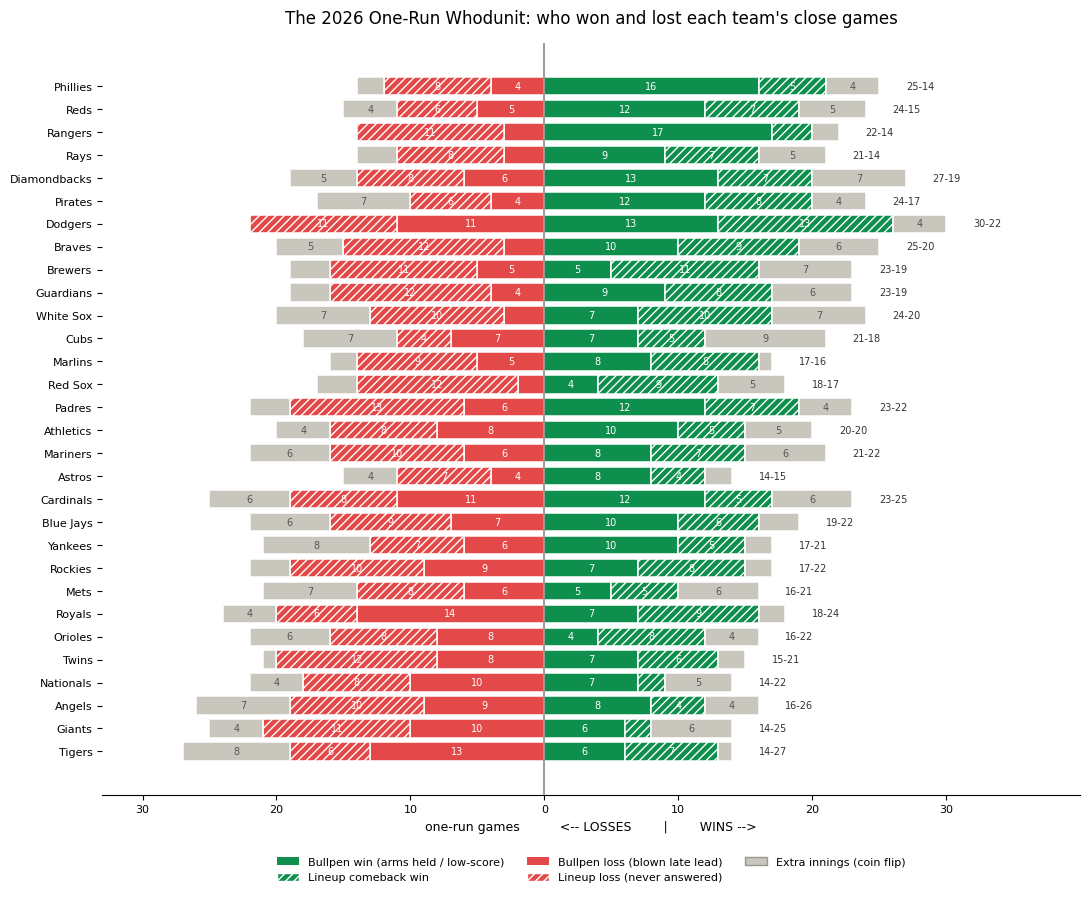
Suspect A, the bullpen: you had the lead, or you were tied, and your relievers coughed up the deciding run in the seventh inning or later. This is the blown save, the loud one, the one that gets a reliever a nickname you cannot print.
Suspect B, the lineup: you never answered. Either you got shut out (the 1-0 loss, the purest form of offensive silence) or you were already trailing by a run heading into the last third of the game and your bats went quietly into the night.
The number I care about is what share of a team’s one-run losses you can actually pin on the pen. Call it the Blame Split. A Blame Split of 50% means the bullpen and the lineup are splitting the tab evenly. Higher, and the pen is buying more rounds than it should.
One housekeeping note before we read anyone their rights. Extra-inning games are their own thing now, thanks to the ghost runner on second, and they are close to a coin flip by design. They make up about 21% of one-run games, and I set them aside so we are judging real blown leads, not a reliever inheriting a runner he never let on.
Myth #1: one-run losses are a bullpen problem
Here is the whole ballgame, so to speak. Across every regulation one-run loss since 2021, the bullpen is on the hook for about 41% of them. The lineup owns the other 59%. Read that again, because it runs backward from how we all watch the game. The blown save is memorable. It is not common. The far more frequent way to lose a one-run game is the way nobody throws a remote over: your offense scratched out two runs, or one, or zero, and simply never tied it up. The call was coming from inside the dugout the whole time.
The lineup is the quiet suspect, and quiet suspects get away with it. Nobody makes a highlight package of a lineup stranding the tying run at second in the eighth for the fourth time this week. But that is where the bodies are buried.
Who is actually guilty on your team
Now, 41/59 is the league. Your team is not the league, and this is where it gets fun.
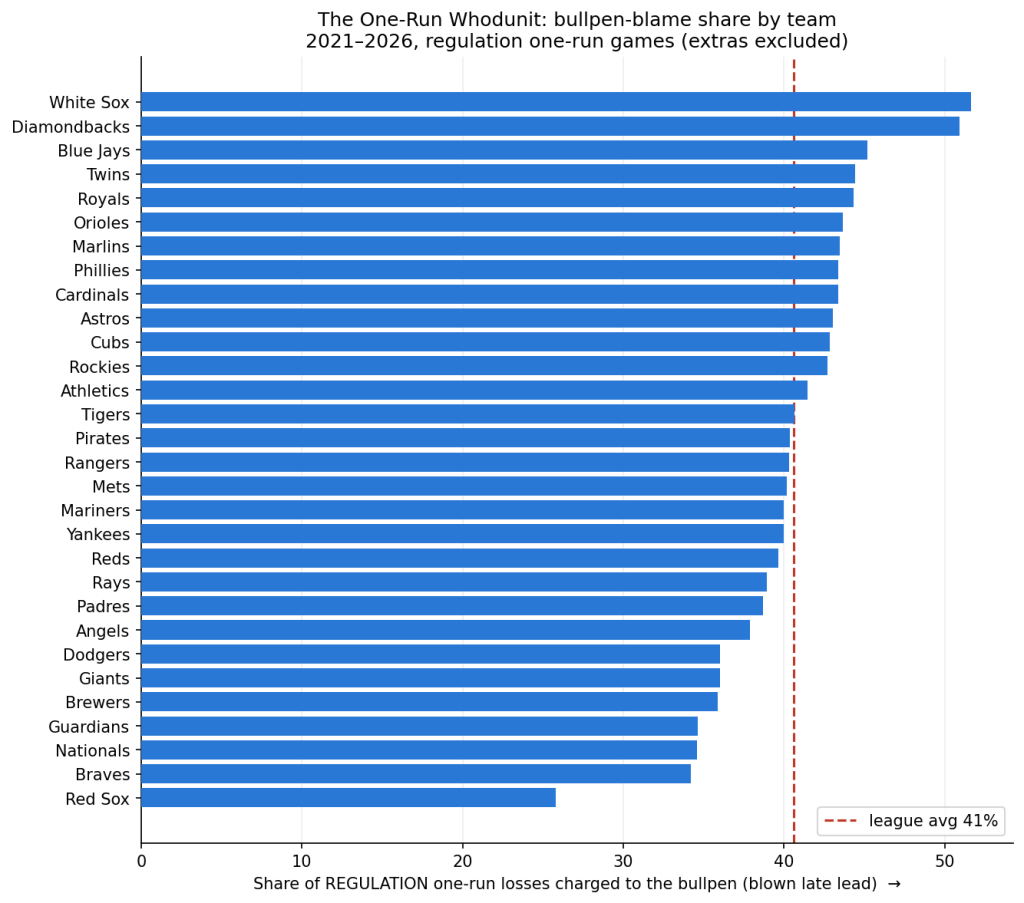
A few teams really do fit the stereotype. The White Sox are the one club where you can keep yelling at the bullpen with a clear conscience: they carry the league’s highest Blame Split, right around 52%, and their late-inning meltdowns are a genuine, load-bearing part of a miserable one-run record. If you rostered a White Sox reliever expecting saves, I am sorry for your loss, plural. Now looking at the flip side, Athletics, Rangers, and Braves lose close games with their bats, not their arms. Braves are the sneaky one: a top-shelf one-run pitching staff dragged underwater by one of the worst close-game offenses in the sport.
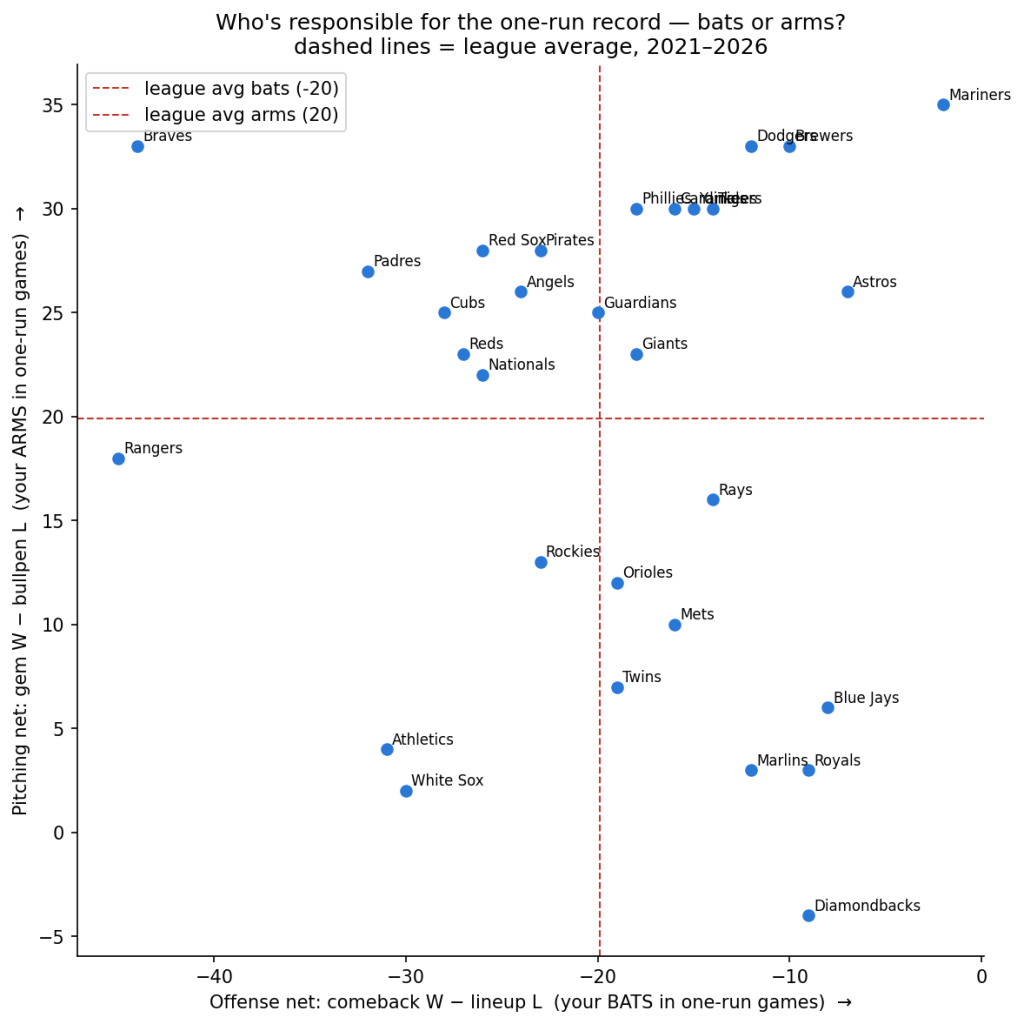
Red Sox are the full split personality, a bullpen that keeps bailing out a lineup that cannot win the low-scoring grind. And the Mariners, bless their heart-attack fanbase, simply win both kinds, which is how you pile up 171 one-run wins, the most in baseball over this span. Arizona, meanwhile, owns the worst one-run pitching in the league, which is a fact I offer to Diamondbacks fans free of charge.
So there is your suspect board. Some teams are bullpen crimes, some are lineup crimes, and the shapes are all over the map.
Myth #2: a team that owns the close ones has a skill
This is the part every saber savvy reader probably already knows: your team went 30-18 in one-run games, the manager “knows how to win the close ones,” the bullpen is “built for October,” and you would like to run it back next year.
I tested it the only way that matters: does a team’s one-run profile carry over from one season to the next? Blame Split, bullpen performance, lineup performance, the whole suspect board. It doesn’t. None of it. Year to year, the correlation on every one of these is essentially zero, bouncing around a tenth in either direction, which is a statistician’s polite way of saying noise. This year’s clutch darlings are next year’s coin flippers. The team that “blows every lead” in May is dead average by the following April. The sabermetric old guard have been telling us for twenty years that clutch is mostly luck; one-run records are that lesson wearing a rally cap.
Here is your kicker, and it is the whole case in one line: a one-run record is a receipt, not a forecast. It tells you, in exhaustive detail, exactly how the money was already spent. It tells you nothing about the next trip to the store. The close-game magic already happened, and it is not coming to the return window. I will be back in a future Stat Chat to point the same magnifying glass at the standings-luck we all pretend is a plan. Until then, tell the boo-birds to go easy on your team’s bullpen, it was probably the lineup.
