

Occasionally you see a good pitcher have a bad start, it happens. Perhaps there are some bad bounces that cost extra runs, but in general the pitcher doesn’t appear to be sharp, and the broadcast booth will say something like, “He just doesn’t have his slider today.” It’s the tidiest story to describe a pitcher’s bad start; He has a pitch he relies on, and it’s not working today for whatever reason, therefore, the train has gone off the rails.
It’s a believable story, but I wanted to know if the bill was real. To analyze this, I looked at every starter’s Stuff+ grades (based on a pitch’s movement and speed) for each of his pitches to determine the “best pitch”, the pitch that serves as the bread-and-butter, linchpin of the pitcher’s arsenal. From there, I looked at the game log to analyze how a pitcher performed based on how the linchpin pitch performed. Looking at a starter’s box score, I calculated what I’ll call the Linchpin Tax = how many extra earned runs a starter coughs up when his best pitch grades in the worst third of his own nights, versus when it doesn’t.
Myth: Everybody pays the linchpin tax
Across 155 starters and about 6,400 starts, the average bad-linchpin night costs +0.35 earned runs per start. That’s not a heavy tax as much as a VAT. Seventy percent of pitchers land on the wrong side of zero, so the effect is technically real, but it’s the kind of thing you’d never see from your couch. Single-game Stuff+ correlates with single-game runs at about −0.1, which in English means: how nasty your best pitch grades tonight tells you almost nothing about how many runs you allowed that night.
Swap Stuff+ for Location+, command instead of filth, and the signal roughly doubles. Where you put the ball predicts traffic on the bases about twice as well as how much it moves. So going back to the broadcast booth example, it’s actually not “he didn’t have his slider,” but more like “he couldn’t locate anything,” which is a less romantic way to say the guy was off his game in general.
So if the assumption was every starter has a pitch they rely on, that isn’t usually the case. For the typical arm, the linchpin tax is an excuse, not a real effect.
Truth: A small group pay most of the linchpin tax
But 30% of the league sits on the wrong side of zero for a reason, and a small group is genuinely, dramatically one-pitch dependent. Rank the two-year sample by Linchpin Tax, and the top of the board is a who’s-who of arms whose ceiling and floor run through a single offering: Noah Cameron, Luis Severino, Joe Ryan, Ranger Suárez, Sandy Alcantara, and the main character of the article, Cristopher Sánchez.
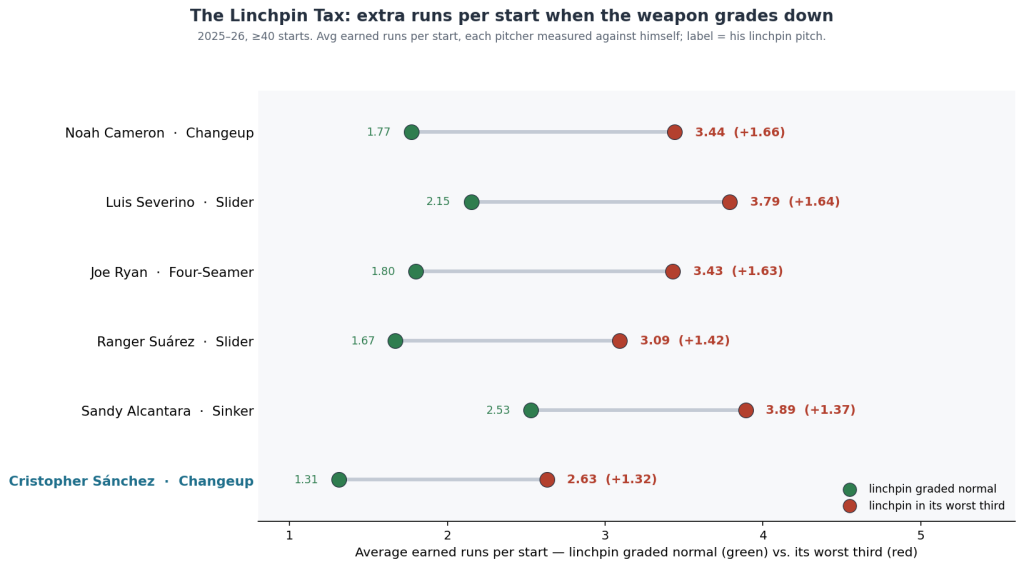
Sánchez matters because he’s the cleanest case in baseball, and because he repeats. He topped this list in 2026 alone, and he’s still top-six over two full years, which is the difference between “ran hot and cold once” and “this is just who he is.” (The opposite pole, the bulletproof arms whose results don’t move no matter what one pitch does, are deep-arsenal types like Shota Imanaga and Seth Lugo)
The Sánchez switch
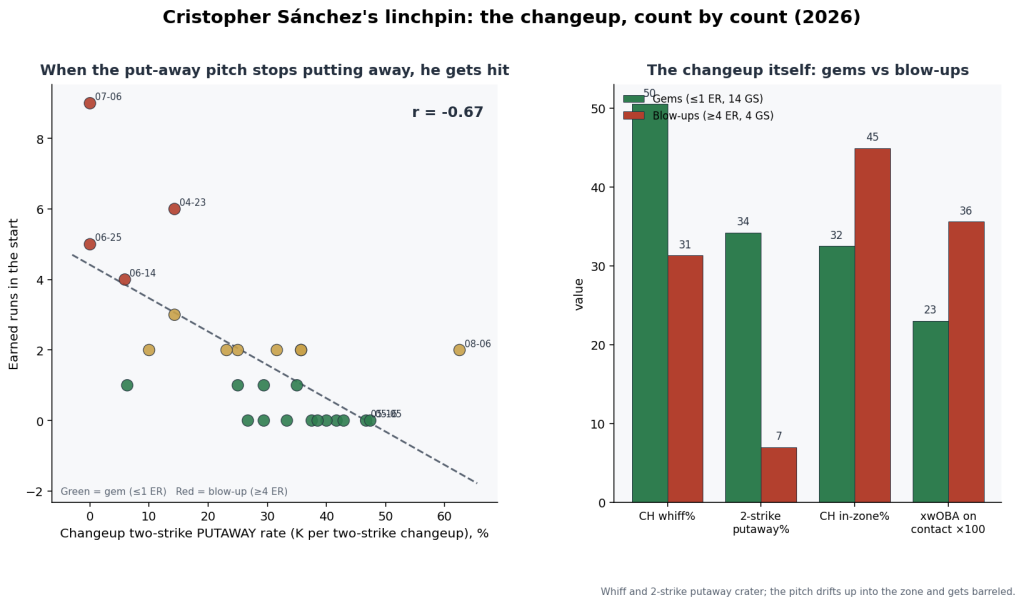
Here’s his 2026 in one sentence: a 2.53 ERA, interrupted by four grenades (nine earned on July 6, six on April 23, five on June 25, four on June 14). Sub-2.50 ace, then arson, then ace again. What flips the switch?
The changeup. Specifically, the changeup’s ability to finish.
I pulled his full pitch-by-pitch from Statcast and split it into gems (≤1 ER) and blow-ups (≥5 ER), and the two-strike changeup, his out pitch, the thing he reaches for when he smells a punchout, completely inverts:
| Sánchez’s changeup, two strikes | Gems | Blow-ups |
|---|---|---|
| Put-away rate (K per 2-strike changeup) | 32% | 9% |
| Whiff rate | 54% | 8% |
In his best starts, more than half the swings on his two-strike changeup come up empty; in his worst, one in twelve. The put-away pitch stops putting away, and everything downstream follows: the at-bats that won’t end, the extra pitches, the lineup turning over a third time. It’s not noise, either. Across all his starts, his changeup’s two-strike put-away rate tracks his earned runs at −0.67, which is the highest tax rate we see among regular starters.
My working theory going in was walks, the changeup misses low, counts run long, free passes pile up. However, it turns out his blowup starts do not come from walks. What’s actually breaking is location, and not out of the zone. In blow-ups, the changeup drifts up: its in-zone rate climbs from 33% to 45%, and it sits about two inches higher. So instead of a pitch that dives under barrels and gets chased, it’s a hittable strike. The whiffs evaporate, and the contact gets loud, expected wOBA on contact jumping from .230 to .356. The bread and butter ends up becoming a plate of meatballs.
And here’s the kicker that sold me: it’s the changeup and not just “Sánchez is streaky”: force the same analysis onto his most-thrown pitch, the sinker, and the fragility vanishes. His sinker actually misses more bats in the blow-ups, not fewer. The sinker is a rock. His entire disaster risk is one pitch’s shape on the night. Live by the changeup, die by the changeup.
The Changeup Tell
The alarm goes off early. Sánchez’s changeup swing-and-miss rate in the first two innings already predicts the night: about 55% of early swings miss in his gems, versus roughly 27% in his blow-ups. His first-two-inning whiff rate correlates with his final line about as strongly as the whole-game number does, meaning the movie’s basically cast before the third inning. A dead-simple rule: early changeup whiff under 40% and brace yourself, flagged three of his four disasters; when he cleared the bar, he blew up once in seventeen tries.
So here’s your playoff “Things to watch for” for a Sánchez start, the thing to check before you decide he’s cooked: in the first two innings, are hitters missing the changeup or touching it? If they’re whiffing through it, pour a drink and settle in, you’re watching the ace and a long night for the other guys. If they’re fouling it off and slapping it into play, if that cambio is catching too much plate and nobody’s chasing it down below the zone, go ahead and start warming up the bullpen. The floor is live, and it almost always shows up before the damage does.
The linchpin theory is mostly a myth, a paper-cut tax the whole league shrugs off. Except for the handful of arms where it’s the entire story, and for one of them, you’ll know how it ends before everyone has found their seat. Just watch the changeup.
