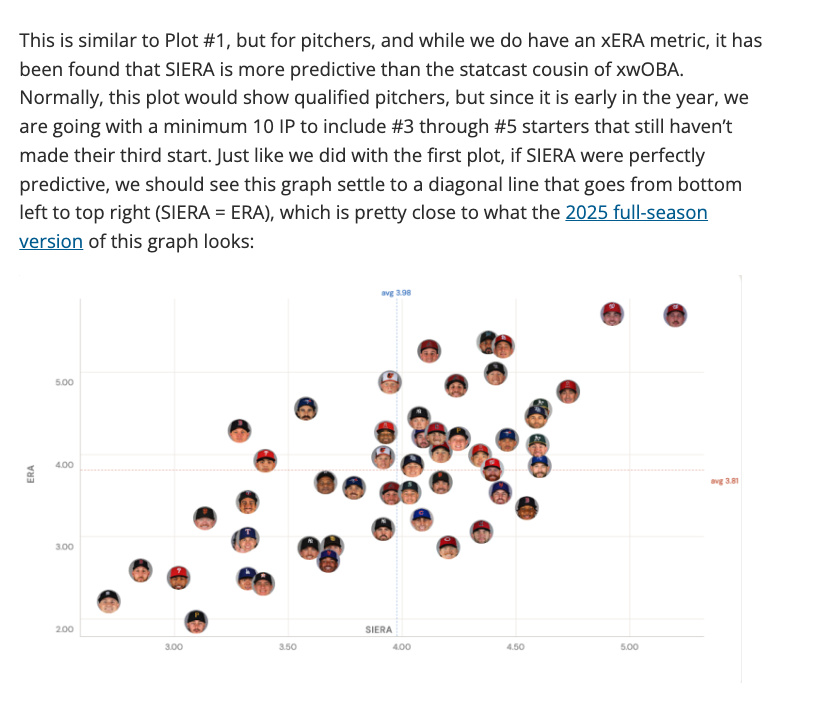
Recently The Approach Angle podcast did an episode called ERA Estimators Made Simple where they covered different ERA estimators available to assess a pitcher’s performance (ERA) against his underlying peripherals. The idea here is that a pitcher’s ERA is noisy (BABIP luck, HR/FB luck, LOB%, all sorts of luck), but their underlying “skill” should be consistent. A pitcher goes from having a 2.50 ERA to 4.50 ERA the next season? Maybe his FIP or SIERA said his ERA should’ve been 3.50, and he simply got lucky one year and unlucky the following year. The idea of plotting an ERA estimator like SIERA was covered in my earlier article Scatman Plotters And The New Scatter Plot Tool.
There are many of these “estimators” we use to predict future ERA. Those covered in the podcast included FIP, xFIP, SIERA, xERA, and another big one is K-BB%. The idea for K-BB% is simple: it’s just the rate that you walk batters (walks divided by batters faced) subtracted from the rate you strikeout batters (strikeouts divided by batters faced). Formulas like FIP, xFIP, and SIERA are just fancy extensions of K-BB%, they basically start with strikeouts minus walks, and add some element like home runs allowed for FIP, “normalized” home run allowed rate for xFIP, a combination of contact estimator based on the type of contact you give up (line drives / fly balls/groundballs) for SIERA, but the core of it is two things: walks and strikeouts.
The mystery begins when you look at how well K-BB% does in predicting future performance, it consistently beats out the “fancier” versions like xFIP and SIERA, and does a better job than those ultra-fancy metrics like xERA or PLV. How is that possible, though? Strikeouts and walks only account for 30% of outcomes for the average plate appearance, 70% of the time, something that’s not a strikeout or walk is happening. Imagine someone watching 30% of what you eat and being able to predict what your future calorie consumption would be. You don’t know what I’m eating 70% of the time!
To really dig into this mystery, I decided to look into what happens right BEFORE a strikeout or walk. The thing about strikeouts and walks are there is only one way to get to each. To walk a hitter, you need three balls first, and to strikeout, you need two strikes first. So if someone is striking out more than they are walking, the assumption is that they are getting to two strikes a lot more than they are getting to three balls. This means the pitcher is probably working with a 1-2 or 0-2 count often, meaning they have Count Leverage on the hitter. The thing about Count Leverage it actually has a big effect on the outcome of the at-bat. If you watch Foolish Baseball’s The Only Thing That Matters in Baseball, he talks about the importance of starting an at-bat 1-0 vs 0-1. My thought was by deriving a stat called “Count Leverage” (CoLev for short), it would act as a proxy for not only K-BB%, but it would capture the other 70% of at-bats because hitters are hitting soft grounders on a 1-2 pitch.
Analyzing pitch-by-pitch data for 1.6 million pitches across 400 pitchers, I was able to calculate CoLev for every pitcher, each year, between 2021-2025. For example, here is the qualified leaderboard for 2025:
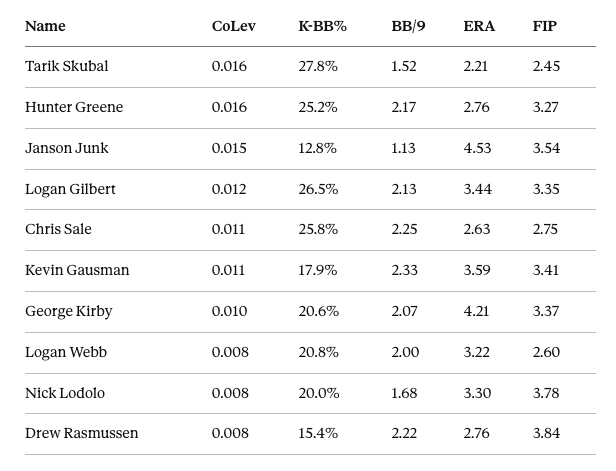
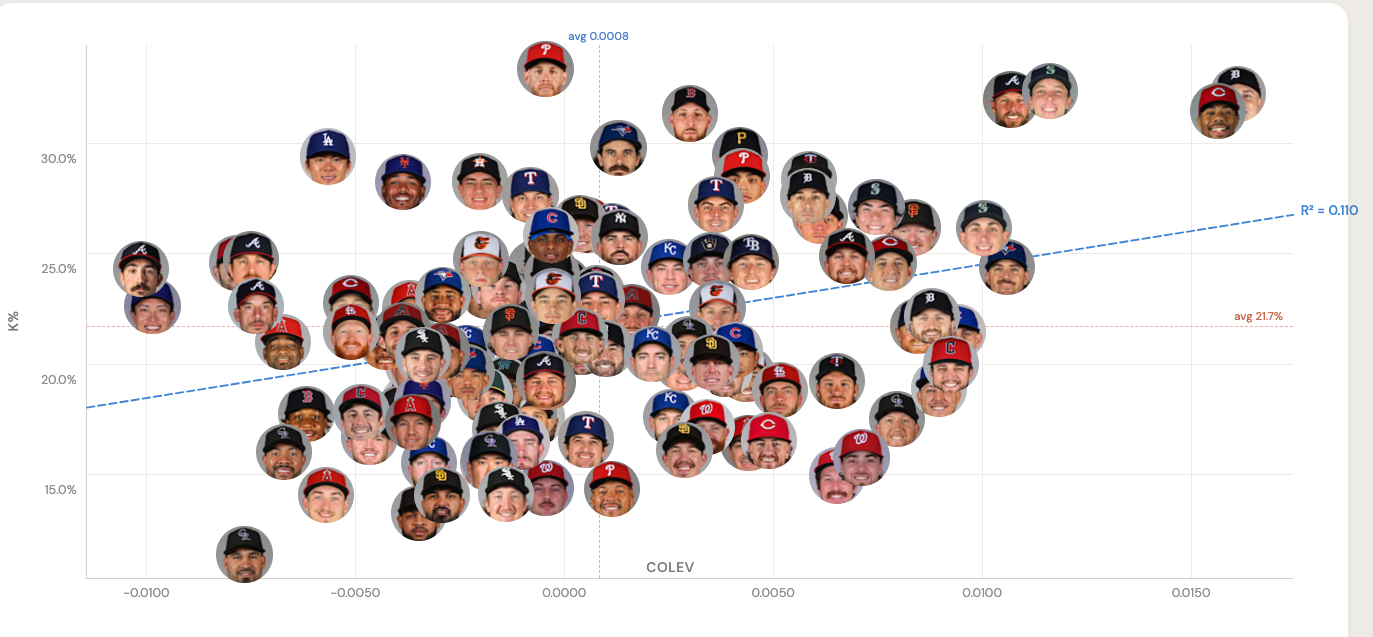
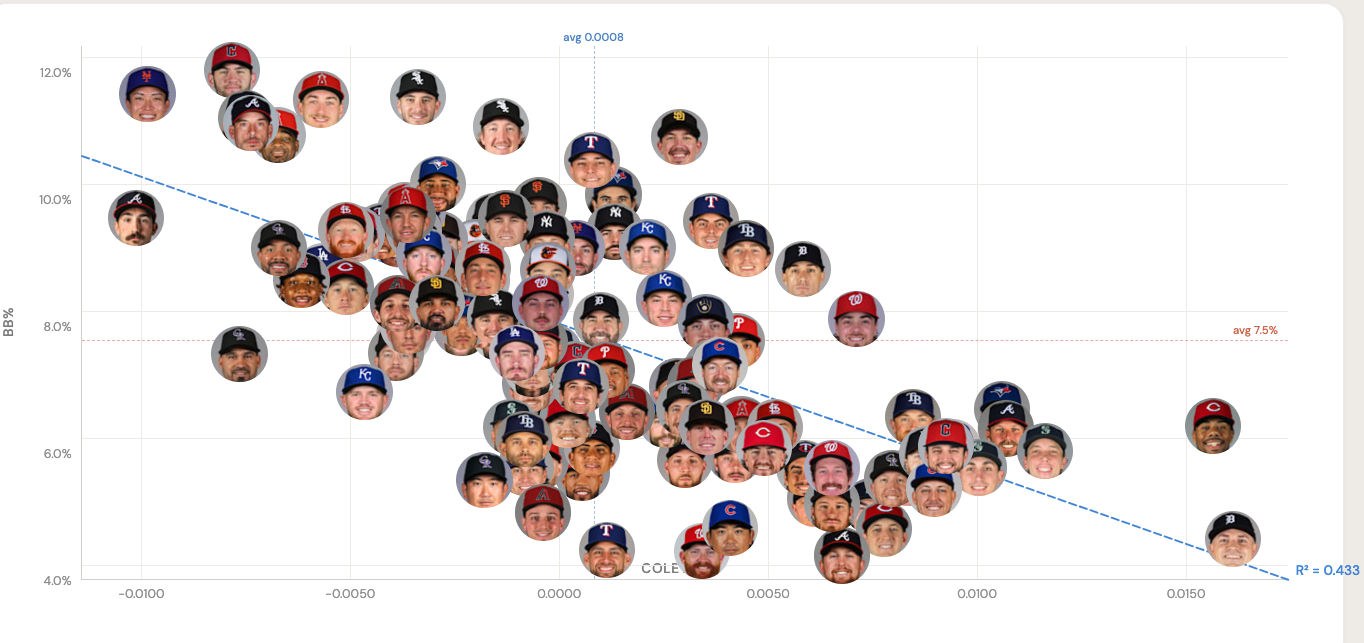
Not too surprising that a lot of the best pitchers last year are towards the top, with, of course, the interesting addition being Janson Junk. Junk represents an interesting finding with CoLev, which is that it doesn’t correlate well with K-BB%, meaning getting to a favorable count doesn’t mean you’re going to get lots of strikeouts and avoid walks. A big factor in that was CoLev being pretty good at predicting walks, but lousy at predicting strikeouts
- r(CoLev, BB/9) = -0.686 (related decently strongly)
- r(CoLev, K/9) = +0.271 (not related well)
The reasons for that is pretty simple. If a pitcher gets to a bad count, there is no skill they need to walk someone, they just need to throw a fourth ball. However, getting to a 0-2 or 1-2 still requires the pitcher to do something hard – get a major leaguer to whiff or watch a third strike. That’s why someone like Janson Junk could have strong Count Leverage but not strike out a lot of hitters.
Moving on to the big question, though, is CoLev better than K-BB% at predicting ERA? Here is the summary table that shows the predictive R2 value for pitchers season-to-season for a bunch of different metrics, including CoLev (remember, higher R2 number is better):
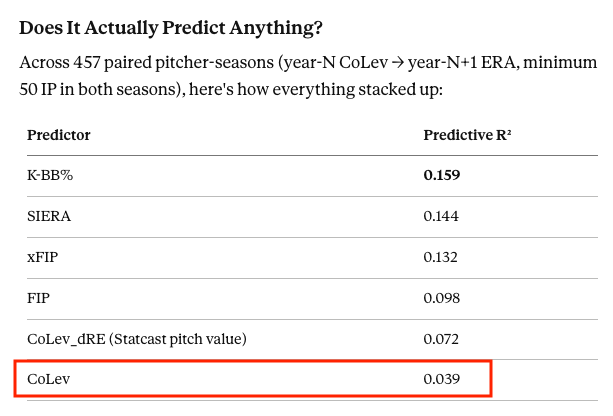

What a big bust! It actually did *worse* than any metric. Which, if you read into what I wrote about Janson Junk, you may have inferred already. CoLev already misses a large part of strikeouts and walks because it doesn’t predict future K-BB%, and given the importance of K-BB% if CoLev can’t get that right, there was a very low chance it was going to get something like future ERA right. So this made me say, aha! But what about those 70% of at-bats that end without a walk or strikeout, the softly hit 1-2 ground balls? Surely CoLev will do a good job predicting those. Turns out, CoLev did not tell us much of anything on those 70% either. Using wOBACON (wOBA on contact), I found that CoLev has an R2 of 0.055 with wOBACON. Compare that to 0.170 R2 with freckin’ K-BB%, the stat that *ignores* balls in play altogether does a better job than the new stat that’s supposed to help explain batted balls!
The real lesson here is that the other 70% is almost impossible to predict. Taking all sorts of different stats, I found it’s nearly impossible to say “this pitcher has magic powers to specifically limit damage on balls in play”. Even taking stats like xwOBACON, which specifically predict how a hitter *should’ve* done on balls in play, it doesn’t correlate well with how that pitcher is going to control damage in the future. So the answer to the K-BB% mystery is none of these metrics is actually doing a good job predicting ERA, and a big reason of that we try to predict the unpredictable 70% of plate appearances. Some pitchers will do better in wOBACON next year, some will do worse, but on the aggregate, it’s pretty random how that will affect a pitcher’s ERA next year. The only thing we can rely on is strikeouts and walks, and thus K-BB%.
Finally, CoLev is available in the scatter plot tool for anyone who wants to check it out. The fun thing here is that you can visually see how CoLev and K% are not related, but CoLev and BB% seem heavily related.
CoLev vs Walk Rate – 2025 Starters with +100 IP
CoLev vs Strikeout Rate – 2025 Starters with +100 IP