

“Sleepers” is one of fantasy sports’ oldest and best terms, with roots in early-20th-century boxing and horse racing. It’s always been used to describe competitors with hidden upside who surface when it matters most. Last week, our hitter profiles focused on a group of deep sleepers going after pick 325 in early drafts, representing the types of players you can stash late while filling out the back end of your roster. This week, we move up the food chain. These hitters will be discussed in draft rooms as we head toward Opening Day, but their prices still lag behind their potential outcomes. The goal here is simple: identify the best mid-round values among players who may be on the verge of a meaningful jump. We’re digging into early ADP data to find hitters whose underlying profiles suggest there’s more coming in 2026 than the market is currently pricing in.
Alec Burleson (ADP 171)
Is it ironic to label a team’s top-drafted hitter a sleeper? Maybe. But the Cardinals enter 2026 with far more fantasy intrigue than certainty, and Alec Burleson sits near the top of that list. Burleson is a 6-foot, 225-pound left-handed hitter heading into his fifth major-league season and squarely into his offensive prime. In 2025, his wRC+ jumped 18 points to 124, continuing a steady upward trend in his overall production. He paired that growth with 18 home runs across 139 games while maintaining a .290 batting average. Despite those gains, Burleson is currently being drafted around the 15th round, in the same range as names like first basemen Willson Contreras and Christian Walker. That makes him an appealing corner infield option with a real chance to return starting-caliber value at first base.
There are several reasons to expect further growth. Burleson has increased the number of balls he puts in the air in every major-league season, while also cutting back on chases outside the zone in 2025. That improvement in swing decisions lined up with a slight increase in his walk rate, a sign of a more stable offensive approach. The underlying power metrics are where things get especially interesting. Among the top 20 players in baseball at squaring up pitches, only two have a higher average bat speed than Burleson in Juan Soto and Ben Rice. When bat speed like that starts pairing with improved plate discipline, the ceiling rises quickly. With continued development, a 30-home-run season with a .280 average is very much within reach.
If you’re looking for a comparable fantasy profile, look just across Missouri. Vinnie Pasquantino is going off the board around pick 90. Burleson offers a similar skill set and path to production, but at a significant discount and with ample playing time available in St. Louis.
Addison Barger (ADP 214)
Barger enters his age-26 season after a strong 2025 campaign in which he hit 21 home runs with 74 RBI across 135 games. His ability to play both third base and the outfield adds useful positional flexibility heading into 2026. From an underlying metrics standpoint, Barger stands out immediately. Bat speed, which is one of the clearest indicators of power potential, places him in the 93rd percentile, sitting just behind bats like James Wood and Ronald Acuña Jr. and just ahead of Shohei Ohtani. Combine that with a 70 percent barrel rate and passable plate discipline, and you have a hitter entering his second full season with real breakout momentum.
The context only helps. Barger is projected to bat second behind George Springer and in front of Vladimir Guerrero Jr., a lineup spot that should generate plenty of opportunities for runs and RBI. That combination of role and skill makes 30-plus home runs very realistic, with room for more if the profile fully clicks. This isn’t a brief hot streak or a World Series cameo driving the hype. It’s a sustainable power profile being drafted like an 18th-round pick. Barger has the type of skill set that quietly wins leagues over six months.
Last week, we looked at another Baltimore outfielder in Tyler O’Neill, and the Orioles’ outfield that remains one of the more crowded situations in the league. Still, Dylan Beavers might be the most well-rounded long-term fantasy option of the group. Beavers’ first taste of the majors was brief and uneven. He hit .227 with four home runs and two steals across 35 games, showing flashes of power but also some adjustment issues against big-league pitching. That small sample doesn’t come close to telling the full story. At Triple-A, Beavers put together one of the more impressive all-around offensive seasons in the minors. Across 94 games, he nearly produced a 20/20 season with 18 home runs and 23 steals, while hitting .304. Just as importantly, he showed the best plate discipline of his career, suggesting meaningful growth rather than a lucky stretch.
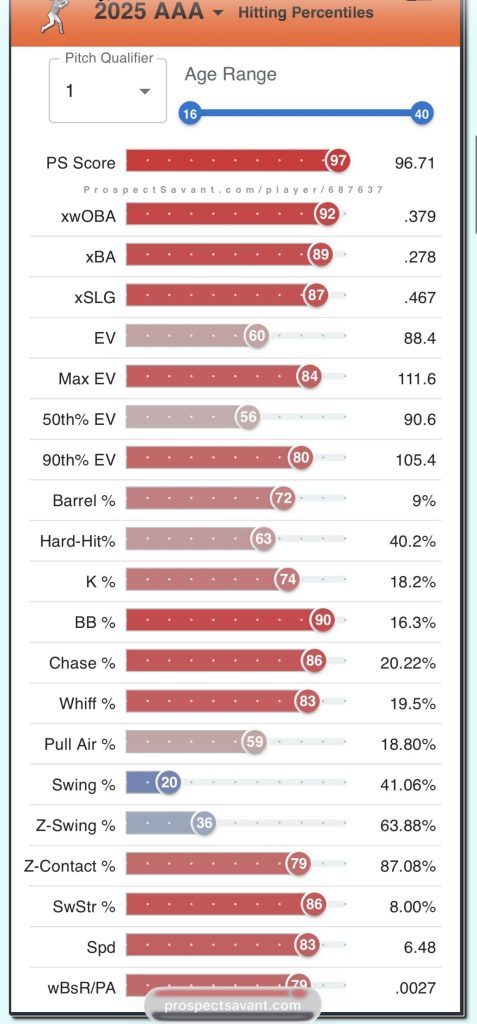
Speed plays a large role in Beavers’ fantasy appeal. His nearly top-10-percentile sprint speed gives him a stable floor, even if the bat runs cold. That athleticism also creates multiple paths to playing time, whether in a corner outfield spot or as a more flexible piece in Baltimore’s lineup construction. There is a very real chance Beavers claims a full-time role in 2026, potentially at the expense of Colton Cowser. If that happens, the combination of power, speed, and improving plate discipline makes him an ideal late-round target. At his current draft price, Beavers offers the kind of upside that can pay off quickly once the opportunity arrives.

Thank you…would you keep either of these guys over Matt Shaw? Tough decisions coming up in our 22 team dynasty 5×5!
I would be all about Bargr over Shaw. Beavers and Burleson are a bit more of a toss up.
For some reason Beavers’ name and ADP isn’t showing on my page.
Thanks for your insight!
Some of the ADP especially NFBC has been spotty for me as well. Good luck and thanks for stopping in!
I guess what I’m saying is that the other 3 I could see highlighted name and ADP, but the graphics may be covering this for Beav
Yes, good catch! Time to go yell at the Editor!!
SO WHERE DID HE LAND? :)