

One of the hardest lessons in fantasy baseball is separating production from value. Just because a player is helping your team today doesn’t mean he’s going to help it tomorrow. Every season, a handful of recognizable stars put together stat lines that look great on the surface, but underneath the hood are warning signs that savvy managers can’t afford to ignore. Sometimes it’s an unsustainable batting average fueled by batted-ball luck. Sometimes it’s a home run pace that doesn’t match the quality of contact. And sometimes it’s simply a matter of name value carrying more weight than the actual rest-of-season outlook. This is the point in the season when contenders need to start thinking like investors rather than fans. If another manager still values a player based on draft-day expectations, past accomplishments, or a hot first two months, there may be an opportunity to cash out before regression arrives. Selling high isn’t about predicting collapse, it’s about recognizing when the market is willing to pay for a version of a player that probably doesn’t exist. These are the hitters whose current value may never be higher than it is right now.
Sell High: Oneil Cruz, OF, Pittsburgh Pirates
There may not be a more difficult player to write up for a sell-high article than Oneil Cruz. On one hand, fantasy managers who invested in him this spring are finally getting the payoff they’ve been waiting years to see. The combination of elite power, game-changing speed, and everyday playing time has pushed Cruz into the upper tier of fantasy hitters, and his full-season production has looked every bit like a first-round pick. The problem is that the underlying trends are starting to tell a different story. Over the last 30 days, Cruz owns a 35.5% strikeout rate while hitting .248. The batting average itself isn’t alarming until you notice the .391 BABIP carrying much of the load. For a player with Cruz’s speed and quality of contact, he’ll naturally run higher BABIPs than most hitters, but asking him to maintain something near .400 while striking out more than a third of the time is a dangerous bet.
What’s even more concerning is that the plate discipline gains we saw early in the season have begun to erode. His chase rate has climbed, his first-pitch swing rate has increased, and he’s expanding the zone far more frequently than he did during his hot start. That aggression is showing up in the walk column as well. Fewer walks mean fewer opportunities to leverage one of his greatest fantasy strengths with stealing bases. While Cruz remains one of the most dynamic athletes in baseball, you can’t steal first base. Pirates fans and local writers have spent much of May debating whether Cruz’s approach is sustainable after he piled up strikeouts at one of the highest rates in baseball. Discussions surrounding his role atop the lineup have become increasingly common all across social media.
The power production also comes with some warning signs. Cruz’s HR/FB rate has jumped to roughly 25%, a significant leap from the sub-18% marks he carried from 2023 through 2025. Normally, that might be easier to buy into given his elite raw power, but the increase is occurring alongside a rise in ground-ball rate. More balls on the ground and fewer balls in the air is not a recipe that typically supports a career-best home run pace. Some level of power regression feels inevitable.
None of this is meant to diminish the talent. In fact, Cruz’s Statcast page remains one of the most impressive in baseball. He continues to rank near the top of the league in exit velocity, hard-hit rate, barrel rate, and bat speed, validating the immense upside that made him such a coveted fantasy asset in the first place. But fantasy baseball isn’t about identifying good players. It’s about identifying market value.
Cruz still carries the allure of a potential 30-homer, 30-steal or better superstar, and the highlight reels continue to fuel that perception. His name value may never be higher than it is today. Add in the fact that his all-out style of play has always carried some injury risk, and the case becomes even stronger. If another manager is willing to value Cruz as a locked-in first-round talent for the rest of the season, I’m listening. The talent is real. The upside is undeniable. But when the underlying profile starts showing cracks while the market still sees a superstar breakout, that’s exactly the type of asset I’m willing to move for a more stable and predictable elite bat.
Sell High: Christian Yelich, OF, Milwaukee Brewers
Christian Yelich has quietly rewarded those willing to make the investment coming into the 2026 season. Despite spending time on the injured list with more back discomfort, he has returned in mid-May and picked up right where he left off. Through just 25 games, Yelich is hitting .280 with four home runs and three stolen bases, putting him on a pace that would translate to the type of 20 home runs and 20 steals profile we expected across a full season while contributing strong counting stats and a helpful batting average.
The problem is that the underlying profile looks far less encouraging than the surface numbers. His walk rate has fallen to the lowest level of his career. At the same time, his hard-hit rate has also dropped to a career low. Those are two foundational skills that have helped fuel his fantasy success for years, and seeing both move in the wrong direction simultaneously is difficult to ignore. The batting average also appears to be receiving some assistance from batted-ball fortune. Yelich is currently carrying his highest BABIP since 2019, a season that now feels like a lifetime ago in fantasy baseball terms. While he has always possessed the speed to run elevated BABIPs, the quality of contact supporting that number is far weaker than it was during his prime.
Perhaps even more concerning is the change in his batted-ball profile. The line drives that once fueled his batting average and power production have nearly disappeared. His line-drive rate sits well below his career norms while ground balls continue to take their place. Ground balls can help sustain batting average, but they rarely support meaningful power output. If the home runs don’t manifest, the profile suddenly becomes much less exciting. The Statcast page tells a similar story. While fantasy managers see a productive veteran putting together a strong season, the underlying metrics paint a far less flattering picture. Much of Yelich’s profile is covered in shades of blue, reflecting below-average quality-of-contact metrics and raising legitimate questions about how sustainable the current production really is.
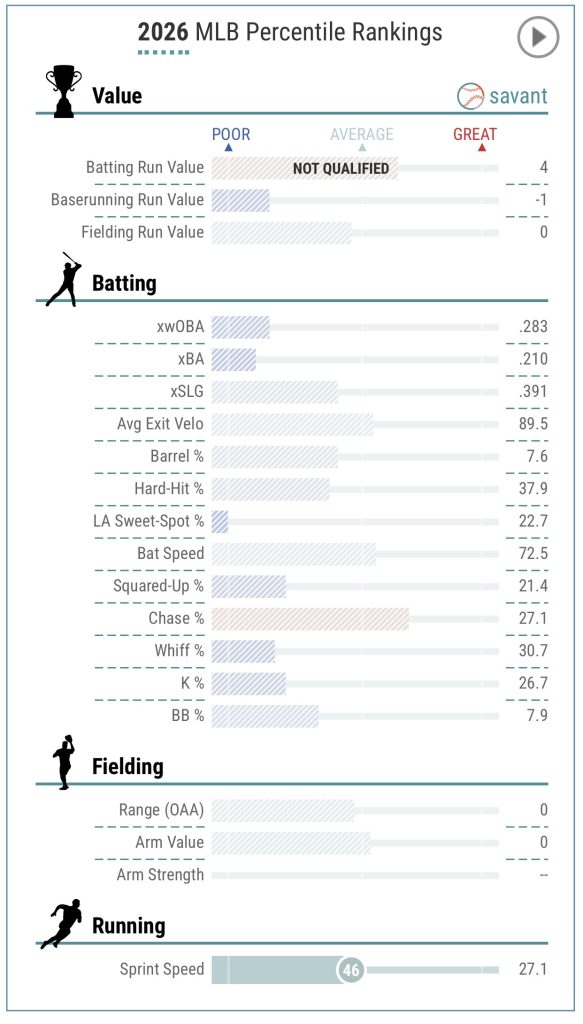
None of this means Yelich is about to fall apart. He remains a talented hitter with enough speed and baseball instincts to provide value across multiple categories. The Brewers continue to trust him in an important lineup role, and his ability to contribute both power and speed still makes him a useful fantasy asset. But fantasy baseball isn’t about identifying useful players. It’s about identifying opportunities to maximize value.
Right now, Yelich’s stat line tells a much stronger story than his underlying metrics. Managers see the .280 average, the pace for a 20/20 season, and a former MVP who appears healthy again. They see a player who may finally be turning back the clock. What I see is a 34-year-old hitter with recurring back concerns, declining quality of contact, career-worst plate discipline indicators, and a batted-ball profile that doesn’t support the production we’ve seen so far. If another manager believes Yelich has rediscovered his peak form, that’s a conversation worth having. The name value remains strong. The production has been strong. But the underlying profile suggests the gap between perception and reality may be wider than most fantasy managers realize.
Sell High: Randy Arozarena, OF, Seattle Mariners
Randy Arozarena has once again become the type of player fantasy managers love to roster. The stat line checks every box. Through the first two months of the season, Arozarena has delivered a .295 batting average, six home runs, and 14 stolen bases. He’s filling every category, providing elite speed production, and looking like the reliable five-category contributor that has been a fantasy staple for much of the past half decade. For managers who drafted him outside the early rounds, the return on investment has been tremendous.
The problem is that the underlying metrics suggest the production may be outpacing the skill set. Let’s start with the batting average. Arozarena is carrying a .374 BABIP, the highest mark of his career and well above anything he has sustained over a full season. At the same time, his expected batting average sits at just .254, creating one of the larger gaps you’ll find among productive fantasy hitters. When a hitter is outperforming his expected average by more than 40 points, history suggests regression is often lurking around the corner.
The power profile is also moving in the wrong direction. While six home runs won’t jump off the page, they have helped maintain the perception that Arozarena remains the same 25-30 homer threat fantasy managers have come to expect. However, his launch angle has continued to trend downward while his ground-ball rate has jumped by nearly 10 percent. More ground balls mean fewer opportunities for home runs, and that makes sustaining even his current pace more difficult moving forward.
The quality of contact metrics paint an even less encouraging picture. Arozarena’s hard-hit rate has fallen to its lowest level in four years. His bat speed has also declined significantly from the levels that fueled many of his best offensive seasons. When hitters begin losing bat speed, it often shows up first in their ability to consistently drive the baseball, and that’s exactly what we’re seeing. The combination of weaker contact, more balls on the ground, and declining bat speed is not typically the foundation of a breakout offensive season.
What’s remarkable is that the fantasy production has remained strong despite those trends. The stolen bases continue to pile up, and Arozarena remains one of the smartest and most aggressive baserunners in the game. That speed component gives him a fantasy floor that many players simply don’t possess.
But fantasy baseball isn’t about identifying productive players. It’s about identifying when perception has moved beyond reality. Right now, managers see a player hitting nearly .300 with double-digit stolen bases already banked and a track record of multiple 20-homer, 20-steal campaigns. They see a proven veteran producing across the board and helping win categories every week. What I see is a hitter whose highest BABIP ever is masking deteriorating underlying skills. I see declining bat speed, declining hard contact, a rising ground-ball rate, and an expected batting average that looks far more ordinary than the actual results.
Arozarena is still a good player. He is still capable of contributing in every category. But the market may be valuing him as the player he was three years ago rather than the player his underlying metrics suggest he is today. If another manager views Arozarena as a locked-in top-25 fantasy hitter for the remainder of the season, that’s a conversation I’m more than willing to have.

Hi Jeremy. I’m contemplating an offer sent to me involving 2 struggling stars. My Tucker for his Machado and Schmitt. Your thoughts please. Thanks
How about selling low on Framber or any other Tigers in that dumpster fire to begin with? Glad I’m not a Skrubal owner who’s lucky to get pennys on the dollar.
I am certainly fine selling low on Framber or even a drop. We talked about him on the Cards and Categories podcast this week. I do not think he has found a fit in Detroit and can’t see anything turning around.