

Sleepers get the headlines in draft season, but under-performers are the landmines that decide leagues. If a sleeper misses, you move on. When an early or mid-round pick underperforms, the damage lingers all summer. Busts are a less glamorous but equally important part of draft prep. For every breakout managers chase in March, there’s a player whose price quietly climbs past a reasonable expectation and leaves a roster with dead weight by July. These hitters aren’t bad players, but their current draft cost bakes in best-case outcomes, recent career years, or fragile skill sets that leave little margin for error. This week, our Hitter Profiles focus on bats being drafted ahead of their likely 2026 production, uncovering the kinds of names that can sink value not because they collapse entirely, but because they simply don’t return what you paid.
Hunter Goodman (ADP 69)
Hunter Goodman had a breakout year in 2025. A 31-homer, 91-RBI campaign with a .278 average and a 118 wRC+ vaulted him into the upper tier at the position. He parlayed that production into an All-Star nod and a Silver Slugger, cementing what looked like a true breakout. Hitting third in a dream run environment at Coors Field only amplified the numbers. From a surface level, it’s easy to see the appeal. Thirty-plus homer power from catcher is a difference-maker. Locking in that kind of pop with a number three hitter is conceptually intriguing. However, once you dig into the profile, the foundation gets shaky.
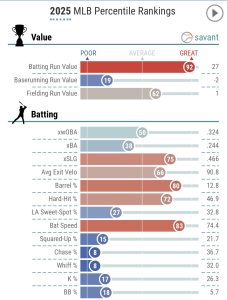
The underlying plate skills are a red flag parade. Goodman ranked in the bottom 20% of the league in strikeout rate, walk rate, chase rate, and overall contact quality metrics related to squaring the baseball. The profile is simple because when he connects, the ball is scorched. The issue is how often he fails to connect. There’s very little margin for error in that type of approach. His .331 BABIP also screams regression. Given his contact profile and swing decisions, he looks far more like a .270 BABIP hitter. Pair that with the swing-and-miss, and you’re staring at an expected batting average in the .240s rather than last year’s .278. That’s a material difference, especially from a player being drafted as the fifth catcher off the board.
The comps reinforce the volatility. Think Christian Walker, Brandon Lowe, Adolis García as hitters capable of massive fantasy seasons when the batted-ball luck and home run variance break right, but equally capable of long valleys when they don’t. Those profiles can win you weeks. They can also bury you for months. At a fifth-round price, you’re paying for the ceiling season to repeat. There isn’t much discount baked in for the approach risk or the batting average correction. In that range of the draft, safer foundational bats are still available. And if you’re set on catcher, waiting a few rounds could net a more stable option like Drake Baldwin or Will Smith without sacrificing as much floor.
Andy Pages (ADP 144)
Staying in the NL West, we turn to the reigning champs and another profile that looks shiny on the surface but comes with real mid-round landmines. The 25-year-old followed up his debut with a 27-homer, 14-steal campaign while hitting .272 in his second big-league season. Even while living in the bottom half of the Dodgers’ lineup, he piled up 86 RBI thanks to a relentless run-producing environment. Add in steady outfield defense, and it’s easy to see why the organization values him. But fantasy value isn’t the same as real-life value.
The first concern will be his playing time security. With Kyle Tucker and Teoscar Hernández locked into everyday roles and Enrique Hernández back in the fold, Pages isn’t fighting for a job, but he’s clearly lower on the pecking order than the names around him. On a roster this deep, even a mild slump can turn into a short-side platoon or a week of four-start schedules. Volume is king in roto, and his isn’t bulletproof.
The speed output also comes with warning labels. Fourteen steals look helpful, but getting caught seven times is not. Even with above-average sprint speed, a 67% success rate won’t earn unlimited green lights. That category could quietly slide from “helpful” to “neutral” in a hurry. Then there’s the underlying quality of contact. A 24th-percentile hard-hit rate, 33rd-percentile squared-up rate, and 45th-percentile barrel rate paint the picture of a player who got to 27 homers more through volume and environment than thunderous contact. Pair that with a chase rate five points worse than league average and a modest walk rate, and the plate discipline profile offers little cushion. He does elevate the ball consistently, but with that approach, the .272 average feels closer to a peak than a baseline. A drift into the .250 range is far more realistic.
At this draft price, you’re paying for last year’s surface stats in one of baseball’s best lineups. What you’re getting looks more like a middling average, capped speed, and lineup spot risk. In the mid-rounds, that’s a profile that can hold your roster together, but it’s not one that wins you a league. If you draft him, just hope that postseason isn’t a hangover after a 4 for 51 showing last October.
Lawrence Butler (ADP 157)
Lawrence Butler’s fantasy appeal starts with the counting stats. In a season where he hit 21 home runs, he paired that power with aggressive base running to produce a 20/20 blend that plays in roto. Every day at-bats allowed him to pile up runs and RBI, and on draft day, that type of category stuffing tends to move players up boards quickly. But the skills underneath the surface are far less stable. The power output needs context. Sacramento played extremely friendly to power, and a noticeable portion of Butler’s 21 homers barely left the ballpark. Neutralize the park factors, and you are looking at something closer to a mid-teens home run profile rather than a 25-plus bat waiting to happen. His quality of contact was solid but not dominant, and nothing in the underlying data screams impending jump. If anything, it suggests last year may have represented the high end of the range, given the setting.
The approach is the bigger concern. Butler’s plate discipline metrics remain among the weakest for hitters, with a 7th percentile strikeout rate. He has an aggressive approach, runs elevated strikeout totals, and does not walk enough to stabilize his OBP in leagues that count it. When hitters with that profile run into cold stretches, the batting average can crater quickly, and he only managed a .234 line last season. There is little margin for error because the swing decisions do not give him a steady floor.
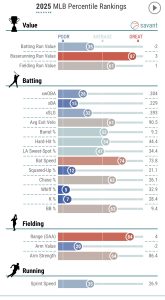
The speed totals also deserve a closer look. While he contributes in steals, the underlying sprint speed grades poorly relative to other base stealers (35th percentile sprint speed), and his efficiency has been inconsistent. That combination can lead to a shorter leash. If the success rate dips, the green light can disappear just as quickly as it arrived, trimming what is currently propping up a large chunk of his fantasy value. Platoon risk adds another layer. Butler hit just .188 against left-handed pitching, good for a 52 wRC+. That type of split opens the door for partial platoon usage, especially on a roster with alternatives. Even if he is not fully benched against lefties, reduced lineup spots or late-game substitutions chip away at plate appearances over the course of a season.
At his current draft cost, you are buying the category accumulation and hoping the environment and volume hold steady. Strip away some of the park help, factor in the approach and platoon concerns, and the profile looks more volatile than the surface stats suggest. In the middle rounds, that kind of risk can either fuel a surge in two categories or quietly drain three.

I’d like to run another one by you.Keeper league My JRam $31 for his Chourio $4 and Raleigh $20. In a vacuum question I realize. Thinking about trading for the future a bit. I know JRam is still a great value at his salary. Thanks
I like it, sign me up for that move.
Great analysis, but wondering about Lawrence Butler. Any validity to the thought that the torn right patellar tendon that he played through last season (which he had repaired during the offseason) affected his production and metrics? Seems like something to consider… or no?
Certainly worth considering. I am not sure there was a major impact but sometimes it is hard to tell. Even if so, I can’t see a price in the current range that makes me want to bet on that being a driving force.
Hi Jeremy. It’s that time again. Love the preseason info. Let me ask you a trade question. I was offered Ketel Marte and Springer for my Vlads and Taylor Ward. Looks like a decent trade considering how shallow 2nd base is and how deep 1st base is this year. Your thoughts please. Thanks
Hey Unc – Welcome back. This is pretty even to me. I probably stick with the Vladdy side without other context seeing Springer on the older side from a keeper perspective and Ketel never truly going to unlock a 30/30 type season. Ward dos make me nervous but for now he pairs well with Guerrero’s ability to hit for average. That is where I lean, but it is a fair deal.
Going to let that one pass by. Thanks
Good stuff, I agree on all 3. Will be taking pitchers around their ADP’s.
Yes, there is a sweet spot for pitchers in the mid rounds this year. Load up!
In a keeper league would you rather keep Goodman at $1 or Basallo at $5?
Give me Basallo at $5. If we are just looking at 2026 then Goodman is probably the pick, but long term I think Basallo is a much better choice. When my rankings come out Goodman will be in front of him just due to redraft framing.
WPS my good friend. Like the old ’70s song says, two out of three (this weekend) ain’t bad. Shoulda beat TCU too.
Anyway, just wanted to say I like this piece. Some very good, useful information here. Hope you’re doing well and hope all your drafts go to the blueprint plan you constructed.
Good to see you Harley! Good luck in 2026!
Liked the article! Appreciated it. I am with ya on Butler. I held him last year in my AL-only league which uses OPS. I can’t do it this year. If he is there in later rounds, maybe I take him, but he can’t hit lefties, and in a mono-league, am going to need the ABs.
It’s even tough in those single league formats. Somebody is going to overpay.